Showing posts with label interesting. Show all posts

Thursday, August 4, 2011

Interesting Animals: Vampire Squid from Hell

This is one of my favorites: Vampyroteuthis infernalis, which literally means "vampire squid from hell."

Artist's rendition, best I could do.
The name is more than a bit appropriate. They live in the very deep sea, are blood red in color, and have spines instead of suckers on most of the length of their arms, though suckers are found on the ends. It isn't quite a squid, and in fact shares traits with both squid and octopuses. They have two fins that appear to be almost ear-like and are used for swimming in the adults. They have extraordinarily large blue eyes, and have numerous parts of the body that are bioluminescent, including the end of the mantle and tips of the arms, which are used to attract prey. They can also release a cloud of bioluminescence as a distraction to predators. One of the most extraordinary things is when threatened they will go into what is called the "pineapple position" with legs arching up to cover its mantle, making use of the dark skin there for protection. My words really do not give these amazingly unusual invertebrates justice.

They have been featured in such documentaries as Planet Earth, as seen below beginning at 0:49.


The footage of these odd cephalapods is all amazing and, despite its lack of David Attenborough, this is some of my favorite.

Image is from Wikimedia Commons under a creative commons license. Source is MarineBio which has yet another video of these creatures.

Tuesday, July 26, 2011

Interesting Animals: Muskrat

A muskrat (Ondatra zibethicus)

In honor of Big Wet Rodent Day (recognized mainly in Canada), I'm featuring the muskrat as an interesting animal! Most people think that muskrats and those other large semi-aquatic rodents are mundane creatures, but they are, in fact, quite interesting animals.

Like all rodents, these creatures have sharp, overlapping incisors that are very effective chewing devices. Muskrats build lodges that look not unlike beaver lodges, though smaller. Muskrats also look not unlike small beavers, though they have a more cylindrical tail. Marshes are ideal habitat for these rodents. They are commonly hunted for their fur, which is very dense and will trap air so that cold water will not touch their skin and also to make them more buoyant. They also have altered blood flow going to their tail and feet, which helps keep their core body temperature stable.

Muskrats live in family groups, and when it becomes too crowded, mothers will kick their offspring out; fighting an cannibalism are not unknown. The term "muskrat" refers to the fact that they communicate via musk though they also squeak and squeal. They have poor senses of sight, smell, and hearing. Though mainly vegetarians, they will also consume animals. They are excellent swimmers.

Here's the Big Wet Rodent Day Song! Happy July 26th, everyone.

Image is from Wikimedia Commons under a creative commons license. Sources are Animal Diversity Web and the National Trappers Association

Friday, July 22, 2011

Interesting Animals: Tardigrade

One of the Phylum Tardigrada, specifically Hypsibius dujardini

This is another case of being more than just one species. Instead, tardigrades (meaning "slow walker") are an entire phylum: Tardigrada. Also known as the water bear, these microscopic invertebrates are the most resilient animals to be found on this planet. By going into a resting stage called cryptobiosis, they can withstand extremes that would easily kill other animals, including us humans. Here's some things that won't kill a water bear:
  • temperatures up to 150 degrees Celsius
  • absurd amounts of radiation (570,00 roentgens killed only half of them)
  • temperatures up to minus 200 Celsius
  • extended periods of dessication (being dried out)
  • the vacuum of space
Crazy, right? Tardigrades are the only animal to ever survive the process of being sent through a scanning electron microscope. This is a process that involves being placed in a vacuum and then bombarded with electrons for over an hour. Amazingly, the animal pictured above in just such a SEM micrograph probably survived the process. They are also a numerous animal, to be found fairly easily in places like patches of moss.

The genome of these tiny creatures is currently being sequenced.

Image is from Wikimedia Commons under a creative commons license

Friday, July 15, 2011

Interesting Animals: Amazon River Dolphin

The amazon river dolphin (Inia geoffrensis)

The Amazon river dolphin is also known as the boto, bufeo, bouto. Of all of the cetaceans (whales), these are some of the most unique. They are the largest of the freshwater dolphins, reaching up to nine feet (2.7 m) in length. Gray as juveniles, they fade with age to become distinctly pink in color and then white. The pink can be surprisingly bright. These dolphins have a very distinctive head with a prominent domed forehead, long beak, and small eyes. Despite this, they have good vision and also a good sense of hearing. They feed on fish and crustaceans and are quite curious in nature. Hairs found on the beak are thought to aide the dolphins when sifting through mud for food.
Boto showing their curiousity

The boto is found throughout north and central South America and may possibly be several distinct subspecies as populations can vary in appearance (as seen in the two images I've used). Natives have a taboo against killing these animals, but other cultures that have come to the area have no such qualms. Because of this, the numbers of these unique dolphins have fallen from what they once were. The IUCN red list currently lists them as Data Deficient but they have previously been listed as Vulnerable. Hopefully, the populations are doing well.

Images are from Wikimedia Commons under creative commons licenses: one, two

Monday, July 11, 2011

Interesting Animals: Upside-Down Jellyfish

Cassiopeia in its usual upside-down position

Cassiopeia, better known as the "upside-down jellyfish" is a fascinating species of jellyfish commonly found in waters off the coast of Florida, the Gulf of Mexico, and the Caribbean. It is actually a genus that includes several different species, but their behavior is always the same. The position they are found in is laying on the bottom with bell to the sand and tentacles facing upward. This is because they are providing the tiny algae (zooxanthellae) in their tentacles with sunlight so that they can photosynthesize. This is not the only food source for the jellyfish, however it does provide a significant portion of the jelly's nutritional needs. They also capture plankton using their stinging cells (nematocysts) as is usually expected of a jellyfish. 

This jelly has a healthy crop of algae


These jellyfish are also one of the few jellyfish to have more than one mouth. They have a primary mouth, as well as several lesser ones. Crabs are known for enlisting other species to aide them  and will sometimes carry upside-down jellys around for protection.


If disturbed, they will swim away in the same position. As far as I know, they never voluntarily turn over to the more usually seen orientation of the Medusa stage of Cnidarians (bell up, tentacles down). They are only found in shallow water so that they can provide enough sunlight to their algae and are a common sight in Mangrove swamps. I observed these creatures in the wild during a trip to Florida.


Images are from Wikimedia Commons under a creative commons license: one, two

Tuesday, July 5, 2011

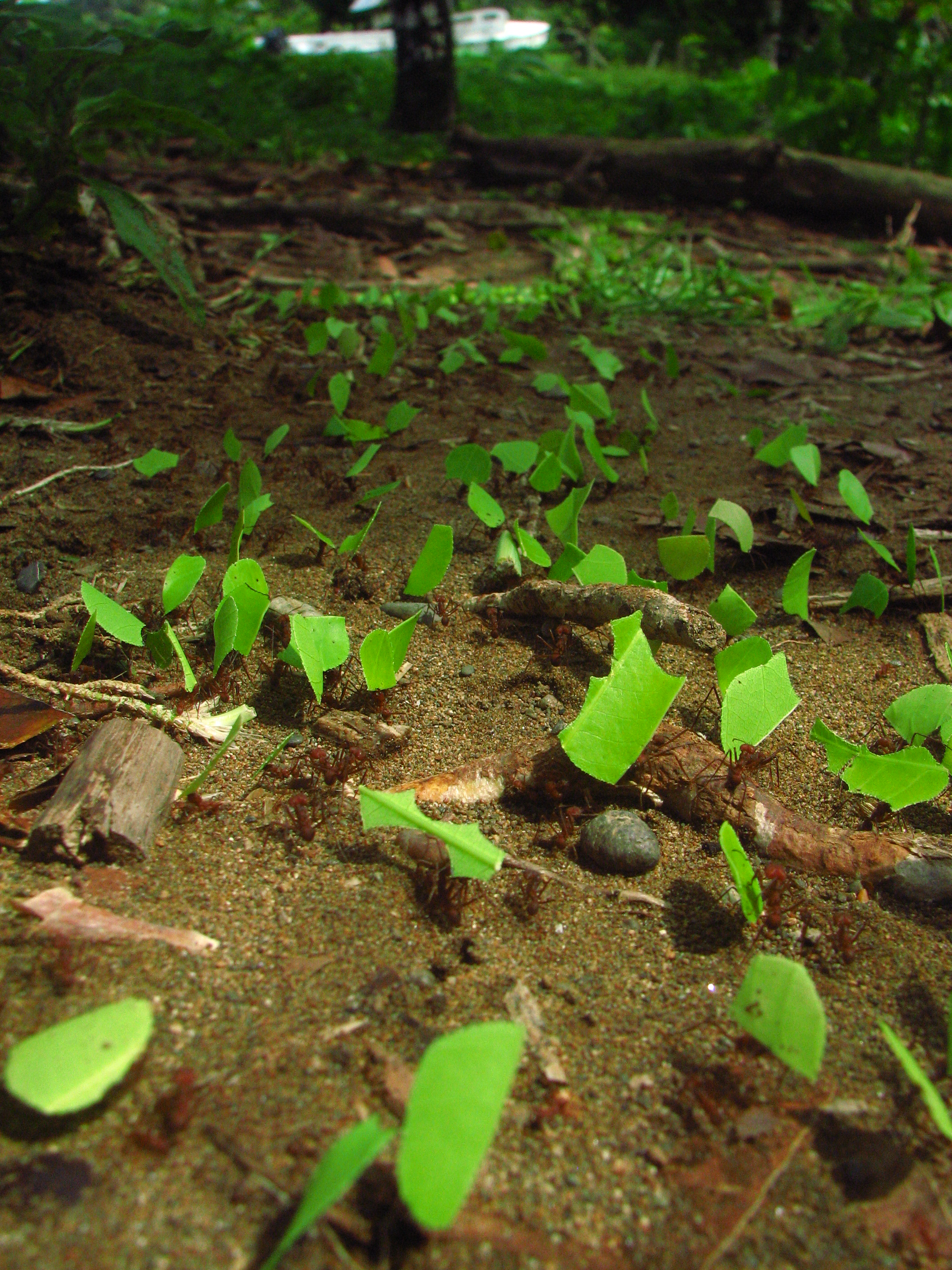
Interesting Animals: Fungus Growing Ants

A leaf-cutter ant

Leaf cutters have large colonies
Most of you probably are familiar with the leaf-cutter ants, but you may not know that they are fungus gardeners. That's right. These little insects take those leaves back to their colonies where they carefully cultivate fungus using the leaves as fertilizer. The fungus is what the ants eat rather than the leaves. Also, "leaf cutter ant" is a very general term and actually encompass two different genera: Acromyrmex and Atta which contain numerous species. They have a very complex colony set up which even includes a dump where bad leaves and dead ants are taken.

The leaf-cutters are not the only fungus gardeners, however. There are thirteen genera total, which grow their fungus on everything from fresh leaves to flowers, beetle wings to herbivorous insect feces (known as frass). Colony size varies greatly from the ants of the genus Cyphomyrmex that only have around fifty to one hundred ants to the massive leaf cutter colonies. Fungus type varies as well. It is usually in a filamentous form, but the Cyphomyrmex genus uses a globular "yeast" form (which isn't a true yeast).
C. rimosus ant under magnification

I was lucky enough to have the chance to work with the little-known Cyphomyrmex ants, specifically C. rimosus which has been introduced locally. They are very odd-looking with large heads and dark bodies that look like they've been dusted with ash. I went on several hunts to find colonies, turning over numerous logs and excavating them. Then, there were months getting the ants settled into artificial colony setups. It was a fascinating process. There has been very little research done on these ants and they are so little known that they don't even have a common name. They are one of the fungus gardeners that use frass as fertilizer.

Here are all of the fungus gardening ant genera: Acromyrmex, Apterostigma, Atta, Cyphomyrmex, Mycetagroicus, Mycetarotes, Mycetophylax, Mycetosoritis, Mycocepurus, Myrmicocrypta, Pseudoatta, Sericomyrmex, Trachymyrmex

First two images are from Wikimedia Commons under creative commons licenses: one, two. The last one is mine.

Sunday, July 3, 2011

Some Birds Can Mimic Everything


That is a lyre bird that has taught itself to mimic some really amazing things, including a chainsaw and a camera shutter in an attempt to impress the ladies. It's an incredibly convincing imitation at that. David Attenborough provides the narration for this amusing video.

Unfortunately, the sounds of power tools means this bird's habitat is in danger. Hopefully, the forest will stay and he'll be able to keep singing his love song.

Thursday, June 30, 2011

Interesting Animals: Devil's Hole Pupfish

Devil's hole pupfish (Cyprinodon diabolis)
These little fish are found in only one small, water-filled cave in Death Valley: Devil's Hole. They forage exclusively on a small rock ledge in the pool, and their population is only 36 individuals. Since the pool is found in such an arid region, there is great concern that the pool could dry up, either naturally, or due to nearby agriculture depleting the water that feeds the pool. These little fish were even involved in a 1976 supreme court case (Cappaert vs. U.S.) that ruled to prevent removal of too much water from Devil's Hole. The IUCN Red List currently has them listed as Vulnerable, though they are in need of being assessed again. 

Devil's Hole
The pupfish are under constant watch (see the camera on the ledge at right), and there is an attempt to create a stable captive population in the event that something happens to Devil's Hole. Some would say "Why save these little fish? It wouldn't make any difference if they weren't there anymore." However, in many ways the conservation of these pupfish is a small-scale exercise in trying to increase the numbers of an endangered species. Indeed, in 1988 these fish were listed as Endangered by the IUCN Red List and their numbers did manage to rebound and stayed fairly steady for many years. Since then, though, they have dropped again and the US still classifies them as Endangered.

There is concern as to how many times the population can shrink and then rebound. Each time this occurs, genes are lost through the bottleneck effect, and can lead to a spiral downward to extinction if the loss of genes no longer allows for the fish to be able to stand environmental changes.

Images used are either copyright-free or under a Creative Commons license at Wikimedia Commons.

Sunday, June 26, 2011

Interesting Animals: Hartebeest

Most of the herd I studied. Nearly all females, with only one juvenile male
Mack, one of the males
I had the privilege of studying these animals in captivity as part of my degree. I worked with the Jackson's hartebeest (Alcelaphus buselaphus jacksoni), whose taxonimic status is currently uncertain. Though once thought to be a separate subspecies, it is now thought they are actually hyrbids between the Coke's (A.b. cokei) and lelwel (A.b. lelwel) subspecies. There are eight subspecies in all, and according to the IUCN Red List one is extinct, one is critically endangered, two are endangered (including the lelwel), one near threatened, and the rest are of least concern (including the Coke's). The subspecies are mainly distinguishable by color: ranging from a dark mahogany color to sandy red, with varying amounts of black.

Cecelia, center, was born during my research
The hartebeest is found through much of Saharan Africa, and they are rarely kept in captivity. Luckily for me, I had a chance to go to St. Catherines Island off the coast of Georgia and work with the animals they had there. 

Hartebeest share a Subfamily with the much better known wildebeest, and in fact they do share some territory in the wild. Both species have curving horns, but the hartebeest's are quite distinctive, forming a sort of S-shape. Their faces are also quite long and thin. In appearance, they are like no other antelope.

Their behavior is quite interesting, but I don't want to spend too much time on that, even though that is what I was researching. They are in fact ruminants like cows and goats, and they do in fact spend a lot of time "chewing their cud". They are members of the Order Artiodactyla or even-toed ungulates (a term for hoofed animals) and in fact have two toes on each foot.

I will never forget my time with these beautiful animals. It will be memorable in many ways, including the death of an animal not in the herd I studied, the birth of a calf, the amusing sight of the young male being reprimanded by his mother, the lemurs, and the remarkable behavior of native wildlife on a private island. Yes, I did say lemurs. St Catherines is famous for their population of free-ranging ring-tailed lemurs (Lemur catta). If you ever see a lemur photographed next to Spanish moss of other iconic southern plants, it's from there. There were also the startling bellows of the Grévy's zebra (Equus grevyi) in the neighboring pen and the equally startling, hollow rat-ta-ta-ta of a pileated woodpecker (Dryocopus pileatus) on the old pine tree behind my observation post.