I got a suggestion recently from MC over at
The House of Two Bows to discuss the Shiba Inu mismarks, especially the cream coloration. So, here we go.
 |
| Two Shiba Inus is the breed's most commonly seen color: red. Image is from Wikimedia Commons under a Creative Commons license. |
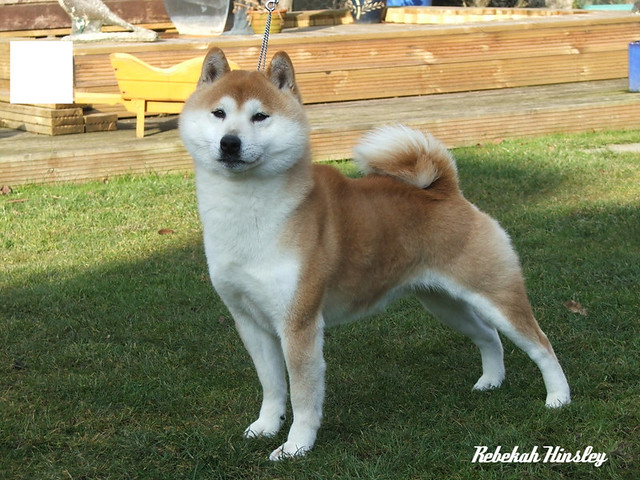
The Shiba Inu is a breed originating in Japan and is a popular pet. Though the breed is most commonly seen in red, allowable colors also include black and tan and red sesame.
As with so many Asian breeds, Shibas have what is known as urajiro: pale points in a similar orientation to those seen in
tan pointed dogs. Urajiro is not controlled by the same gene, though (which is why the breed can be black and tan with urajiro), and is either a simple recessive or a polygenic recessive. There is quite a bit of support for the polygenic theory because the intensity of the urajiro can
vary so much. As with so many purebreds, Shibas have some mismarks:
 |
| This Shiba is a cream mismark |
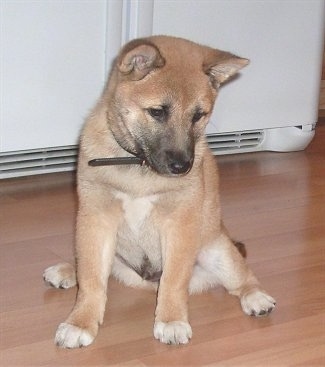
Cream is by far the most commonly seen mismark in the breed. It's caused by the same genes that cause white German shepherds. This color is a form of red that has just been very diluted. Characteristically, this means that the dog will usually not be white, but instead a shaded cream, often with red-tipped ears. Since it is a sort of recessive red, there will be no black hairs to be found on the dog. These genes also don't have any potential negative affects on the dog's health, unlike other forms of "white," such as albino, double merle, harlequin, and extreme white piebald. The only potential for health issues in dogs of this color would come from inbreeding which, since the color is recessive, is a common technique used by breeders who purposefully breed creams for profit. However, if a cream randomly pops up in a litter it will be no more likely to develop some sort of health issue than its siblings.
Pinto markings are also found in the breed, but seem to be far less common. It is far from unusual to see a Shiba Inu with a
white paw or two and/or
white chest, so there are several white spotting genes seen. Dogs with a bit of white, or even those that have basically none, can quite possibly carry the piebald gene that causes pinto. So, if you breed the right two dogs together, a pinto or two will pop up.
Though the Shiba Inu was once a dog used for hunting, now it is almost exclusively a companion animal. I have not found a single good argument as to why the colors continue to be excluded from the standard. Unlike some standards that exclude a color because of known common health issues that are linked to the genetics of the color itself, this is one of those cases where there doesn't seem to be any good reason to disallow the mismarks. Also, any attempts to breed them out really won't work because, if you remove all creams and pintos from the breeding population, you will still have dogs (including 2/3 of the siblings of the mismarks) who still carry the recessives. Any inbreeding that occurs will only make it more likely for the mismarks to show up. Even without close inbreeding, the occasional mismark will still pop up. In addition, by removing dogs from a closed population simply because they are the "wrong" color, precious genetic diversity is being removed for no good reason. In a closed population, genetic diversity is of serious concern because there is only so much to go around. Since the pedigree dog world is so against adding new genetic diversity by out-crossing to other breeds, what diversity there is needs to be maintained as much as possible or things do not bode well for a closed registry system.