Showing posts with label tidbits. Show all posts

Wednesday, August 15, 2012

Cats don't Prefer Sweets

Cats taste the world very differently than humans

One thing that I found fascinating during my undergraduate studies was my Modern Biology class. It involved learning about and implementing numerous techniques that are rather new to the field of biology. Thanks to this class, I isolated a number of different cell components, ran various biological molecules through a gel electrophoresis machine, and performed polymerase chain reaction. I also took my own DNA and prepared it for sequencing, which involved refining and isolating the material, cutting out the gene we wanted to look at, then replicating it so that it could be sent off for the actual sequencing process to be performed.

The gene that we looked at was one of the two that go into making the receptors on your tongue that register sweetness. Specifically, the TAS1R2 (taste receptor, type 1, member 2) gene. TAS1R2 must join up with a second protein to signal that sweet flavor. Here is the TAS1R2 gene (specifically, my copy) in its three hundred fifty-five nucleotide entirety: 
GCTGCGTACCACACCCAGCGCCGACCACCACATCGAGGCCATGGTGCAGCTGATGCTGCACTTCCGCTGGAACTGGATCATTGTGCTGGTGAGCAGCGACACCTATGGCCGCGACAATGGCCAGCTGCTTGGCGAGCGCGTGGCCCGGCGCGACATCTGCATCGCCTTCCAGGAGACGCTGCCCACACTGCAGCCCAACCAGAACATGACGTCAGAGGAGCGCCAGCGCCTGGTGACCATTGTGGACAAGCTGCAGCAGAGCACAGCGCGCGTCGTGGTCGTGTTCTCGCCCGACCTGACCCTGTACCACTTCTTCAATGAGGTGCTGCGCCAGAACTTCACTGGCGCCGTGTGG
...not really that interesting.

This is your average TAS1R2 gene for Homo sapiens, nothing special. Just about every human out there has this exact sequence, with few exceptions (one of my classmates, for example, had a single point mutation). However, it is one gene crucial to why humans like sweets so much. This is what the gene looks like after it's been translated into its protein form (the letters are standard for amino acids):
Query  2    LRTTPSADHHIEAMVQLMLHFRWNWIIVLVSSDTYGRDNGQLLGERVARRDICIAFQETL  181
            LRTTPSADHHIEAMVQLMLHFRWNWIIVLVSSDTYGRDNGQLLGERVARRDICIAFQETL
Sbjct  82   LRTTPSADHHIEAMVQLMLHFRWNWIIVLVSSDTYGRDNGQLLGERVARRDICIAFQETL  141

Query  182  PTLQPNQNMTSEERQRLVTIVDKLQQSTARVVVVFSPDLTLYHFFNEVLRQNFTGAVW  355
            PTLQPNQNMTSEERQRLVTIVDKLQQSTARVVVVFSPDLTLYHFFNEVLRQNFTGAVW
Sbjct  142  PTLQPNQNMTSEERQRLVTIVDKLQQSTARVVVVFSPDLTLYHFFNEVLRQNFTGAVW  199 
This is a comparison showing my own protein versus the average human. It's a perfect match and codes for a fully functional receptor protein. This gene is seen in a very wide variety of different animals, and the shared genetic material is quite astounding, allowing for countless species to have the ability to taste sweetness.

A cat enjoying a fresh fish

So, why am I talking about humans a post about cats? Well, let's compare the sequence above to the equivalent gene in a cat. The "query"line is the human gene again, and the "sbjct" or subject line is the equivalent gene in Felis silvestris catus.
Query  2    LRTTPSADHHIEAMVQLMLHFRWNWIIVLVSSDTYGRDNGQLLGERVARRDICIAFQETL  181
            LRT P+ +H   AM  ++ +FRWNW+  + + D YGR   +   E    RDICI F E +
Sbjct  184  LRTIPNDEHQATAMADIIEYFRWNWVGTIAADDDYGRPGIEKFREEAEERDICIDFSELI  243

Query  182  PTLQPNQNMTSEERQRLVTIVDKLQQSTARVVVVFSPDLTLYHFFNEVLRQNFTGAVW  355
                 +Q    EE Q++V ++   Q STA+V+VVFS    L     E++R+N TG +W
Sbjct  244  -----SQYSDEEEIQQVVEVI---QNSTAKVIVVFSSGPDLEPLIKEIVRRNITGRIW  293
Cat tongue anatomy
Overall, the genes are fairly similar, but with one major difference. I'm not going to get too complicated with this, but the dashes you see indicate amino acids that are absent in the final protein found in cats but present in humans: a deletion. Changes in a protein don't necessarily result in a change in its functionality, but that deletion is enough to result in the cat's protein being non-functional. Since the protein cannot bond to molecules of sugars or sweeteners, cats simply cannot register the sensation of sweetness. This deletion seems to be unique to the cat family, since other carnivores, such as dogs and bears, have a functioning gene. From what I remember, big cats have this non-functioning gene as well, but it isn't known whether or not the cat allies (such as civets and genets) share this unusual feature.

Though cats aren't able to taste sweetness, this doesn't mean they will avoid it. They are, in fact, completely indifferent to the flavor. So, if your kitty likes something sweet, it's probably going after something other than the sugar. They're quite fond of certain amino acids, so it's possible that's what your kitty enjoys.

Sources Basic Local Alignment Search Tool (BLAST), PLOS Genetics, Journal of Nutrition, and GeneCards. Images are from Wikimedia Commons under Creative Commons licenses: one, two, three.

By the way, BLAST is an amazing tool. Feel free to plug in the ATCG sequence above into their databases to compare the gene for yourself. The programs I used for this post are nucleotide blast and blastx.

Thursday, July 19, 2012

Hairless Breeds and Skin Color

I was recently asked by a confused reader about what sort of link there is between skin color and hair color in hairless breeds. In breeds like the Chinese crested, it's not uncommon for a dog with dark skin to have pale hair. In other cases, the skin matches the hair. So, what causes this? To answer this, I'm going to look at a number of dogs and discuss the genes that are likely causing their hair and skin colors. First, though, some notes.

As a general rule, the darkest skin color should match the black pigmentation that would be seen in the coat. Patches of pink skin, whether spotted or not, represent what would be white markings on a dog with a full coat. By taking into account these characteristics, plus what's seen in whatever hair the dog happens to have, you can get a pretty good approximation of what genes are causing the dog's appearance.These rules don't always work, but I'll try to explain these exceptions.

This dog is really straightforward and a good place to start. It has minimal white and its skin matches its hair almost perfectly. In this case, the dog is black. Probably dominant black (K-). The white that is seen includes markings on all four paws, the chest, neck, and a bit on the face. This fits with minimal Irish markings (sisi) and would cause a dog with fur to look kind of like this.

This dog is also black, but clearly there is more going on here. Instead of having very little white, this dog has a lot of it. This explains all of the pink skin and white hair. In fact, it appears that this dog is extreme white (swsw), which results in a dog who is almost completely white. If this dog had a full coat it would look rather like this. Since this dog has so few spots, it probably doesn't have a copy of the ticking gene.

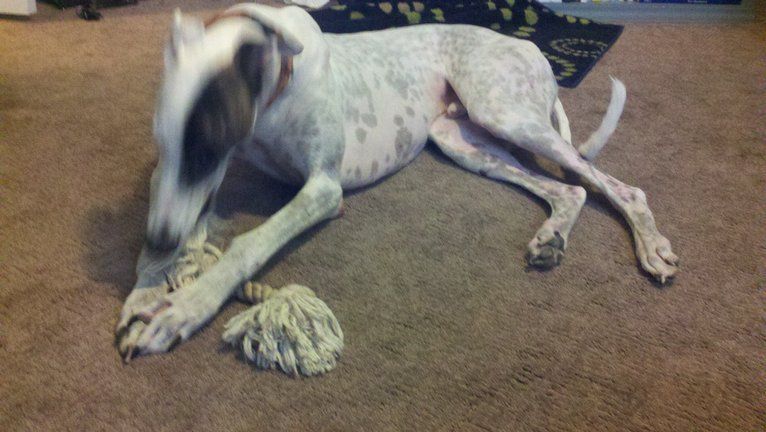
This dog is almost identical to the dog above with one notable difference: spots! White the dog above has almost no spots on its skin, this dog has a lot of them. It's quite possible that this dog has a copy of the ticking gene, but this isn't necessarily the case. Most dogs with white markings will have at least some skin spots, but more spots are seen in dogs with ticking. This dog is rather a lot like my dad's greyhound, Siggy, whose skin spots overwhelm his red ticking spots because his fur is so thin.

This dog is expressing something a bit different. Thought its skin is pink, this is due to something other than a white gene. This dog is sable (Ay-), which explains the dark tips on its hair. The skin color on sable dogs can vary from completely matching the color of its nose to something like this. In dogs like this, the nose, eye rims, and paw pads would be dark, but the predominant skin color is actually pink. If there are any white markings on the dog, it would be difficult or maybe even impossible to tell. If this dog had fur, it would look kind of like this.

You can also find a number of dogs that look like this. Clearly, the dog's skin and hair are completely different colors. This dog is most likely a recessive red (ee) that's been diluted down to white. Recessive red is a gene that doesn't allow any black in the coat, so it can hide a lot of different colors. This appears to be a common color in the breed, probably due to the flashy appearance of pale hair on a dark body. In cases like this, the dog is probably black behind the recessive red, which would explain the dark skin. As before, the spotted areas are white markings, which are basically indistinguishable from the pale color of the rest of the hair. If this dog had fur, it would look somewhat like this.

For simplicity's sake, I will end with this dog. This dog again has two skin colors, but both of them are pale. Unlike the dogs before who have black pigment, this dog's pigment has been diluted down. Since its skin is so pale, I suspect that it's expressing both the blue (dd) and liver (bb) genes, making it fawn or Isabella. I have actually heard of cresteds that are this sort of color being called palomino which is an...interesting way of looking at it. The genes behind horse color are completely different from those behind dog color, so those sorts of naming schemes don't make sense to me. Anyway, the fawn coloration doesn't just change a dog's coat color, but it also dilutes down the skin color. In combination with this, the dog is also expressing the recessive red gene. This explains why it has white hair. If this were not true, the hair would be similar in color to the skin,and the dog would look more like this.


Images are from Wikimedia Commons and Flickr.com under Creative Commons licenses: one, two, three, four, five, six.