|
| A sign warning visitors to not feed the animals. |
It's actually a very common sight to see people feeding wild animals. Usually, it is a kindhearted attempt be nice to the animals, especially if it appears hungry or is begging for food. However, most of these feeders have no idea what the potential ramifications of their actions may be. Very often, the animals themselves suffer from being fed, and the reasons for this are varied and numerous. Also, people who feed wild animals are putting their own health and well being, and even their lives, on the line.
 |
| Lyme disease is carried by ticks |
To begin, feeding wild animals can be potentially hazardous to the feeders' health. For one, coming in close contact with a wild animals comes with a risk of contracting numerous infectious diseases and other nasty things. Wild animals often carry some form of parasite (such as ticks or tapeworms), and may also be harboring other forms of life like bacteria, protists, or fungi (as well as non-life like viruses and prions) that may not really affect them, but could potentially kill you. By coming in close contact with the animals, especially if you actually touch them, you could become very sick.
More dangerous, however, are the changes in behavior so often seen after an animal is fed. Fed animals loose their natural fear of people, as as such are more likely to come up to people and to enter populated areas. This comes with a major set of dangers for the animals, and people too. Depending on where the animal is feed, it may stay on or near a roadway, and as such be put at risk of being hit by a car, which may easily result in the death of the animal, the driver, or both. Also, when entering developed areas, animals will often cross roadways, with the same potential risk. More risk to the animal comes from the potential for them to approach the wrong person or the wrong area, and thus possibly ending up being shot, attacked by domestic pets, or otherwise injured or killed.
 |
| I sure wouldn't want to face an angry 'gator. |
Another major behavior change so often witnessed is increased aggression. Since the animal has now lost its fear of people and is begging for food, it will also expect that when people are around it will be fed. If no food comes, the animal may become angered by this, especially if it is in fact hungry. This can often lead to the animal attacking, resulting in injury or even death of the person being attacked. Feeding an herbivore may not be all that dangerous (depending on its size), but large carnivores that have been fed are
extremely dangerous.
If those reasons aren't good enough to stop you from feeding wild animals, here are some more. Human food in notoriously bad for animals. Many of them have very specific dietary needs, and receiving an improper diet can lead to all sorts of issues. Tooth decay and ulcers are just a few of the
fairly minor problems that may come from feeding the animal. Other
concerns include such things as weakened immune systems and blockage of the digestive tract. In fact, some animals have very narrow dietary constraints, and an improper balance can be dangerous. The wrong diet can kill an animal. Ever heard of
colic in horses? It's a very similar concept (though not necessarily involving the same biological reasons).
 |
| This opossum was eating trash |
Major concerns continue with the potential for the animal to ingest foreign bodies. In an object, such as trash, smells like food it may very well be eaten. As you can imagine, eating trash is horrible for the animal, as it can lead to major damage or blockage of the digestive tract. If neither of these occur, there remains the potential for hazardous chemicals to enter the blood stream when the animal is trying to digest, say, plastic. All of these can kill. Trash is also one of the ways in which animals may become trapped, such as having its head stuck in a peanut butter jar, quite often leading to injury or death.
 |
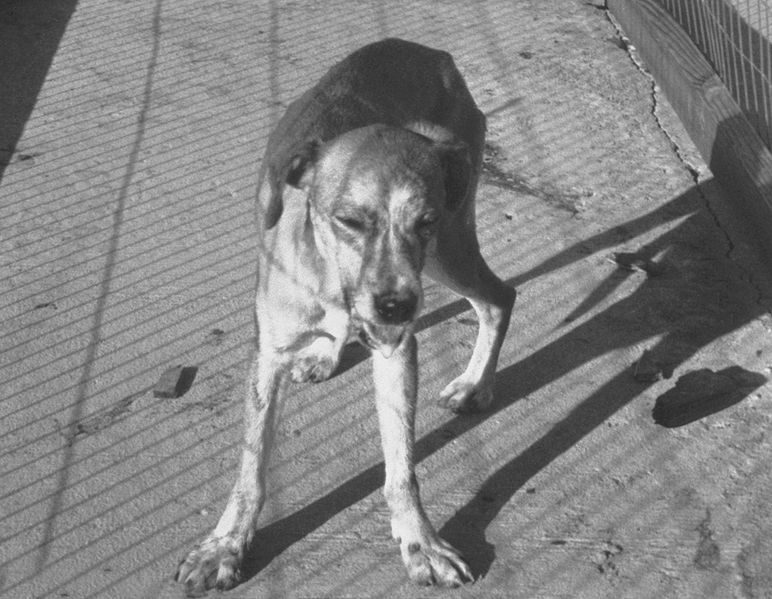
| Rabies is of frequent concern. |
Disease is also a serious issue in animals that are being fed. One would think that feeding the animal would make it healthier, but in fact the opposite is true. On top of the potential for the food to trash their bodies due to it being improper, and the potential for the ingestion of non-food substances, there is an increased risk of disease. If you think about it, it makes perfect sense. Since nearly all animals have a natural fear of people, approaching areas that are frequented by people is pretty unusual. The first to approach a person offering food may very well be sick to begin with. On top of that, putting animals that may very well be more solitary in nature into a group situation (which, let's face it, is almost always the situation when wild animals are fed) increases the risk of disease transmission between individuals of the species. The potential for a severely weakened immune system from the food only compounds this. Also, diseases can be transferred to and from domestic animals and people.
There is also always the concern of dependence. Fed animals will often become dependent on the food they are being given, and thus will be unable to fend for themselves in the wild. If the food supply runs out, then there is little the animal can do except starve to death. It may also exhibit many of the undesirable behaviors listed above, such as becoming aggressive or venturing into urban areas in an attempt to obtain food. This is especially sad for endangered species, since in most cases every effort is being put into helping the animals bounce back from their trip to the edge of nothingness. If the animals cannot fend for themselves, then a truly wild population can never be brought into being.
Sadly, the most humane thing for a fed animal is for it to be put it to sleep. All of this is because someone was trying to be "nice."
Never feed wild animals! Help keep them wild.
Sources are the Center for Wildlife Information, Office of Environment & Heritage of the Government of New South Wales, National Oceanographic and Atmospheric Administration, Northfield News, Huffington Post, and the Center for Disease Control and Prevention. Images are from Wikimedia Commons under Creative Commons licensing or are copyright free: one, two, three, four, five.