Showing posts with label invasive species. Show all posts

Sunday, March 30, 2014

Invasive Species - Lion Fish

Red lionfish (Pterois volitans)
A problem has been growing off the east coast of the United States. An animal that is known for its beauty and venomous spines, the lion fish, has invaded the waters and its population continues to grow larger. After the first definite sighting in 2002 of a fish off the coast of North Carolina, these fish began popping up all the way from south Florida to as far north as Long Island.

Devil firefish (Pterois miles), aka the common lionfish
There are actually two species involved in this invasion, the red lionfish (Pterois volitans) and the devil firefish (Pterois miles). The exact source of the fish is unclear, but it's believed to be due in part to an unfortunate accident during to Hurricane Andrew. Its likely private aquarium owners are also to blame, as the irresponsible are known to release their unwanted fish into various waterways. This is a terribly common story behind many invasive species.

I first learned about this problem in 2009 and these animals have only grown more numerous in the past few years. They pose serious dangers to reef organisms, as they are quite voracious predators.

Interestingly enough, they are apparently delicious. So, if you are so inclined, some careful fishing could net you quite the interesting meal.

References are the Global Invasive Species Database, Sailors for the Sea, NOAA, and CNN. Images used are from Wikimedia Commons and are under Creative Commons licenses: one, two.

Saturday, June 30, 2012

Invasive Species: Apple Snail

An apple snail (Pomacea canaliculata), also known as a miracle snail
Apple snails are native to the Amazon basin on down to parts of Argentina and are quite large-bodied, growing up to ten centimeters. They have become invasive in a large swath of South and Eastern Asia, as well as Guam, the Dominican Republic, Papua New Guinea, Hawaii, and parts of the continental United States. Introduction has been through the aquarium trade, the nursery trade as eggs attached to plants,and through attempts to use them as a food source. They are also known to escape captivity.

The first transports of this species out of its native range began in the 1980's. After attempts to sell the snails as food, they escaped and began becoming crop pests. The species is known to feed on such plants as rice and taro, causing major damage to important food sources, but they also feed on water chestnut, lotus, and other plants. Since they are aquatic, the species spreads quickly and easily in watery environments. They pose a threat to native plant species in and have been linked to the decline of several species of native snail. Mainly due to crop damage, the economic losses these snails have caused in some countries are huge.

Egg mass, scale 5cm
The most important management method thus far is prevention. Spread of the snails must be prevented, particularly to potentially vulnerable areas such as wetlands in India and Australia. Simple things such as copper barriers have proven effective at preventing spread of infestations. Eradication of the pest is done where possible, but cannot be done when there are too many snails. As much as possible, egg masses and hatched snails are removed from effected areas. So far this has been the most viable form of control. Other methods, such as pesticides and biological controls via predators, have not worked out so well. One big concern for any of these methods involves concerns over the environment. Hand removal, on the other hand, as minimal effect if any.

This species is currently on the list of 100 World's Worst Invasives at #73. 

Images are from Wikimedia Commons and are under a Creative Commons license or are copyright free: one, two.

Wednesday, June 20, 2012

Invasive Species: Burmese Python

A Burmese python (Python molurus bivittatus)
Burmese pythons are good swimmers
Pythons are popular pets among reptile enthusiasts and can grow to be quite large. As is common with pets, captive individuals can vary greatly in color and come in a number of different "morphs." Due to their size, they have the potential to be quite dangerous and owners of these snakes have been attacked in the past. Since these pythons are capable of killing and eating such things as full grown pigs and the small crocodilians known as caimen, they definitely present a risk to people. This is especially true of children due to their small size. They are excellent swimmers and climbers, which allows them to prey on just about anything.

Burmese pythons are native to much of Asia including such countries as Thailand, Nepal, Vietnam, and parts of China and India. It's capable of living an a variety of habitats, including in areas that are colder than you might expect. They have become invasive in parts of Florida and Puerto Rico. Though their invasive range is currently not that far-reaching, they have the potential to spread across the entirety of the southern United States from California to Georgia, north to Virginia and Washington. Introduction has been exclusively through the pet trade, with individuals either escaping or being released by owners who no longer want them, often because they have grown too large to handle.

An alligator fighting with a python
The threats this species presents have the potential to affect a vast amount of native species. Some species compete with the python for food, while others will be eaten. There is also a risk of disease transmission. In Puerto Rico, there is concern about their native constrictors, which are smaller in size and likely not able to compete for resources. They are few species capable of preying on these pythons, however, they are at least sometimes eaten by native alligators.

Attempts to manage the python invasion appear to be mainly focused on education of the public. Permits are required for ownership in Florida, and ownership is heavily regulated in general. Importation is quite difficult. There are also steep fines for releasing a Bermese python throughout the United States, which is in part an attempt to prevent the species from becoming established anywhere else. There is also suggestion that removing canals will help prevent spread of these animals within the Everglades. There is also much being done to remove the snakes that already live in Florida. Snakes are lured, trapped, tracked, and caught in all sorts of ways. There's even a hotline for locals to call in sightings. Overall, people who manage the areas where these invasive snakes occur basically have a kill every python they can capture policy. As with any invasive, they shouldn't be there, so this is a good sort of policy to have.

Source is the Global Invasive Species Database. Images are from Wikimedia Commons and are under Creative Commons licenses or are copyright free: one, two, three.

Thursday, June 14, 2012

Invasive Species: Fishhook Waterflea

The fishhook waterflea (Cercopagis pengoi) is pictured at top. The other species is also an invasive
I have been featuring a lot of large-bodied invasive species lately, so this time around I've decided to talk about a far smaller species that still causes a lot of issues. This small crustacean is native to Southern Europe, coming from some small lakes in the area as well as the Black, Azov, and Caspian Seas. Through mainly ballast water, the species has spread to the Baltic Sea waterways all over Easter Europe, along with the Great Lakes and Finger lakes in North America.

Though small, this waterflea is rather formidable. A predatory species, it eats all sorts of native zooplankton and has been linked to large drops in the numbers of many known prey species in its introduced range. It also competes with native species that also eat zooplankton and fouls fishing equipment, nets especially. Fishhook waterfleas also will eat very young fish, particularly those that normally feed on phytoplankton. This can lead to major ecological changes, including changes in upper-level predation and increases in the intensity of algal blooms that occur. It's believed that the trophic changes that these small creatures cause will prove problematic for fish stocks, which, combined with equipment fouling, does not bode well for fisheries. Apparently, there have also been allergic reactions reported in fishermen that handle materials that have become fouled by these animals.

There is currently no known way to kill off these crustaceans, and the only management methods that are being done are really to prevent further spread of the animal. This includes better control of ballast water and regulations on the proper disposal and cleaning of equipment that has been in water known to house populations of the fishhook waterflea.

This species is currently on the list of 100 World's Worst Invasives at #21.  

Image is from Wikimedia Commons and is copyright free.

Monday, May 28, 2012

Invasive Species: Eurasian Collared Dove

A Eurasian collared dove (Streptopelia decaocto) in Polland
Though not as nasty as some of the invasives I have featured on this blog, the Eurasian collared dove is still an invasive species. Their native range includes a wide swatch of Eurasia, including countries such as Afghanistan, Korea, Italy, Morocco, and Finland. The introduced range of the species now includes countries such as the United States, Canada, Japan, Cuba, and the Caymen islands just to name a few. Interestingly enough, many of the areas that are considered part of the species' native range have historically lacked these birds, and natural migration has led to the wider geographic distribution than what was seen around 1930.

The main source of introduced birds has been through the pet trade. For example, birds are believed to have escaped from a breeder in Bahamas in the 1970's. These escapes are believed to be the sources of the birds now seen in the Bahamas, as well as the Caribbean and the North America.

There are several major concerns involved with having these birds become an invasive species. For one, they compete with native species such as the turtledove and mourning dove. They are also known for fouling and eating grain crops and products, and are thus an agricultural nuisance. They are also known to carry West Nile virus, and are believed to be possible amplifiers that, as carriers, could cause outbreaks of the disease. They also carry another virus, pigeon circovirus, which has the potential to kill dove and pigeon species that the collared dove may come in contact with. 

This is a species that I have seen in my area. It's hard to miss that black collar. As with any invasive, it concerns me greatly whenever I spot one. In certain parts of the bird's introduced range, they are popular with hunters. Hunting can be one of the most effective methods of controlling an invasive species, so I see this as a positive thing.

Source is the Global Invasive Species Database. Image is from Wikimedia Commons under a Creative Commons license.

Thursday, May 3, 2012

Invasive Species: Chinese Mitten Crab

A Chinese mitten crab (Eriocheir sinensis), which goes by numerous other common names.
As the name implies, this species is a native of Asia: mainly China, extending into Taiwan and parts of Russia. Since it was first sighted in Germany in 1912, the Chinese mitten crab has become invasive in most of Europe. Since the species prefers a warmer climate, they are rarely seen, but still occasionally pop up in the colder waters off the coats of Norway. They are also found in the United States on the West coast, in the Great Lakes, and the Mississippi delta. Sightings have also occurred in parts of Canada and Japan.

The pale claw tips are their "mittens"
Methods of introduction have included trade for both food and aquarium purposes. The species is considered a delicacy in some areas, so they have even been spread through smuggling. These crabs have also been spread through ballast water and in the communities of fouling organisms that will coat the bottom of boats. Larvae will also disperse naturally to nearby environments.

The damaging affects that have lead to the species' designation as an invasive vary widely. Their migration to and from freshwater systems strips biomass from freshwater communities, which will result in serious changes to the food web. Mitten crabs also burrow into sediment, which can damage levees, dykes, and other man-made structures. They also eat just about everything, which results in a drop in the native biodiversity of a habitat. Direct competition with species who have similar diets to the crab is also of concern. They are known to impact native species of salmon-type fish in California. These crabs are also known to damage fishing gear, steal bait, and block pipes due to their sheer numbers. They also take over tanks meant to protect fish from turbines that move water, causing the fish the tanks are meant for to die. As for humans coming into direct contact with these crabs, they are a known intermediate host for a species of lung fluke. They are also known for bioaccumulation, a process by which toxic chemicals collect in food collects in the animal's tissue. If the crab is then eaten, all of those toxins are then passed on to whatever ate it. Considered the species' classification as a delicacy, this could be of direct concern to humans.

This species is currently on the list of 100 World's Worst Invasives at #34. 

Images are from Wikimedia Commons under Creative Commons licenses: one, two.

Saturday, April 14, 2012

Invasive Species: Red-Eared Slider

A red-eared slider (Trachemys scripta elegans) in Spain.
Baby sliders being sold at a market
The red-eared slider is a very common pet. If you've had a pet turtle, it was most likely a red-eared slider. It's believed that the popularity of pet turtles peaked during the airing of the popular Teenage Mutant Ninja Turtles television show.

The species is native to much of the United States, with its range extending into parts of Northern Mexico. Their introduced range is now global, with introduced populations being found in South American, Europe, Asia, Africa, and parts of North America that are outside of its native range. The introduced range is believed to be all thanks to the pet trade. Turtle farms have bred millions of turtles that have been exported all over the world. The vast majority of the sliders are sold when they are still very small hatchlings a mere three or four centimeters long. A large number of buyers don't realize that the turtles will grow to up to ten times this original size to a substantial maximum size of thirty centimeters. Release of unwanted pets that have grown too large for their terrariums is one of the biggest reason why these turtles have ended up in some many places.

Though it has proven difficult to fully assess the damaging affects of this species in its introduced range, a number of impacts have been determined. They compete directly with other turtle species for basking sites and food sources. This includes competition with the endangered European pond turtle. They are even predators of some aquatic species. Sliders are also known carriers of parasites, many of which may be transmitted to native species. The red-eared slider is considered an Extreme Risk to the native species of Australia. Salmonella is also a concern for the human owners of pet turtles, as sliders are well known carriers of the bacterium, including some antibiotic-resistant strains thanks to antibiotics being heavily used in many turtle hatcheries. This species has been linked to a number of Salmonella outbreaks.

Efforts to manage the invasion include bans on importation of the species, however the sliders have been replaced by importation of other species which may be even more dangerous if they become invasive. The turtles can be caught by hand or using nets to help control the populations, and dogs have also been used to track down and remove eggs, as well as the turtles themselves.

This species is currently on the list of 100 World's Worst Invasives at #93. 

Sources are the Invasive Species Specialist Group, United States Geological Survey, San Francisco State University, Texas Parks & Wildlife, and the Centers for Disease Control and Prevention. Images are from Wikimedia Commons under Creative Commons licenses: one, two.

Tuesday, March 27, 2012

Invasive Species: Green crab

The European green crab (Carcinus maenas) is also known as the shore crab.
Blue = native range, red = current invasive range, green = at risk
This species is native to the waters off the coast of North Western Europe on down to parts of Northern Africa. It has now become invasive in waters off the coast of Australia, South Africa, Canada, Argentina, and Japan. Many other areas of the world are at risk of invasion. Introduction was through the shipping industry, either through ballast water or fouling organisms.

Many of this species' characteristics makes it an incredibly infective invader. It tolerates a wide range of temperatures, salt levels, and types of habitat. It is an omnivore that will eat just about anything it gets its claws on, including known species from 158 genera at least. It is directly linked to falling numbers of several other species of crab as well as some mollusks. It is even linked to the collapse of the soft-shell crab industry in Nova Scotia and New England. $22 million in damages can be linked to this species in the United States alone. Overall, it has caused decreases in biomass and biodiversity of estuaries where it is found.

This species is currently on the list of 100 World's Worst Invasives at #18.

Images are from Wikimedia Commons under Creative Commons licenses: one, two.

Saturday, March 3, 2012

Invasive Species: Cotton Whitefly

The cotton whitefly (Bemisia tabaci) is also known as the sweet potato whitefly
These little insects are rather cute, but that doesn't change the fact that they are invasive. Found on every continent besides Antarctica, the native range of this species can't actually be confirmed, but is believed to be in India.  Global transport of goods has been the main cause of the now wide-spread distribution. The source of original importation to the United Kingdom is believed to be the ornamental poinsettia, which is known to be a host of these animals. However, the insects have also been found on numerous other plants. It's likely that many different goods were involved in causing the current distribution.Adults are also able to fly from crop to crop in local areas.

These creatures are parasites that feed on the fluids found inside of plants. They will feed from a wide variety of plants, of which at least six hundred are known. Though the act of the insects feeding on the plant is damaging, it is not the only point of concern. This species is known to carry over one hundred different plant viruses. Thanks to this fact, an infestation of these small insects can lead to the loss of an entire crop! In addition, the watery droppings of the larval whiteflies, known as honeydew, causes the growth of mold, further damaging the plant.

These small flies disperse and reproduce quickly, making an infestation difficult to control. Of major concern is the potential danger to staple crops of poor farming communities, such as cassava in Africa and elsewhere. If cassava crops become infected with viruses that the whiteflies carry, it will be devastating to a poor area. Management is possible, but success requires many steps. This includes removing infected plants, spraying pesticides, use of nets and traps, and biological controls.

This species is currently listed as one of the 100 World's Worst Invasives at #14.

Image is from Wikimedia Commons and is copyright free.

Monday, February 13, 2012

Invasive Species: Goat

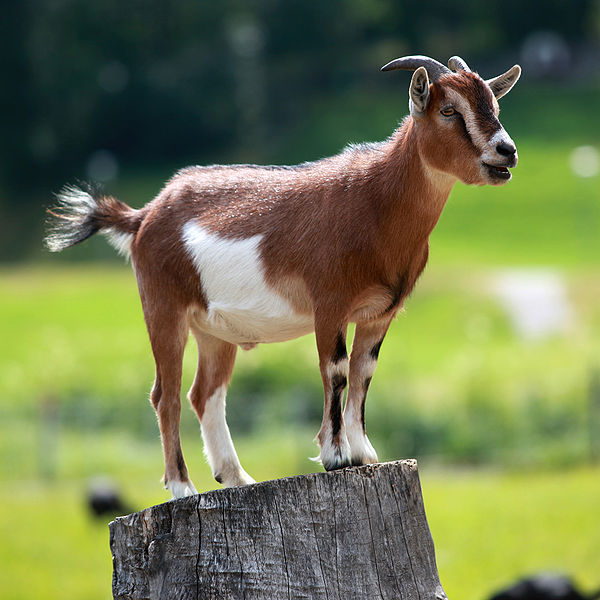
A domestic goat (Capra hircus).
Indeed, the goat is another domestic animal that is considered to be an invasive species. It has made it onto the 100 World's Worst Invasives list at #17.

The goat was originally domesticated approximately ten thousand years ago in Iran, and feral goats of course came from the domestic strains. Introduction methods included purposeful release just in case a ship was wrecked and people became marooned. Also, some goats were introduced to islands for use as milk producers. They were considered favorable for these purposes because they are able to survive so well in harsh conditions, including eating virtually anything. This is part of the reason why goat meat and milk are consumed in higher quantities than any other animal's meat or milk. They are also heavily used for their fur and, of course, the angora goat is known for its very soft fur that can be made into mohair.

Unfortunately, of course, the species has become invasive. Goats introduced to islands have lead to  drops in plant biodiversity, including threatening many vulnerable species. This, in turn, has caused erosion and loss of native animal species who feed on the plants the goats have affected. Control methods vary, but elimination is possible on fairly small islands. Hunting can be highly affective, including aerial hunting in the terrain is favorable. "Judas goats," which will seek out wild herds, are also used, as are hunting dogs specially trained to go after goats. Again, however, these methods become less helpful the large the area on which eradication must take place.

Monday, January 30, 2012

Invasive Species: Warty Comb Jelly

A warty comb jelly (Mnemiopsis leidyi). The species has numerous other common names.
Comb jellies are often confused with the other soft-bodied transparent inhabitants of the world's ocean. However, unlike true jellyfish, box jellyfish, and other cnidarians, comb jellies cannot sting! They are also far more complex morphologically, including the presence of a complete digestive tract rather than the blind sack gut that Cnidarians use. Comb jellies are also classified on their own in the Phylum Ctenophora, with groups quite neatly and separately from Phylum Cnidaria. The origin of the common name "comb jelly" comes from the eight rows of cilia ("ctenes") that are arranged along the body of the organism. These cilia beat in unison and create the rainbow-like sheen that is so often seen when observing ctenophores. Compared to cnidarians, ctenophores are rather harmless. Some comb jellies are even bioluminescent.

M. leidyi in the Black Sea
When looking at the warty comb jelly, however, things are not all sunshine and roses. Ctenophores are all predators, but this particular species is a voracious predator of fish larvae and eggs. In fact, it can be directly linked to crashes of fisheries. Even worse was what happened when in the 1980's these creatures were accidentally introduced to the Black Sea via ballast water. Since the introduction, biodiversity has plummeted, as overall abundance of organisms and the biomass that is produced. The same has occurred in the Sea of Azov, Sea of Marmara, and Caspian sea, though the latter has been hit the hardest. Every part of the food web (or trophic level) has been affected, up to and including the endangered Caspian seal.

Management of the warty comb jelly is difficult, and may in fact prove to be impossible. However, there has been some success following the introduction of a biological control in the form of a natural predator: another ctenophore (Beroe ovata). Though the introduction was accidental (ironically, through ballast water as well), this new species is though to be the only viable way to control the warty comb jelly.

This is another organism from the 100 World's Worst Invasives list, where it sits at #57.


Images are from Wikimedia Commons and are either under a Creative Commons license or copyright free: one, two.

Tuesday, January 17, 2012

Invasive Species: Eurasian water-milfoil

This invasive was suggested to me recently by the author of The Spotting Ghost, who has made numerous suggestions and contributions before.

Water-milfoil (Myriophyllum spicatum) in Ontario coating the bottom of a body of water.
A detailed illustration
This plant is native to much of the Easter hemisphere and has become invasive in North America. The first plants were believed to be in 1942 to Washington D.C. It reproduces rapidly, using an asexual "vegetative" method, namely it just keeps growing and growing, but bits may break off and settle down to grow, allowing it to spread to more areas more quickly. It is generally only found in still water, but when it takes over it competes with other plants for light, shading them out. It is also not as effective a food source for the various animals in the water, including when it comes to the amount of invertebrates that live on the aquatic plants. Crowding also isn't good for fish, making it more difficult for them to find food. In addition, when the plant grows out of control and then decays, it causes the water's oxygen supply to drop.

Managing this plant has proven to be difficult, as it always is when dealing with an invasive species. Herbicides have been tried with little success, but more success has been seen using physical methods. Blocking light from the plants and also removing them or chopping them to bits have had at least some success. There has also been a biological control that has been proposed in the form of a species of weevil.

I don't honestly know what else to talk about. There is a lot more reading to be done on this species, especially if your are interested in the structure, distribution, reproductive methods, and so on. Aquatic plants are quite intriguing due to their only distant relationships with algae. Some of the sources I found most informative are the Wisconsin Department of Natural Resources, United States Geological Survey, and University of Florida.

Source is the Global Invasive Species Database. Images are from Wikimedia Commons and are copyright free or under a Creative Commons license: one, two.

Tuesday, December 27, 2011

Invasive Species: Feral Pig

Feral pigs are also known as feral hogs and razorbacks.
Feral pigs are a major issue in numerous parts of the world. They are virtually everywhere, and may be more of an issue than reported as some sources may think the pigs are of no concern. In fact, feral pigs can be a serious problem. Due to their omnivorous nature, they eat virtually everything, uprooting anything in their path. This destroys crops and countless food sources used by other animals. They may be nocturnal or diurnal and live in virtually every type of environment. Many feral pigs are descendents of domestic pigs gone wild and it's amazing what that process does to the animals. Feral pigs are more like their wild hog relatives, with long snouts, straight tails, lean bodies, and shaggy hair forming a prominent ridge along the back. This patch of longer hair is the origin of the common name "razorback."

Pigs were often purposefully introduced to areas for use as a food source, either as semi-domestic animals or for use as game. As such, it was common for explorers to leave some behind after they discovered a new location. Sometimes pigs would escape, but in almost all cases the ancestors of the feral pigs seen today were purposefully released. Part of this is thanks to some of the methods used to feed the pigs: namely letting them run free and having them find their own food.

When it comes to managing pig populations, there are numerous methods used. Poisoning is one of the most common as it is the most cost effective. However, as with any poisoning, there is a high risk of poisoning species other than the one being targeted. Also, pigs are known to vomit up certain poisons, making them less likely to actually kill the pig. Trapping is also done, after which the pigs will generally be destroyed rather than relocated. Since they are such mobile animals, it's unlikely simply moving the pig will be helpful. Hunting is also quite common, with various methods being used. Hunting pigs with dogs is one of the most commonly used methods.

Despite their extremely destructive habits, pigs do have their uses. Aside from being a source of food, they were once traded for money or goods. They can help control larvae of some damaging plant parasites. They were also once used to clear and aerate soil for gardens.

Feral pigs are on the list of 100 World's Worst Invasives at #91. 

Image is from Wikimedia Commons and is copyright free. 

Saturday, December 3, 2011

Invasive Species: Common Carp

The common carp (Cyprinus carpio) is now found all over the world
The common carp is a very common species of fish used for food. Many of you may know this species by another common name: the koi. Koi are carp that have been selectively bred for their color, and are considered to be an ornamental species due to this. They are very commonly used in public ponds and fountains, as well as those owned by private individuals.

Ornamental koi carp in numerous varieties
The species was first cultivated in China approximately three thousand years ago, and since then it has become a major food source for people. Its native range includes parts of China, on west to the Danube. The current range of the species is virtually everywhere, with them appearing on every continent except Antarctica. The ways that they have been introduced and distributed are so varied that I don't feel the need to list them all here. However, it includes such things as the sharing of resources between different groups of people, as well as some of the most commonly seen causes of invasive spread (such as the aquarium and pet trades).

The major reasons why this species has become invasive include a variety of things: altering habitat and thus changing ecosystems, affecting the normal nutrient cycling of a habitat and disturbing bottom dwelling species, reducing local species diversity, competing with and threatening native species, and loosening sediment, thus clouding water among other things.

The current uses for the common carp include cultivation for food (aquaculture), as an aquarium species, and also for various forms of fishing. This, interestingly enough, includes both commercial and sport fishing.

The common carp is on the list of 100 World's Worst Invasives at #30.

Images are from Wikimedia Commons under Creative Commons licenses: one, two.

Friday, November 11, 2011

Invasive Species: Caulerpa

Caulerpa taxifolia is one of numerous species in its genus, which varies greatly in shape. Where as this species is frond-like in appearance, others are long and thin or even grape or bubble-shaped! C. taxifolia is also known as the "killer alga."
This alga easily fits on the list of 100 World's Worst Invasives at #19.

The species, native to a wide band of tropical and temperate waters around the world, is quite popular as a decorative plant in aquariums. It is understandable, as it is a rather attractive plant. Through this trade, it was released into the Mediterranean where it is now wreaking havoc. It has also become invasive in parts of California and the Adriatic, and possibly Australia, though the populations there may in fact be native. The invasive is considered to be a separate "aquarium strain" that has slightly different traits from the wild forms, including being more tolerant of colder water.

Killer alga is an appropriate common name for the species, as in its invasive form it smothers all other algae, plants, and sessile (i.e. attached and non-moving) invertebrates. This is partly due to direct competition for space and light, but C. taxifolia also produces toxic substances. In addition, the species greatly reduces the habitat for native fish species. Most native animals cannot eat the alga, and those that can collect the toxins in their bodies and thus cannot be eaten by humans. Killer alga can also tangle boat propellers and nets. which serves as a common way that it has been spread. Attempts to eradicate the species cost millions of dollars each year. There is at least one opisthobranch mollusc (i.e. sea slug) that has great potential for use as a biological control.

Methods to eliminate the species are fairly limited. What has been most successful has been application of chlorine or covering beds with black tarps to smother them. Direct hand-removal has had limited success, but there is some risk in this as any fragments that are left can sprout back fairly quickly. The invasive form is a completely male clone and spreads only through the continuous growth of tissue.

SCCAT is the organization dedicated to prevent the spread and eliminate the existing populations of this aggressively invasive species in California.

Thursday, October 20, 2011

Invasive Species: Gambian Pouch Rat

I decided to break away from the list of 100 World's Worst Invasives for a little while, as the database seems to have malfunctioned and is displaying well over 100 listings currently.

The Gambian pouch rat (Cricetomys gambianus)
The Gambian pouch rat is native to much of Africa and it is invasive in the Florida Keys. It's one of the largest Murid rodents (i.e. rats, mice, and related species) and have a maximum weight close to three kilograms. One distinctive characteristic is the last third of their tail, which is a pale cream color. They are a burrowing species and can live for up to eight years.

These large rats were introduced to the area through the pet trade, and it is likely that several of the animals either escaped or were purposefully released. One potentially negative impact is associated with this species' abilities to carry a large number of diseases referred to as "zoonoses." These sorts of diseases are easily transmissible between humans and other animals. The Gambian pouch rat is a carrier for such zoonoses as monkeypox and leptospirosis. In fact, a monkeypox outbreak in the United States led to a ban on the import of this species for five years. Other negative impacts of this rat includes threatening several endangered or threatened local species. They are also a known eater of food crops. 

One of the APOPO HeroRATs
Positive uses of the Gambian pouch rat includes its use as food in Nigeria and as pets. My favorite use of the species, however, is a group called the APOPO has been training these animals to detect landmines! Some advantages to using rats as opposed to other forms of finding the mines are: they are too light to set the mines off, they are food motivated, they are cheap to care for, are a low-tech option for areas with few resources, and they have great senses of smell. They are also resistant to many of the local diseases that could otherwise be problematic. Apparently they are really quite effective, and they can also be trained to detect tuberculosis in human sputum. Tough an invasive species, these rats can also help save numerous lives though their work with such organizations as APOPO.


Sources are the Global Invasive Species Database and APOPO. Images are from Wikimedia Commons and are either under a creative commons license or are copyright free: one, two

Saturday, October 8, 2011

Invasive Species: North Pacific Seastar

Asterias amurensis, also known as the Japanese starfish
 The North Pacific seastar is another invasive on the list of 100 World's Worst Invasives at #21.

This rather striking Echinoderm is native to much of the Western North Pacific. It is now an invasive off of the coast of South-Eastern Australia. There is no real known use of the species for humans, though it has been suggested that drying for collectibles could be a possibility. In their native range, there are several known predators, including the king crab, but no such predators are seen in its invasive range.

There are numerous ways in which larvae and adults of this seastar can be transmitted to new waters, including in the transport of live fish, ballast water, and they can also attach to the hulls of boats and to equipment. Normally, the larvae are only passed along through normal water currents. Their diet is wide-ranging and can include countless other species, as well as other members of its own species when necessary. This is the cause of the majority of its negative impacts, both in its native range and its introduced range. They also like to feed off of mariculture (i.e. farming of ocean life), which is a great burden on the industry.

There isn't much information on management methods for this species, however studies have shown that this species has the potential to become a major invasive species in the future due to the potential damage they can cause to an area.

Image is from Wikimedia Commons and is copyright free.

Thursday, September 22, 2011

Invasive Species: Red Fox

A European red fox (Vulpes vulpes)
The red fox is an invasive that has likely caused or has a great part in the decline of numerous animals in both Australia and North America, including more than a few extinctions. However, the true impact of the species is complicated to determine as there are likely other factors that have led to the loss of those prey species. Though there isn't much competition seen between the red fox and other species, it is believed that qoulls in Australia are being negatively effected. The red fox is also known to take livestock (as in chickens and young sheep and goats) and is a potential carrier for rabies. Fox pelts are a large part of the fur industry, for which they are raised on farms. I would imagine that the several color varieties make the species especially attractive to the industry.

This species is native to a very large area: Europe and virtually all of Asia, plus parts of North Africa and North America. They have been introduced to Mexico, Canada, the United States, and Australia. Due to the addition of this introduced range, the red fox is easily called "the most widely distributed carnivore in the world."

Numerous methods have been and continue to be used in attempts to control the red fox population, especially in Australia. Poisoning, shooting,  fencing, and trapping have all been used, but recently there has been more concentration on trying to limit the foxes' abilities through baiting. These baits may include poison, vaccines, or something that effects fertility, which reduces the number of young born. In Australia, the poison used is derived from a native plant that native species can tolerate so as to only kill the invasive. Exclusion fencing can also quite useful if constructed in the right manner.

The red fox is on the list of the 100 World's Worst Invasives at #99.

Image is from Wikimedia Commons under a creative commons license.

Saturday, September 10, 2011

Invasive Species: Giant Reed

This species actually goes by numerous names, including bamboo reed, giant cane, reed grass, and numerous others.
Giant cane (Arundo donax), which can be nearly two and a half meters tall

This is another organism from the 100 World's Worst Invasives list, where it sits at #10.

Bamboo (left) and giant reed (right)
Giant reed is a species of grass and its native range runs all the way from the Eastern Mediterranean, up to much of the former Soviet Union, and East to the Pacific. It has been introduced practically everywhere. It's major impacts are mostly caused by its rapid growth and spread. It can easily out-compete most native species, and recovers from fires significantly faster that other plants. It is also a cause of fire because of it is actually highly flammable! It is a massively tall grass, with the only taller grasses being bamboo.

It is an attractive plant, and as such it is often grown as an ornamental and its flowers (which are somewhat purple) are used for decoration. It has been used to make musical instruments, including pipe organs. It is also used to reduce erosion in wet areas. Giant cane has also found use in folk medicine, where it is believe to cure or help ease numerous illnesses.

Close up of the leaves
Control and management methods vary greatly. Australia does not allow the plant to be imported. Some pesticides work, though its effectiveness largely depends on the method used when applying, as does physically pulling the plants out of the ground if done properly. Burning does not work, as it can actually help the reed spread. Biological controls have been rather ineffective, but it seems goats may be an effective way to control this aggressive grower.

Images are from Wikimedia Commons under creative commons licenses: one, two, three

Thursday, August 25, 2011

Invasive Species: Coypu

A coypu or nutria (Myocastor coypus)
This species goes by many names, the most well-known being the nutria. They are a semi-aquatic rodent native to South America and they have been introduced to all sorts of places, including areas of North America, Europe, Africa, and Asia.

They are considered a serious problem species, with their major impacts involving erosion and destruction of dykes through burrowing and feeding on rhizomes, which are horizontal stems used to propagate species of grass. I large numbers, they can also reduce a marsh to nothing but an open stretch of water, putting a great number of marsh species at risk. They will also destroy crops.

The coypu is used as a source of meat and fur, and you can find the meat online, complete with recipes and meal suggestions. Management methods remain trapping and shooting, and a bounty system is set up in certain areas. Several states have managed to eradicate them from their area. Interestingly enough, the World Wildlife Fund opposed eradication attempts in Sicily. I wonder what their reasoning was?

The nutria is on the list of 100 World's Worst Invasives at #60.