Showing posts with label drawing animals. Show all posts

Saturday, November 19, 2011

Drawing Animals: Thylacine

 Thylacinus cynocephalus (meaning dog-headed pouched-dog) is more commonly known as the Tasmanian tiger, but I prefer it when they are referred to as thylacines. Though they are named after the island off of the Australian coast, the thylacine was once found on the Australian mainland. As such, they were one of the few mammalian large predators that were found naturally on the landmass. The species has been extinct for quite some time, with the last known individual dieing in 1933. They were fascinating animals that look quite like wolves or tigers, but their marsupial ancestry made them quite different from the placental species. They had five toes on their front feet instead of the usual four and a dewclaw. They could also open their jaws remarkably wide.

Here's a video of the last know live thylacine:


My interpretation. I couldn't get the head right. I may try to fix that.

Friday, November 11, 2011

Drawing Animals: Nudibranch

Nudibranchs or sea slugs are a kind of opithsobranch mollusc and vary greatly in size, shape, and color. This, specifically, is Glaucus atlanticus, which is actually usually found living on the bodies of the Portugese man-o-war and other similar colonial cnidarians (such as the by-the-wind sailor). The coloring  and shape of the animal is such that it blends in well with its host's body. It actually feeds on the dangerous tentacles of its host, and the stinging cells get incorporated into the projections that come off of the body. As such, if you find one washed up on a beach, treat it with the same caution you would any cnidarian (including jellyfish, box jellies, and the man-o-war and their relatives).


My interpretation

Saturday, November 5, 2011

Drawing Animals: Horseshoe Crab

Horseshoe crabs are an ancient arthropod that is classified more closely with spiders than with crustaceans or insects. They have blue blood that is copper based rather than iron based. Though they look a bit dangerous, they are quite harmless. Their telson (tail) is simple used to right themselves when they've been flipped over. They are an important part of the diet of migrating seabirds, as migrations coordinate with mating cycles. During the mating season, they come ashore en masse,and many diet during the process. The bodies litter beaches, and are often collected by visitors. I have an incomplete shell myself (it lost its telson before I collected it) that is about six inches across. They can grow to be much bigger. Image is from Wikimedia Commons under a creative commons license.
My interpretation. Not my best.

Friday, October 28, 2011

Drawing Animals: Roseate Spoonbill

Today's animal is the roseate spoonbill.
The roseate spoonbill (Ajaia ajaja), is an unusual wading bird that breeds from the Gulf states all the way down to Chile and Argentina. There is nothing quite like a spoonbill, with their flat, spatula-like bill and, in this species, its bright pink color. Their feathers were once highly prized for use in lady's fans. It's such a common and easily recognized animal along the Gulf that they were included in the Disney movie The Princess and the Frog, which is set in Louisiana, during the "Dig a Little Deeper" sequence. Image is from Wikimedia Commons under a creative commons license.
My interpretation, which scanned a little oddly

Saturday, October 22, 2011

Drawing Animals: Somali Wild Ass

The Somali wild ass (Equus africanus somaliensis), a subspecies of African wild ass, is a very small wild equid and is actually rather delicate in structure, with the narrowest hooves in the equid world. They are about four feet tall and weight about six hundred pounds, feed on mostly grass, and are known for their unique leg striping. The species is , unfortunately, critically endangered. Image is from Wikimedia Commons and is copyright free.
My interpretation

Friday, October 14, 2011

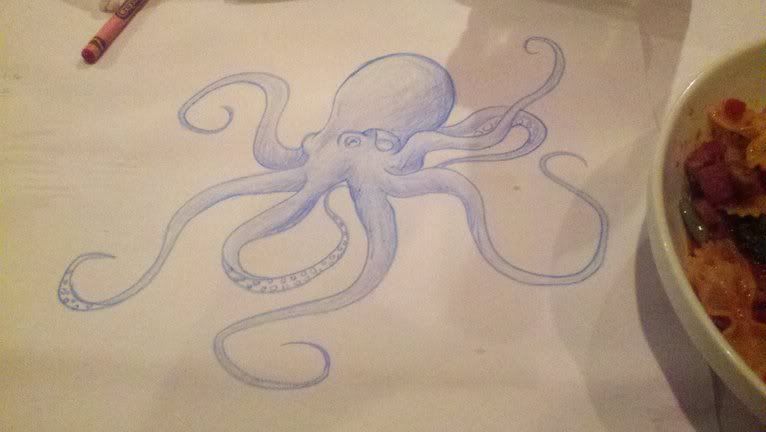
Drawing Animals: Common Octopus

This time around, I doodled an octopus in blue crayon on the table at the local Macaroni Grill. I love going to that restaurant due to the fact that they almost expect you to doodle on the table. They cover the table with butcher paper and provide crayons. The food's good too.

The common octopus (Octopus vulgaris), which is found worldwide. Image is under a creative commons license on Wikimedia Commons

My interpretation

Tuesday, October 11, 2011

Drawing Animals: Basking Shark

I hope to make this a new weekly post, probably every Friday after this initial post or something like that. I like to draw in my spare time, and one fun thing I love to do is draw animals that are not often seen in artwork. I have difficulties finding time to draw during the semester and attending classes, so it often helps if I make myself draw.

For this regular item, I will be sketching some animal either with my tablet or using my other favorite tool: ballpoint pen on sketch paper. In all likelihood, I will more often be sketching in ballpoint and the digital sketches will not often involve color. For the future, feel free to give me suggestions as to which animal you would like to see me draw. I hope you enjoy my first animal: the basking shark (Cetorhinus maximus).

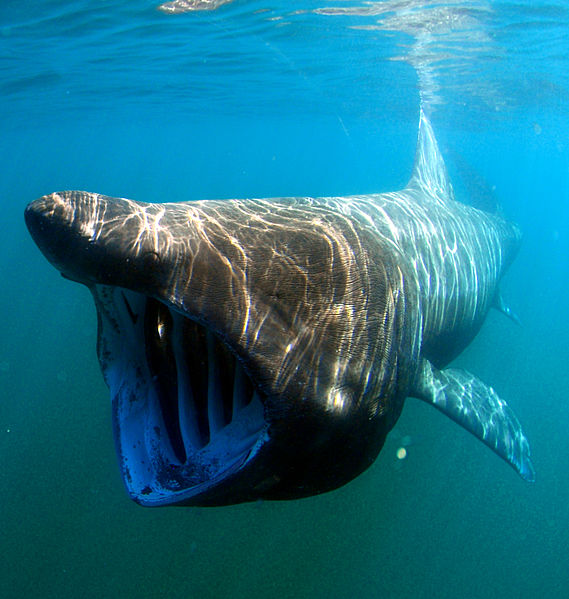
The basking shark, a large species which uses its gaping mouth and specialized gills to filter tiny organisms from the water. Image is copyright free from Wikimedia Commons

My interpretation