|
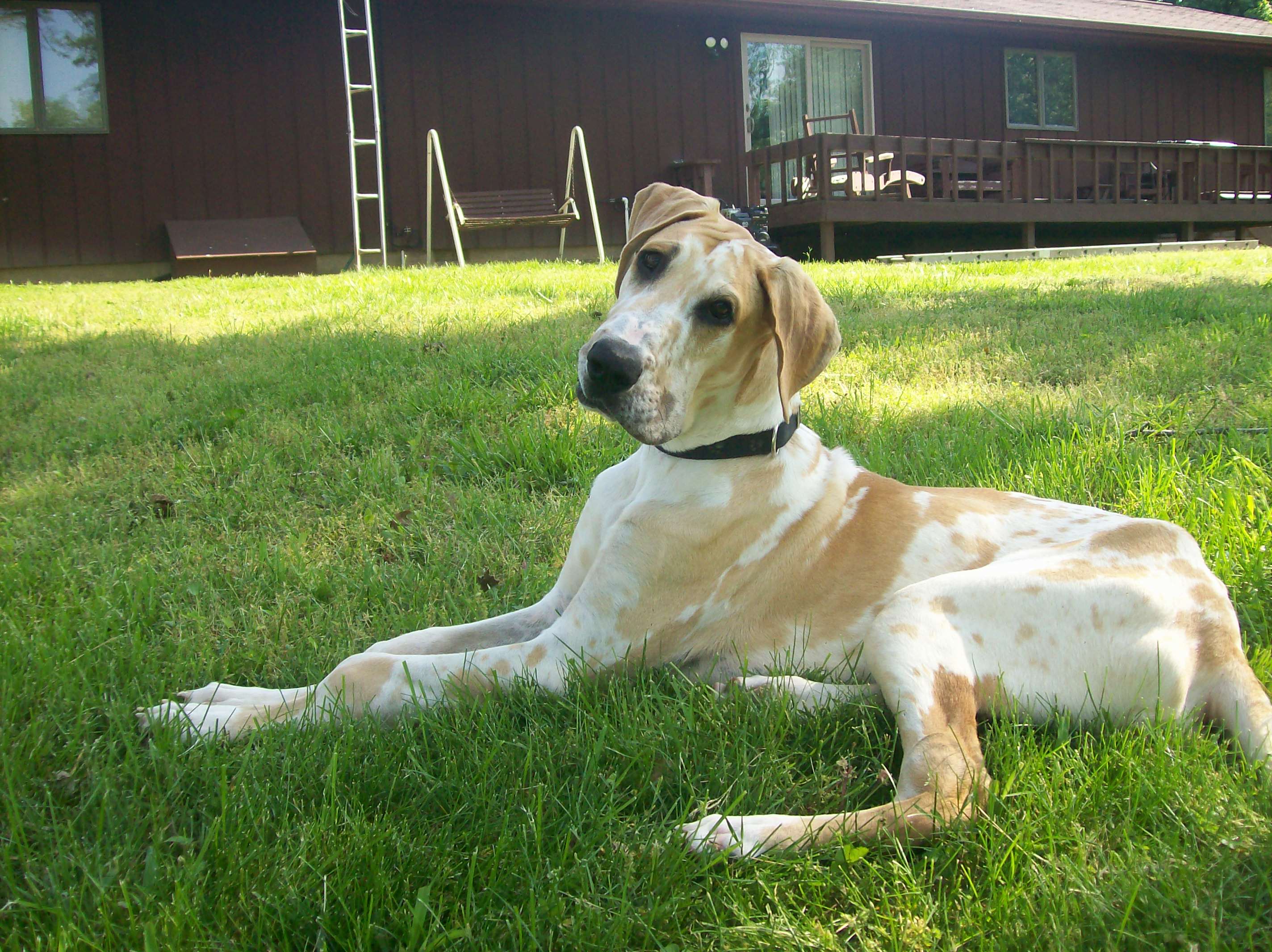
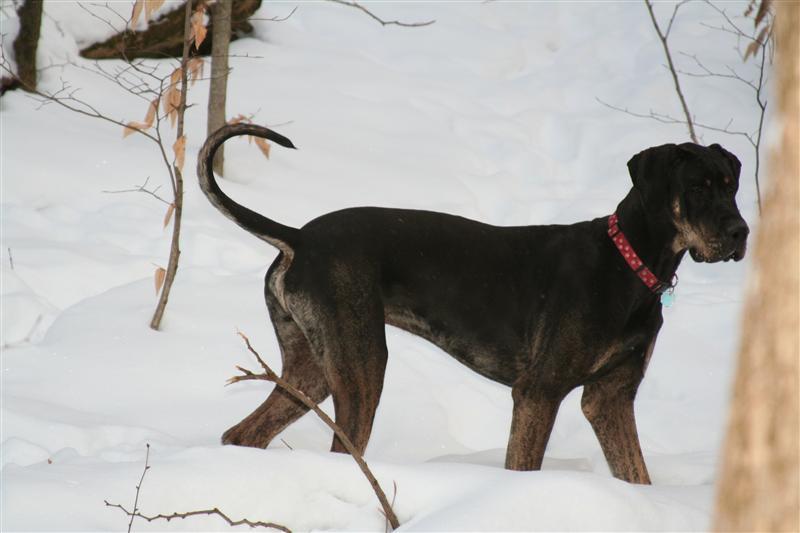
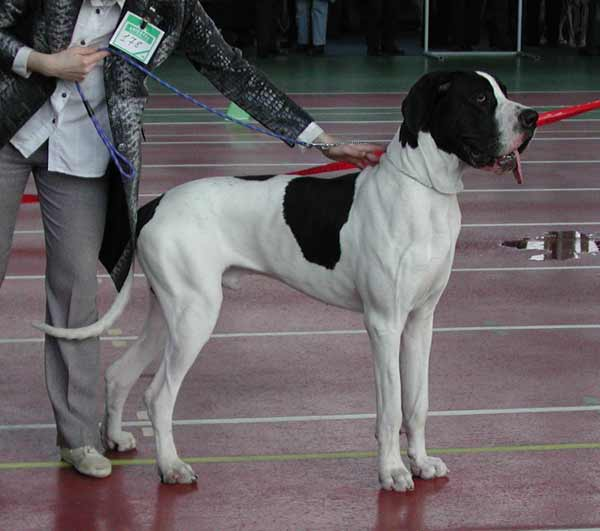
| A group of great Danes, two in standard colors (fawn and mantle) and two in non-standard colors (merle mantle and "true" blue merle aka dilute merle). Image is from Flickr.com under a Creative Commons License |
Fawn and Brindle
Breeding of fawns and brindles to other fawns and brindles whose pedigrees are free of black, blue, or Harlequin
Blue
Breeding of blues to other blues or to "blue-bred blacks" whose pedigrees are free of fawn, brindle, or Harlequin. A blue or blue-bred black can also be bred to a black-bred black
Harlequin
Breeding between mantles, Harlequins, and "Harlequin-bred blacks." It is also acceptable to breed a dog from this class to a black-bred black. Any combination is acceptable so long as the pedigrees are free of fawn, brindle, or blue. This includes the pairing of two Harlequins.
Black
"Black-bred blacks" come from generations of exclusively black to black breeding, resulting in pedigrees free of blue, fawn, mantle, brindle, or Harlequin.
Even breeding within these classes does not eliminate mismarks, with more than a few breeders being surprised when, for example, they pair a mantle with a five-generation pedigree fitting the Harlequin class to another mantle of the same designation and produce a blue mantle or fawn mantle. This is not even getting into the flaws with Harlequin in and of itself.
Bolded are standard colors and green are non-standard colors produced ONLY from genes that go into the standard colors. I've omitted Harlequin + mantle and similar as they can be visually indistinguishable from dogs without.
All of these colors are recognized as existing by the American Kennel Club so, unlike with some breeds, the vast quantity of potential mismarks are well known to exist. Fitting (mostly) within the above chart are subsets that would severely penalize or disqualify an otherwise acceptable color from conformation: bad black (aka seal), improper pigmentation (usually a pink-nosed Harlequin) and white on a blue, black, fawn, or brindle (some is allowed, but not preferred). Although unusual, there have been instances of tan pointed and maskless great Danes as well. Ticking sometimes happens, but, for the AKC at least, there is no mention of whether it would be penalized or not.
Perhaps the biggest indicator of color in great Danes is the K locus, which codes for black and brindle. Black (K) is most dominant, followed by brindle (kbr), and then non-black/non-brindle (k). Since a black dog only needs one copy of the dominant K gene to be black, it can easily carry either brindle or fawn as Kkbr or Kk, respectively. When the right two dogs come together, a litter that was expected to be all standard black mantles could throw something unexpected. When homozygous for the non-black/brindle allele (kk), the agouti locus will show through unobstructed. For most Danes, this will make them fawn, but this would also be why the tan pointed or even brindle pointed Dane appears. In the case of brindle points, the agouti locus is still peaking through, but it is obscured by the brindle overlay.
Referring back to the chart, it's quite clear that most of the standard Dane colors are black-based. Black, mantle, and Harlequin all have obvious black on them, while blues are genetically dominant black with the extra quality of also being diluted. Due to the black base of all of these colors, if a dog inherits a gene combo that does NOT code for black (kbrkbr, kbrk, or kk) then it would have either brindle or fawn instead of black. This includes Harlequins (turned to brindlequin or fawnequin) and mantles (turned to brindle mantle/brantle or fawn mantle/fawntle).
Blue/dilute is a simple recessive gene inherited on the D locus, with the dog having to receive two copies (dd) for it to show. Dilute affects all black in a dog's coat, turning it to some shade of gray. This includes masks and stripes in brindles. Even if trying to only breed the dominant variant of a gene, there is no guarantee that the recessive form will disappear. This is why diluted variants such as blue Harlequin (aka porcelain) continue to pop up from parents whose pedigrees may have not seen a blue for decades.
The A (agouti) locus is probably the most varied locus in the dog world, but in great Danes there appears to be only two variations, with the breed being nearly fixed for one of them. Being fixed for a gene means that no other genetic variants are seen at that locus. Sable (Ay), which causes Fawn, is the most dominant of the agouti variants and tan point (at) one of the recessive variants. Considering the low incidence of tan point, great Danes can, for the most part, be treated as if they were fixed for sable due to there not being many tan point carriers.
Fawn and brindle great Danes are also known for having black masks. This is inherited independently on the E locus, aka the extension locus. The most dominant of the extension genes is, indeed, the mask gene (Em). Considering that maskless Danes do exist, some other variation has to exist, but it can be difficult to tell whether that would be recessive red (e, which strips away all black in a coat, leaving it entirely red) or the "null" allele of non-masked, non-everything-else (E). There is some evidence for both but, like with the agouti locus, the breed appears to be near fixed for one allele. In this case, that's the mask gene.
Mantle comes from recessives on the S (spotting) locus. White spotting varies significantly from virtually no white to virtually all white. Blue, black, fawn, and brindle Danes must have at least one copy of the solid (S) allele. If carrying Irish white (si), piebald (sp), or extreme white piebald (sw) a dog will likely have at least a small amount of white due to the semi-dominant nature of the spotting genes. This is usually on the chest and/or toes, but may also lead to a white tail tip or some facial white. A dog with white, however, does not necessarily carry any of the recessive variants. Residual white is quite common in genetically solid (SS) dogs due to how color migrates during very early development. It essentially spreads from the spine to the extremities in the womb, so if the color doesn't spread all the way, a dog will be born with some amount of white. As with many breeds some white is allowed on otherwise solid Danes, but too much is penalized.
To be mantle, a dog's phenotype must have more white than what is possible from a homozygous solid dog. The white required by the breed standard is essentially Irish white, a pattern most people associate with breeds such as the border collie. This appearance can come from several variations of the spotting locus. As expected, a dog can be homozygous for the Irish white variant (sisi), but a dog carrying piebald (sisp) will look similar, though possibly with a little more white. Since the standard allows white to break the main body of the dog, some Danes who fit the standard appear to be minimal piebalds (spsp). In addition, pseudo Irish white, caused by either a solid carrying extreme white (Ssw) or what would have been a low-white Irish carrying extreme white (sisw), will look like a homozygous Irish dog.
Due to the vast amount of variation in the potential genotypes that would lead to the acceptable mantle phenotype, it isn't surprising that piebalds and extreme white piebalds are known to pop up in the breed. As extreme white is more common, it's likely there are a lot of pseudo Irish dogs out there.
In addition to the vast quantity of potential for mismarks seen above, there is the illogicality of the nature of breeding for Harlequins. Harlequin can, by its nature, NEVER breed true. It is a color caused by a very specific combination of two problematic genes. One of them is merle (M), which is well known to cause serious issues when a dog inherits a double dose of the gene. Harlequin (H) is, in some ways, worse than merle. While double merles are generally viable despite the high incidence of deafness and/or blindness, double Harlequins are lethal in utero. Since no living dog can be homozygous for Harlequin, this explains why merle dogs are to be expected in every litter with at least one Harlequin parent. The worst part of Harlequins, however, is that breeding a Harlequin to another Harlequin is perfectly acceptable under color class breeding. This is a serious problem.
Here is a Punnet square for a Harlequin/Harlequin cross:
When crossing two Harlequins together, the assumption is that the breeder wishes to produce more Harlequins. Considering this, a 25% chance of a Harlequin is pretty bad when the price to pay is the likelihood one-in-four of the puppies will never even have a chance to live and another 18.75% of embryos have a very high chance of being blind and/or deaf. That's almost half the litter! Some breeders cull double merles, but this is a shameful practice, sweeping poor decisions under the rug in the form of dead puppies. The alternative, however, isn't exactly wonderful. Due to their sheer size, only so many people are willing to adopt a great Dane. When that size comes with impaired senses, the number of available homes plummets. A dog that is deaf and/or blind is significantly more difficult to train than a dog with full use of its senses, and a huge, poorly trained dog can be very difficult to deal with. I once met a deaf great Dane at my local dog park who would not stop humping my Labrador. My poor dog barked at him in frustration, but, being deaf, the dog had no awareness of such social cues. If my dog wasn't so even-tempered the Dane could have easily been injured due to his poor social skills. Since the Dane's owner wasn't leaving, I understandably removed my dog from the situation.
Many assume that white great Danes are albinos, but their lack of pigment is caused by a very different set of circumstances. As breeding from a merle is not acceptable in color class breeding, whites come from Harl/Harl crosses like the one above and, as they are double merles, they have a high risk of sensory issues. Some may be very lightly marked Harlequins, but this is unlikely. I have also seen at least one dog that appears to be an extreme white piebald Harlequin, but this is also not the most likely phenotype. What patches you do see on white great Danes will usually be solid black, but just as fawn mantle and blue Harlequin can occur, you can also get double merle Harlequins of a different color as well.
In contrast to the Harl/Harl cross, here's a Punnet for a Harlequin/black cross where the black does not carry the Harlequin modifier:
This cross has the same 25% chance of producing a harlequin, but there is a 0% chance of color-related non-viable embryos and a 0% chance of double merles, so the breeder will not have to find homes for deaf and/or blind dogs. There will still be merles, but since the Harlequin modifier is lethal in a double dose, this is an inevitable consequence of Harlequins.
Since merle is never going away, the absurdity of making it a disqualification is rather remarkable. In most breeds, colors that pop up with the high frequency of merles in great Danes are generally accepted by the standard. In addition, why does the Great Dane Club of America allow Harlequin/Harlequin cross when crossing a merle with a black that's been tested positive as a carrier for the Harlequin modifier is frowned upon? Both have the potential to produce Harlequins, but the merle cross, like breeding a Harlequin to a non-carrier black, doesn't have the issues that a Harlequin/Harlequin cross does. Mantle became an accepted breed color because of Harlequin breeding. I don't see why merle shouldn't be treated the same way.
The last color determinant I have not discussed is the B locus. Brown/liver acts much like the blue dilution. It's a simple recessive (so all dogs expressing it are bb) that turns any black in the dog's coat from black to some shade of brown. Like dilute, any dog with black can have liver coloration instead. In great Danes, liver is known as chocolate. It can also act in combination with blue, diluting down to Isabella (also known by names such as silver, gray, ash, pearl, lilac, and fawn). Weimeraners are well known for their Isabella color. In great Danes, it appears that Isabella is known as either silver, lilac, or dilute chocolate. There is some evidence that chocolate was once an acceptable color in the breed that since fell out of favor, and the seventeenth century portrait at right is interesting in relation to this possibility. If the dog is in fact a very early great Dane or Dane relative, it isn't any color that would be found in a modern show ring. It appears to be an Isabella mantle.
With the limited variation that comes with closed registries, selective breeding is like taking a weed-wacker to a spindly bush. It can only take so much before there isn't enough of it left to survive. That is essentially what is occurring in modern dog breeds, where effective populations sizes are worse than what is considered at risk of immediate extinction in endangered species. Since the great Dane has such major restrictions in color acceptance, there is a massive amount of potential for loss in genetic variation that could have otherwise been saved.
Images in this post are from Flickr.com or Wikimedia Commons with the exception of the heads used in the Punnett squares, which were created by me. Everything is under a Creative Commons license and source links can be found beneath each image.
Even breeding within these classes does not eliminate mismarks, with more than a few breeders being surprised when, for example, they pair a mantle with a five-generation pedigree fitting the Harlequin class to another mantle of the same designation and produce a blue mantle or fawn mantle. This is not even getting into the flaws with Harlequin in and of itself.
The Mismarks:
 |
| This great Dane is a merle mismark, one of the most common seen in the breed. |
| Black | Fawn | Brindle | |
| add Irish white | Mantle | Fawn mantle | Brindle mantle |
| add dilute | Blue | Blue fawn | Blue brindle |
| add Irish + dilute | Blue mantle | Blue fawn mantle | Blue brindle mantle |
| add merle | Merle | Fawn merle | Brindle merle |
| add merle + dilute | Blue merle | Blue fawn merle | Blue brindle merle |
| add merle + Irish | Merlequin | Fawn merle mantle | Brindle merle mantle |
| add merle + Irish + dilute | Blue merlequin | Blue fawn merle mantle | Blue brindle merle mantle |
| add merle + Harlequin modifier | Harlequin | Fawnequin | Brindlequin |
| add merle + Harlequin + dilute | Blue Harlequin | Blue fawnequin | Blue brindlequin |
| add merle + merle | Double merle replaces single merle. Causes an increase in white. Has a high likelihood of deafness, blindness, and/or eye abnormalities. | ||
| add merle + merle + Harl | White. Most whites have virtually no color. Has the same health concerns as double merle. | ||
| add liver | Chocolate acts like dilute, replacing black. This includes masks on fawns and stripes on brindles | ||
| add liver + dilute | Blue and chocolate combine to make Silver Silver replaces chocolate, dilute, or black | ||
| add piebald | Piebald would replace Irish in the above combinations. Both piebald and extreme white piebald are possible | ||
 |
| Tan on this Dane is consistent with a seal |
 |
| This great Dane has no mask |
So, what causes all of that, anyway?
As can be seen in the chart above, a very large number of mismarks can occur when only looking at the genes that make the six standard colors. |
| This puppy is a Brindlequin mismark |
Referring back to the chart, it's quite clear that most of the standard Dane colors are black-based. Black, mantle, and Harlequin all have obvious black on them, while blues are genetically dominant black with the extra quality of also being diluted. Due to the black base of all of these colors, if a dog inherits a gene combo that does NOT code for black (kbrkbr, kbrk, or kk) then it would have either brindle or fawn instead of black. This includes Harlequins (turned to brindlequin or fawnequin) and mantles (turned to brindle mantle/brantle or fawn mantle/fawntle).
 |
| This dog is a heavily marked blue Harlequin |
Blue/dilute is a simple recessive gene inherited on the D locus, with the dog having to receive two copies (dd) for it to show. Dilute affects all black in a dog's coat, turning it to some shade of gray. This includes masks and stripes in brindles. Even if trying to only breed the dominant variant of a gene, there is no guarantee that the recessive form will disappear. This is why diluted variants such as blue Harlequin (aka porcelain) continue to pop up from parents whose pedigrees may have not seen a blue for decades.
 |
| This Dane is a fawn mantle mismark |
The A (agouti) locus is probably the most varied locus in the dog world, but in great Danes there appears to be only two variations, with the breed being nearly fixed for one of them. Being fixed for a gene means that no other genetic variants are seen at that locus. Sable (Ay), which causes Fawn, is the most dominant of the agouti variants and tan point (at) one of the recessive variants. Considering the low incidence of tan point, great Danes can, for the most part, be treated as if they were fixed for sable due to there not being many tan point carriers.
Fawn and brindle great Danes are also known for having black masks. This is inherited independently on the E locus, aka the extension locus. The most dominant of the extension genes is, indeed, the mask gene (Em). Considering that maskless Danes do exist, some other variation has to exist, but it can be difficult to tell whether that would be recessive red (e, which strips away all black in a coat, leaving it entirely red) or the "null" allele of non-masked, non-everything-else (E). There is some evidence for both but, like with the agouti locus, the breed appears to be near fixed for one allele. In this case, that's the mask gene.
 |
| This dog is a dark blue mantle mismark |
 |
| This great Dane is a piebald merle |
 |
| I've met a dog much like this extreme white Dane |
In addition to the vast quantity of potential for mismarks seen above, there is the illogicality of the nature of breeding for Harlequins. Harlequin can, by its nature, NEVER breed true. It is a color caused by a very specific combination of two problematic genes. One of them is merle (M), which is well known to cause serious issues when a dog inherits a double dose of the gene. Harlequin (H) is, in some ways, worse than merle. While double merles are generally viable despite the high incidence of deafness and/or blindness, double Harlequins are lethal in utero. Since no living dog can be homozygous for Harlequin, this explains why merle dogs are to be expected in every litter with at least one Harlequin parent. The worst part of Harlequins, however, is that breeding a Harlequin to another Harlequin is perfectly acceptable under color class breeding. This is a serious problem.
Here is a Punnet square for a Harlequin/Harlequin cross:
| HM | Hm | hM | hm | |
| HM |  HHMM double double lethal! | HHMm double Harlequin merle lethal! |  HhMM double merle Harlequin possibly deaf/blind |  HhMm Harlequin |
| Hm | HHMm double Harlequin merle lethal! | HHmm double Harlequin lethal! | HhMm Harlequin |  Hhmm black or mantle carrying Harlequin |
| hM | HhMM double merle Harlequin possibly deaf/blind | HhMm Harlequin |  hhMM double merle possibly deaf/blind |  hhMm merle or merle mantle |
| hm | HhMm Harlequin | Hhmm black or mantle carrying Harlequin | hhMm merle or merle mantle | hhmm black or mantle |
 |
| This white Dane is deaf. |
Many assume that white great Danes are albinos, but their lack of pigment is caused by a very different set of circumstances. As breeding from a merle is not acceptable in color class breeding, whites come from Harl/Harl crosses like the one above and, as they are double merles, they have a high risk of sensory issues. Some may be very lightly marked Harlequins, but this is unlikely. I have also seen at least one dog that appears to be an extreme white piebald Harlequin, but this is also not the most likely phenotype. What patches you do see on white great Danes will usually be solid black, but just as fawn mantle and blue Harlequin can occur, you can also get double merle Harlequins of a different color as well.
In contrast to the Harl/Harl cross, here's a Punnet for a Harlequin/black cross where the black does not carry the Harlequin modifier:
| HM | Hm | hM | hm | |
| hm | HhMm Harlequin | Hhmm black or mantle carrying Harlequin | hhMm merle or merle mantle | hhmm black or mantle |
This cross has the same 25% chance of producing a harlequin, but there is a 0% chance of color-related non-viable embryos and a 0% chance of double merles, so the breeder will not have to find homes for deaf and/or blind dogs. There will still be merles, but since the Harlequin modifier is lethal in a double dose, this is an inevitable consequence of Harlequins.
 |
| This great Dane is a merle mantle mismark |
 |
| This puppy is a chocolate fawn |
 |
| This portrait is believed to include a Dane |
Conclussions
Of all the breeds I have looked at, the great Dane is most problematic in terms of its color standard. It's one thing for a breed to have a number of recessive colors that show up on occasion, but on top of that Danes have mismarks that are guaranteed to occur when breeding one of its six acceptable colors. Also problematic are the color classes, which essentially create breeds within breeds. All purebreds have limited gene pools due to closed registries. Color classes take that genetic variation and limit it again. Since closed registries prevent any new genetic variation from being added, what there is cannot be replaced once it's gone. Genetc variation is essential to a healthy animal, allowing their immune system to function effectively. The less variation, the less functional the immune system.With the limited variation that comes with closed registries, selective breeding is like taking a weed-wacker to a spindly bush. It can only take so much before there isn't enough of it left to survive. That is essentially what is occurring in modern dog breeds, where effective populations sizes are worse than what is considered at risk of immediate extinction in endangered species. Since the great Dane has such major restrictions in color acceptance, there is a massive amount of potential for loss in genetic variation that could have otherwise been saved.
Images in this post are from Flickr.com or Wikimedia Commons with the exception of the heads used in the Punnett squares, which were created by me. Everything is under a Creative Commons license and source links can be found beneath each image.