Tuesday, March 24, 2015

Food Hopping: Why I've Stuck with Inconsistent Feeding

In my pantry right now
For over three years now, I have been exploring the wide world of dog food. In that time, I have never bought two bags of the same food in a row. As soon as I begin to run out of one bag, I transition over to another brand. This means that, at maximum, my Labrador is eating a certain food for about thirty days. I've had some interesting discussions with the workers at the pet store within walking distance of my condo, and they think it's simply bizarre that I would do what I do. It's unusual, sure, but I think it's had a positive effect on my fella.

Before this journey began in early 2012, Ebon hadn't really eaten that many foods in his life. When I first brought him home, he and our old dog Charlie ate Purina One and I was not the major decision maker in what sort of food was bought (I was only sixteen at the time). When Iams became cheaper at the grocery store we went to, we switched to Iams. Ebon was fed Iams for maybe three years. I got older and wiser and Ebon was eventually switched to Nutro's Natural Choice, then to Blue Buffalo. Purina One and Iams did Ebon no favors, and the changes when he stopped eating them were pretty fantastic. I finally switched him to the PetSmart-exclusive Simply Nourish, which was the food he was eating when I decided I wanted to try something different. I started doing single-bag trials and reviewing the food based, in part, on how well Ebon did while eating it.

The funny thing about this, though, is he has been generally more stable in terms of coat quality, digestive health, and energy than he was when being fed a single food for an extended period. Sure, there's been some duds that upset his stomach and so on, but he also had more than a few incidents when he had been eating the same kibble for months. There's a reason why I worry so much about his stool and call his stomach "a bit touchy." For the longest time, it seamed like so little could set him off. But since my little experiment started, he's had fewer problems and the ones he does have tend to be more minor. This could very well be a coincidence, but I suspect it's more than that.

For people, it's not generally considered healthy to eat the same thing day in, day out. So, why wouldn't that same rule apply to our pets? A person shouldn't eat turkey on rye for every meal, so why should a dog eat lamb and brown rice for the rest of its life? While pet foods are meant to be complete and balanced for long-term nutrition, it is still very possible that a certain food would lead to some sort of deficiency thanks to things like digestibility, ingredients, and nutrient bioavailability. For example, I've discussed before my concerns about the inclusion of plant-based protein boosters in pets foods. Nutritional information on pet food is very limited, and one of the few things that we do get are things like the percent of food that is protein. The problem with this is that plant proteins, due to being more difficult to digest, have a lower bioavailability than animal proteins. That means that the amount that can be measured in the sources is different than the amount that a body can actually absorb and make use of. Since dogs, being carnivores, have short digestive tracts, bioavailability is a very valid concern when discussing food quality. A food with a large amount of plant protein may mean that a dog isn't able to actually utilize as much protein as it should. In addition, plant proteins are generally not complete, meaning they're missing one or more essential amino acids: the protein building blocks that a body cannot manufacture itself. Those amino acids have to come from somewhere, and deficiencies can cause pretty serious side effects (see Kwashiorkor).

Due to all of that, it's not unlikely that even a very well formulated food has flaws. So, switching between foods on a regular basis may have the positive effect of mitigating whatever nutritional deficiencies a certain food may have. Considering what I've seen with Ebon, this very well may be what has happened with him.

It's also been fascinating to learn more about how my dog ticks. Comparing him to my parents' dogs has also contributed to my current opinions of dog food. One main thing? Every dog is different. Ebon does better on more calorically dense foods than my parents' greyhounds. For Ebon, fish-based foods are more likely to set him off than mammals and birds. Grain-free and grain-inclusive foods aren't any different for him even though a lot of dogs do best on grain free. The greys can't go grain free because it gives them the runs. Then again, a lot of things give them the runs. They have the notoriously awful stomachs that are so common in the breed. Ebon has his issues, but they're pretty exclusively linked to nervousness, while for the greys it could just be a Wednesday.

After all this time jumping brands and knowing that Ebon does well as long as the food fits a fairly short list of criteria, I've been shopping sales and picking up whatever hits the right balance of quality and price. One major advantage to this is I can often save several dollars a bag versus if I was constantly buying the same brand every month. I also have a few other criteria. I watch how much rice Ebon eats, since there is some concern about levels of arsenic. I am careful about my own rice intake, so I'm careful about his too. I never feed two bags of dog food that contain rice in a row, so it tends to alternate between grain-free and grain-inclusive. I also try to rotate out proteins, but this isn't as easy to do. He tends to get a lot of chicken, but I buy non-chicken food as often as I can.

When my little experiment first started, my goal was to find a food to settle on for the rest of Ebon's life. Now, however, I think I'll continue to switch it up indefinitely.

Ebon recently, still as happy as ever. 

Tuesday, March 17, 2015

Facing Reality: Old Dog Problems

Update: I had a chat with them. I had forgotten about another accidental death. Ebon is the last one left. I'm going to go give him a big hug now. 

Happy boy. Tag by Aggie's Anvil


Ebon, my field-bred Labrador, turned ten years old this January. He's arthritic is both hips and one knee, making him have a hitch in his stride. He's developing cataracts. He tires easily, so he's playing less. However, this isn't what has bothered me the most. After all, for his age and size he's still doing rather well. It's been the loss of his brothers.

Ebon's brother Roscoe, lost this month
As long-term readers may remember, Ebon is part of a litter of five black boys from a chocolate mother and a yellow father. One pup died in an accident, but the others lived to adulthood. In the past six months, two brothers had to be euthanized. The reason? The big c-word: cancer.

Of course, this wasn't entirely unexpected, with the average life expectancy of the breed being ten to twelve years. But even so, finding out last October that one of the brothers hadn't made it to his tenth birthday saddened me. This month I was informed of the loss of another, and I really started to worry.

Cancer is distressingly common in retrievers, though Labradors as a whole have a lower incidence than other retriever breeds. Ebon's litter was blessedly free from those ever-common hip, elbow, knee, and eye problems, though they all wound up being epileptic. I still suspect this was due to maternal stress, however, as the breeder was robbed and the dogs were drugged while Hellon (the mother) was pregnant. Ebon hasn't had a seizure in over two years, and the ones he has had were comparatively very minor.

Since Ebon is from field lines, breed statistics, due to the sheer popularity of non-field Labs, are probably a bit misleading. It's difficult to say how well those statistics apply to field lines specifically. I know Ebon's father came from lines that didn't have the best longevity, but it was mostly due to hunting accidents, so there's no way of saying how long those dogs would have lived or what they would have died of otherwise. Since Ebon was a gift, I got what I got, but I do wish I knew more. I have never seen his pedigree because I never registered him, so I don't know anything about his COI. Since his mother was from Texas and his father was from Georgia, it's very possible that the litter was born of a highly unrelated pairing, but for all I know the parents were half-siblings. I don't know what happened to his father. I know his mother had cancer, but she was almost fifteen when she was euthanized. Just looking at her, he probably inherited some really good genes. But that's only one part of the picture.

If Ebon winds up being the last one standing, I really don't know how I'll feel. But I do know I'm going to cherish every moment we have left.

My old man

Monday, February 2, 2015

Hashimoto's Disease: Working to Understand my Diagnosis

The thyroid gland
Late last year I discovered I had developed a goiter. For those who don't know, a goiter is an enlargement of the thyroid gland, often becoming a visible bulge at the lower part of the front of the neck. It scared me a bit. This was a combination of me thinking about the neck being a sensitive area and my mind immediately jumping to lump = bad. It kept getting bigger, and right now I can feel it when I swallow. After testing, I showed clearly elevated thyroid auto-antibodies. After a lot of poking, prodding, blood tests, and questions I was told it was pretty definitive that I had Hashimoto's disease: an autoimmune disorder also known as chronic lymphocytic thyroiditis. I am now in the very early stages of treatment using levothyroxine, a synthetic thyroid hormone.

The curious side of me, of course, wanted to know more. Especially as this is going to affect the rest of my life.

The endocrine system
The thyroid is one of many glands that make up the endocrine system, which is a complex of hormone-secreting organs that control major aspects of normal body function. The endocrine system controls a body's development from child to adult. It keeps levels of certain substances, like insulin and calcium, in balance. It helps regulate your sleeping patterns. It also controls your metabolism and body temperature. The thyroid is involved in those last two. For proper function, the thyroid requires iodine as both thyroxine (T4) and triiodothyronine (T3)--two hormones produced by the gland--contain iodine. Consuming too much or too little iodine can exacerbate existing thyroid problems, or even cause them under certain circumstances.

When it comes to maintaining levels of thyroid hormones, there is a feedback loop involving the thyroid, the pituitary gland, and the hypothalamus. It's a classic negative feedback loop. The hypothalamus produces thyroid releasing hormone (TRH), which then triggers the pituitary to release thyroid stimulating hormone (TSH). This then triggers the thyroid to produce T4 and T3. When levels of T4 and T3 in the blood reach a certain level, this then signals the hypothalamus and pituitary to stop releasing TRH and TSH, respectively. When testing to see if someone has a thyroid problems, looking at levels of TSH and T4 will generally tell the most about about what is going wrong. If someone has low TSH and high T4, it would indicate hyperthyroidism (over-activity of the thyroid gland). High TSH but low T4 would be due to hypothyroidism (under-activity of the thyroid gland).

In many ways, hypothyroidism and hyperthyroidism cause symptoms that are opposite of each other. Hyperthyroidism includes things like difficulty tolerating heat, sweating more, restlessness, anxiety, and weight loss. Hypothyroidism, on the other hand, has symptoms that involve difficulty tolerating the cold, depression, and weight gain. One speeds everything up while the other slows it all down. However, both ends of the spectrum will make you tired.

Hashimoto's disease is pretty typical of hypothyroidism, but with a few interesting caveats. As it's an autoimmune disorder, but a very specific one, it involves someone's own immune system attacking the thyroid gland. Over time, the thyroid is killed off. Hashimoto's tends to have a gradual onset because it takes time for the thyroid to be damaged to the point that it enlarges or a person starts experiencing noticeable symptoms. It can be years before someone is diagnosed, if they are diagnosed at all. There is also no cure, and the only current treatment is thyroid hormone replacement therapy.

My goiter
In my case, I'm honestly not quite sure whether I've been having symptoms for an extended period of time. I gained some weight after some setbacks kept me from exercising as much as I had been and since then I've had difficulty losing even a single pound. Over the past few years it has seemed like I've been more tired, feeling less and less able to be as productive as I once was. My iron levels tend to be low, so I usually would chalk it up to needing more iron in my diet again. Now I can't help but wonder if it's been more complicated than that. My feet tend to not retain heat well, but I don't know if that is just the nature of my circulation or if it was an early sign of Hashimoto's. Lately I've definitely noticed how cold I've been feeling. One day my feet were so cold I lost feeling my toes and, after checking my thermostat, I was startled to discover it was 70°F inside. That is pretty definitively not normal. I've also been very tired, on more than one occasion sleeping through most of the day. I've actually woken up, gone to work, come home, and almost immediately fallen asleep again on more occasions than I care to count. With how much this has interfered with things, this is the biggest symptom I want to stop.

The good thing? The medication does seem to be starting to help a bit. The doctor and I just need to work on dialing in the right dose. 

Hashimoto's disease is diagnosed at a rate of three to fifteen per ten thousand people. It is the most common cause of hypothyroidism in the United States. There are two major risk factors: having a family history and being born female, with only one male being diagnosed for every twenty females. Looking at my family history, it's really not overly surprising that I have a thyroid problem. On my mother's side, my grandfather took synthetic thyroid hormones. On my father's side, I have two aunts with hypothyroidism of some sort and a cousin who I know has Hashimoto's. That's a lot of malfunctioning thyroids!

Sources are Johns Hopkins Medical Institutions Autoimmune Disease Research Center, National Endocrine and Metabolic Diseases Information ServiceUniversity of Maryland Center for Diabetes and EndocrinologyAmerican Medical AssociationColorado State University, Medline Plus: Chronic thyroiditis (Hashimoto disease), Medline Plus: Hypothyroidism, Medline Plus: Hyperthyroidism. Images one and two are from Wikimedia Commons under Creative Commons licenses (one, two). The third image was taken by me. 

Monday, December 15, 2014

Friday, December 12, 2014

Name that...Animal!

Hint: it is NOT a lizard.

Image is from Wikimedia Commons under a Creative Commons license
Click "read more" to find out the answer!

Tuesday, December 2, 2014

Influenza: the Risks and Why you should Get Vaccinated

This is, to a small extent, in relation to my post on Ebola. While in the United States Ebola is currently a non-issue despite the recent and, in some cases, continued panic, this year's flu outbreak is here. Though there have been comparatively few cases thus far, things are only going to get worse.

A sneeze travels further than you might think. Droplets like this can easily spread the influenza virus. 
Flu outbreaks happen throughout the world every year, with a year-round risk near the equator and seasonal risk centered around winter in both the Northern Hemisphere (November to April) and Southern Hemisphere (April to November). There are a number of theories as to why the seasons fluctuate the way they do, but I won't speculate here.

So, what is influenza?

An electron micrograph of H1N1
Influenza, aka flu, is a caused by a virus with each subtype having variants in the proteins found on the viral surface. You've probably heard of a flu outbreak being referred to as something like "H1N1". This is a designation given to describe those variations in the two major viral proteins (hemagglutinin and neuraminidase, respectively). Even if someone gets the flu and recovers, if they had, for example H3N2 and then became exposed to H5N1, they would still get sick. This is thanks to the specific nature of our immune systems. It became very good at fighting off the first virus, but it doesn't have the ability to fight off the second one. It has to start all over again. In addition, since influenza is viral there is only so much that can be done to treat it. Since we don't have broad antivirals like we do antibiotics and antifungals, treatment is pretty much limited to supportive care.

How do I avoid getting sick?

Influenza is transmitted through droplets of saliva and mucus, usually through sneezing and coughing. However, simply breathing can release minuscule drops into the air. It is also possible, however, to get the flu by touching a door handle or other surface that has recently been in contact with a sick individual. This is especially true if they aren't very fastidious about covering their mouth and/or nose. If you are sick, the safest way to contain a cough or sneeze is to cover your face with something other than your hands. This is to prevent any viral particles that come out from being transferred to other people after contaminated hands leave the virus behind when they touch other surfaces. A tissue is effective, but if you can't get a tissue, sneezing or coughing into your sleeve or the crook of your arm works as well. You can also wear a face mask.

It is also suggested that everyone take precautions during flu season. If someone is sick, keep your distance, as the closer someone is, the more likely that they will get sick as well. Wash your hands frequently or use alcohol-based hand sanitizer and avoid touching your face to prevent infection from contaminated surfaces. If you do need to be in close contact with someone who is sick, like when caring for a sick child, thoroughly clean surfaces they have come in contact with, including dishes. Wearing a face mask is also not an unreasonable option.

I've had the flu a total of once in my life, and it was an awful experience. I was seven and at the time I had been diagnosed with reactive airway disease (it can develop into asthma, thought not in my case), which caused complications whenever I became sick. A cold usually led to bronchitis, so I used an inhaler regularly for years. Much like a lot of asthma sufferers with flu, my condition worsened the symptoms, though I'm not sure whether I ended up with yet another case of bronchitis. I was so sick that water once triggered me to vomit, so I didn't drink anything for a while, which only made me much, much sicker. My father, who's a trained medic, threatened to start an IV to get me hydrated. This scared me into accepting fluids, and I slowly recovered. The strangest thing about the experience is I can't remember most of it, which tells me that I was really stinking sick. If at all possible, I never want to get influenza again, and I can't understand why more people aren't more careful about it.

Why should I get vaccinated?

Vaccination is the most effective way to prevent getting influenza. As with every year since around 2005, I have received my flu vaccine. This year it was in shot form, but in the past I have also received FluMist, the nasal spray that is now mainly recommended for children. The number of people who believe the vaccine is unnecessary really surprises me, but then again we haven't had a truly major outbreak in the years since the vaccine became available to test its effectiveness on a wide scale. The fact is that the vaccine does help the people who end up getting exposed every year, but this isn't widely reported because "generic flu" is so passé compared to, say, Ebola in the US. Yes, I am still bitter about the Ebola panic, why do you ask? Now, let's be honest, a lot of people either don't care about data or don't want to spend the time finding it and interpreting it. The data is there, so let's interpret it together:

Studies have shown that vaccination reduces an individual's risk of hospitalization for influenza by over 60%. This holds true across all ages from the very young to the elderly. It is over 70% for those under the age of sixty. If a pregnant woman is vaccinated, it reduces the risk her baby will need to be hospitalized due to flu by over 90%. Though less effective, it still reduces hospitalizations for people with chronic lung conditions by over 50%. It benefits everyone across the board and the flu vaccine is free through most health insurers and fairly cheap otherwise.

Though side effects can include low-grade fevers, aches, and a runny nose, the vaccines DO NOT have a risk of someone developing the flu. Any side effects are usually quite minor. I've had just about all of them at some point or another (I've had fewer issues from the shot than from the FluMist) and while they can be a bit irritating, they're nothing to worry about. Flu vaccines have been proven safe in just about everyone, but if you have an egg allergy you should talk to your doctor to make sure you're getting one of the vaccines that are produced without egg involvement. There are currently two available vaccines of this type (Flucelvax and Flublok).

It does remain true that the flu vaccine does not guarantee that one will never get sick as the viral strains that the vaccine protects a person from may end up being different from the one that makes the most people sick. Until we are able to produce a general flu vaccine, this will remain a risk. However, in recent years the vaccines have contained multiple strains, which make it more likely that it will prevent you from getting sick.

1918 Spanish Flu: a Reminder of Flu Dangers

An emergency hospital in Kansas during 1918
After World War I, a flu pandemic swept across the planet, killing more people than the war itself. Unlike most outbreaks where the very young and the very old die at the highest frequencies, the 1918 pandemic killed a huge number of people in their prime. It had three separate waves that occurred over a year's time, coming on the extreme ends of the normal flu season. Its unusual activity still causes worry that another pandemic could happen. Flu is easily transmissible and another outbreak like the 1918 Spanish Flu could still cause a pandemic of devastating proportions.

For further information, see Flu.gov's The Great Pandemic or 1918 Influenza: the Mother of All Pandemics.

In other news...

The Ebola vaccine is in trial. Here's hoping it proves safe and effective.

Source is the Centers for Disease Control and Prevention. Images are from Wikimedia Commons and are in the Public Domain: one, two, three, four.

Thursday, October 23, 2014

Dog Food Review: Purina Pro Plan Focus

I'm upset with myself about this one. I don't remember why I bought this food, but it was probably because it was on sale. I didn't look at the label until over half the food was gone and I was unhappy with what I saw. This oversight bothers me far more than when I lost my notes on a seven brand backlog of food reviews (which was the main reason it took me so long to get back to these). I really regret feeding Ebon this food, and I'll get into why as I go. Anyway, let's begin:

Purina Pro Plan Focus Large Breed Formula
Dog Food Advisor Rating: ★★½ This food is AAFCO approved for adult maintenance.*

Ingredients: Chicken, brewers rice, whole grain wheat, corn gluten meal, whole grain corn, poultry by-product meal (natural source of glucosamine), animal fat preserved with mixed-tocopherols (form of Vitamin E), barley, corn germ meal, fish meal (natural source of glucosamine), animal digest, fish oil, wheat bran, dried egg product, calcium phosphate, salt, potassium chloride, potassium citrate, Vitamin E supplement, choline chloride, L-Lysine monohydrochloride, zinc sulfate, ferrous sulfate, L-ascorbyl-2-polyphosphate (source of Vitamin C), manganese sulfate, niacin, Vitamin A supplement, calcium carbonate, copper sulfate, calcium pantothenate, garlic oil, pyridoxine hydrochloride, Vitamin B-12 supplement, thiamine mononitrate, riboflavin supplement, calcium iodate, Vitamin D-3 supplement, menadione sodium bisulfite complex (source of Vitamin K activity), folic acid, biotin, sodium selenite. 

Items in italics will be discussed later.
Yes, I'm going to be talking about just about everything in this food. 

Bag's recommended daily feeding for a dog 76-100 lbs: 3 3/4 to 4 1/2 cups
Crude Protein: minimum of 26.0%
Crude Fat: minimum of 12.0%
Crude Fiber: maximum of 4.5%
Moisture: maximum of 12.0%
Calorie content: 396 kcal/cup, 3732 kcal/kg
Calculated amount to maintain Ebon's ideal weight (82.5 lbs): 4.21 cups or 0.45 kg (0.99 lbs)
Price per pound when buying the largest bag (34 lbs at $41.99): $1.235
Estimated cost of feeding Ebon per year on this food: $446.27 (10.628 of the 34 lb bags)
Ebon receives slightly less than the calculated feeding amount to allow for his daily treats
Ebon's overall health on this food: Disappointing. Energy levels low. Digestion could have been worse, but wasn't great. Coat had more dandruff and shed more than normal.

The kibble is large and typically shaped and smells vaguely of meat. The lack of chelated minerals isn't exactly ideal as the chelated form allows the nutrients to be more easily absorbed by the animal's body. I am disappointed by the lack of probiotics/microorganisms. These help maintain healthy gut flora, allowing for better digestion.

The company boasts that "high-quality" chicken is the first ingredient. And while this may be true, that is followed by a lot of extremely questionable inclusions, including things that I NEVER want to see in foods. The ingredients list reeks of ingredient splitting, where a company will shuffle things around to be able to say "look at all the meat!" when there really isn't that much. In this case, chicken is followed by brewers rice, whole grain wheat, corn gluten meal, whole grain corn. These are all starchy grains and lumped together, due to their high placement on the ingredients list, this means the food is really mostly grain. And I'm not even including the other grain ingredients! Also, since corn gluten meal, whole grain corn, and corn germ meal are all listed instead of just "corn", it's likely the company wants to hide how much corn is actually in the food by shifting it down the list. This is classic ingredient splitting. Not only that, but corn gluten meal is a high protein plant product that brings the quality of the food's protein content into question. Plant proteins are not complete, lacking many essential amino acids that animals need to function. I don't like to see protein boosters such as this since Ebon has a history of not doing as well on foods with significant plant-based protein.

Even more troubling to me are poultry by-product meal, animal fat, fish meal, animal digest, fish oil. These are all unnamed ingredient sources, which I NEVER like seeing in a food. Though poultry and fish are at least provide the barest amount of specificity, "animal" is very concerning. This could literally be any animal and there has been evidence of roadkill, among other things, winding up in generic "animal" ingredients, which doesn't bode well for ingredient safety, let alone quality. One of my basic requirements for me to be comfortable with a food is that all of the ingredient sources are identified. It's not just fish, it's salmon. It's not just poultry, it's turkey. And it most definitely isn't just animal, it's beef or chicken or lamb or duck or venison or kangaroo or whatever. In addition to all of that, "animal digest" is not just a mishmash of who knows what, it is a coating sprayed on the exterior of the kibble to make it smell and taste more appetizing. The food should be appetizing on its own without the need for such tactics. Much like Hill's, there are very good reasons why I've written off Purina as a brand that just really can't make a truly good food.

What amazed me most about this food was Ebon's reduced energy levels. Since it's moderately high in protein he should have done fine on it, so I honestly chalked it up to aging. However, as soon as I started switching him to a food with an ingredients list that I am content with he really perked up. He is back to his old self, excitedly nudging me to get pets and gleefully galumphing after his favorite toy. He's still almost ten and he still doesn't have the endurance of his youth, but he doesn't need to lose his spirit too. Because he's getting older, the last thing he needs is crap food. You get out what you put in. I am not going to make this mistake again.

The first food Ebon ever ate after I brought him home was Purina One. He didn't do so great on that either, but I didn't really know the reasons behind it until I started learning about pet food quality. Seeing the changes since he's been on better foods are amazing. I keep seeing adds for the "Purina ONE 28 Day Challenge" and I can't help but think back to my glee at his improved health when we left Purina behind all of those years ago.

* Note that "Adult" is defined as ages one through six. Though Ebon will be ten years old in January, I do not feed him foods specifically formulated for seniors and I have no plans to begin doing so any time soon.

Wednesday, October 8, 2014

Ebola: The Fine Line between Reasonable Concern and Needless Panic

A colorized electron micrograph of the virion that causes Ebola viral disease. 
As many of you are already aware, the United States recently had its first ever case of Ebola viral disease (formerly known as Ebola hemorrhagic fever) to be diagnosed within its borders. Last month a Liberian native, Thomas Eric Duncan, tested positive for the virus in Dallas. Unfortunately, today it was announced that, despite aggressive treatment, he has passed away.

These events have raised serious questions about what is the most widespread outbreak of the virus to date. According to the World Health Organization, it has caused more deaths and cases than all previous outbreaks combined. The CDC lists the last known numbers at 8033 cases (4461 confirmed) and 3865 deaths. This is is a death rate of between 48.11% and 86.64%, depending on what number of cases are used: the total based on symptoms or only the lab-confirmed cases. Generally, the death rate for this outbreak has been given as "around 70%." Statements such as that are rather terrifying, and it's no wonder people are getting scared. However, there is a great deal of difference between being concerned in the right way and just panicking at the statistics.

Where Ebola viral disease has occurred
Except for a comparatively tiny number of cases, the current Ebola outbreak has been clustered in west Africa. Liberia has been the hardest hit, but Guinea and Sierra Leone have also had very large case numbers. Nigeria has had significantly lower numbers, though there have still been death, and all other places have minuscule amounts of cases compared to the three major countries of concerns. The disease originates in western or central Africa, and the main origin appears to be the bushmeat trade, with fruit bats believed to be normal carriers of the Ebola virus. In the past, Ebola has essentially been self-regulating. Since it is so deadly, the virus would "burn itself out" before spreading very far. Before this year, the largest number of cases in a single outbreak was 425 in the 2000 Ugandan epidemic, and the greatest death count was 280 in the first recorded Ebola outbreak: the 1976 event in what is now the Democratic Republic of the Condo.

This is why the current outbreak is so concerning. It has spread wide and killed many, with no real sign that it's stopping. Borders have been closed to try and prevent spread to more countries. People in west Africa are scared, and they have reason to be. HOWEVER, there are major traits about the disease that, under certain circumstances, make it quite difficult to transmit. These points are very important to emphasize. People can only become infected if they come in direct contact with bodily fluids of someone who is symptomatic. Note: Someone is ONLY infectious if they are CURRENTLY SHOWING SYMPTOMS. So, for instance, since the man who was diagnosed in the United States started showing symptoms after he was already in the country, he posed no risk to the people who traveled near him on his way over.

Researchers working with the 2014 Ebola variant
Perhaps the biggest issue with the regions that have been worst hit is that they do not have very good infrastructure. Health care workers that have traveled oversees to help in west Africa frequently report a lack of all sorts of supplies, including facilities and staff. Some areas do not have consistent running water, making sanitation more difficult. It can be harder to set up quarantines if the government does not have protocols on how to do so effectively. There have been cases of villagers refusing to cooperate with medical personnel, believing those who were trying to help them were the reason behind the deaths. Some victims have been afraid to look for help for similar reasons, putting those around them at greater risk of infection.

In west Africa, people have good reasons to be afraid. In the United States and other developed countries, the reason for concern is vastly lower. Sadly, I've already run across irrational panics and insane conspiracy theories (this one really takes the cake). Despite the death in the United States and the Spanish nurse who is now the first person to contract Ebola outside of Africa, the risks are not very big. We have the infrastructure that is lacking in so much of west Africa, which is why there have been infected people evacuated to their home countries for treatment. We can more easily prevent spread with quarantine laws, good facilities, and well-trained medical staff. This is the sort of thing that is needed oversees so that in the future widespread outbreaks can be prevented. It also wouldn't hurt if we could stop people from eating bushmeat, nipping the problem in the bud before it even starts.

The United States is now screening people who have flown in from countries where Ebola is active. This is not an unreasonable action, and is a step toward protecting US citizens. Unfortunately, it also means a big hassle if someone winds up sick with something less serious, but still has to deal with quarantine. The people at greatest risk of infection from Mr. Duncan have been quarantined, so with luck the number of future cases in this country will be few to none. I can only hope that Liberia, Sierra Leona, and Guinea will see a speedy end to the epidemic.

Sources are the WHO, CDC, and BBC (one, two, three, four, five, six). Images are from Wikimedia Commons under Creative Commons licenses or are copyright free: one, two, three

Thursday, September 18, 2014

For Long-Time Readers

Those familiar with this blog will recognize some furry faces that haven't shown up for a while. I feel like I've kept you all out of the loop. I've featured a number of animals so far on the blog, and I must share an unfortunate update about two of them.

Ashe


Ashe and his half brother Jen, who treated him like a matress
My brother's cat, Ashe, one of the sweetest little creatures I have met, was also quite sickly the last time I saw him. He was a tiny cat, believed to be a pseudo dwarf due to his small body and outsized ears and tail, giving him an eternally kittenish appearance. Though he had checked out okay with a vet, his appetite was poor for some time, turning him into a rather thin creature. After my brother moved away, Ashe's condition worsened. He limped along for a while on only one functioning kidney, but when the other failed in September of last year the decision was made that it was his time to go.

He was eighteen. He was a lap cat. I love lap cats.

Ashe begging for attention while he still lived with me. 

Albus


New Years 2014
As it so happened, a leak at my condo meant I was staying with my parents for a while and was present for the next set of events.

In better days, 2007
Albus, my parent's cat, ever the fighter, dealt with urinary problems for several years. A special diet and low-stress life helped him a lot, but he still had to be hospitalized multiple times due to blockages. This was not what was his undoing, however. He began vomiting with increasing frequency and losing weight rapidly. He was taken to the vet where it was discovered through a barium swallow that he had pyloric stenosis, a narrowing of the opening at the bottom of the stomach. I was startled when I saw the x-ray and realized how small the opening really was: less than one quarter of an inch in diameter. No wonder he's been having so many issues! His own body was starving him. We changed his diet to try to get some weight on him so that he could make it through the required surgical fix. He was eating kitten food, due to the hope that the high caloric content would make it more likely he would get enough nutrients trickling through. He perked up and seemed to regain some of his vigor.

His ear tips started drooping as he lost weight. Ginny, his housemate, is still doing well to this day.
Then, we woke up one day to find Albus's ears tinged yellow. After rushing him to the vet, our fears were confirmed. He was jaundiced. He had also lost more weight, a half pound in a little over a week, taking him down to 10.2 pounds. Being a big cat, he was scrawny. You could feel most of his bones. The vet deduced that he had feline hepatic lipidosis (a fatty liver), which is caused by sudden weight loss. Hepatic lipidosis has a fairly good recovery rate with proper treatment, which involves getting a lot of food into the cat so that their body stops using fat as an energy source. Tube feeding is often necessary.
In his last week

We had a very lengthy discussion, asked the vet numerous questions, and had a good cry. Considering everything surrounding Albus' pyloric stenosis, including the fact that the liquid from the barium swallow stayed in his stomach for four hours before they could get a good x-ray of it trickling through the constriction, it didn't look like the treatment for the fatty liver would work. Without proper treatment, hepatic lipidosis does not have a very high survival rate, and he was already weak from the weight loss. Even if he did somehow make it through that hurdle, there was still the pyloric stenosis, and if he continued losing weight at the rate he had, it wouldn't be long before that did him in. Being so weak, he probably wouldn't make it through an attempt at surgery to alleviate the constriction. It seemed like his own body was against him. We decided he had suffered enough.

It was March 14th. He was thirteen.


 I miss snuggling with him.

Wednesday, September 17, 2014

Nearly Wordless Wednesday: Rainy Day


One of the many live oaks in this beautiful city. As expected, it's sprinkled with resurrection fern and draped in Spanish moss.

Monday, September 15, 2014

Dog Food Review: Hill's Ideal Balance

Years ago, I wrote off Hill's as a company that strictly produces foods that are mediocre at best. When they came out with their Ideal Balance line I was curious and looked over the ingredients. However, it took a sale for me to actually buy any of their products. I grabbed a twenty-one pound bag of one of the grain free foods, thinking it would be the best choice for Ebon as he tends to do better on higher protein foods. I also purchased an entire flat of cans that was extraordinarily cheap at the time. As I treat canned food for the dog the same way as I do ice cream for myself, the flat is taking some time to get rid of. To begin, let's look at the kibble:

Hill's Ideal Balance Grain Free Natural Chicken & Potato Recipe Adult
Dog Food Advisor Rating: ★★★☆☆ This food is AAFCO approved for adult maintenance.†

Ingredients: Chicken, Potato, Yellow Peas, Pea Protein Concentrate, Potato Starch, Chicken Fat, Chicken Meal, Dried Beet Pulp, Chicken Liver Flavor, Lactic Acid, Flaxseed, Vegetable & fruit blend (Green Peas, Apples, Cranberries, Carrots, Broccoli), Iodized Salt, Potassium Chloride, Choline Chloride, vitamins (Vitamin E Supplement, L-Ascorbyl-2-Polyphosphate (source of vitamin C), Niacin Supplement, Thiamine Mononitrate, Vitamin A Supplement, Calcium Pantothenate, Biotin, Vitamin B12 Supplement, Pyridoxine Hydrochloride, Riboflavin Supplement, Folic Acid, Vitamin D3 Supplement), minerals (Ferrous Sulfate, Zinc Oxide, Copper Sulfate, Manganous Oxide, Calcium Iodate, Sodium Selenite), Taurine, Mixed Tocopherols for freshness, Phosphoric Acid, Beta-Carotene, Natural Flavors.

Items in italics will be discussed later.

Bag's recommended daily feeding for a dog 80 lbs: 3 1/3 to 4 2/3 cups
Crude Protein: minimum of 24.2%*
Crude Fat: minimum of 20.1%*
Crude Fiber: maximum of 1.5%*
Moisture: maximum of 10.0%
 * These dry matter values are from the company website. They are lower when taking into account the food is 10% moisture. 
Calorie content: 419 kcal/cup, 3891 kcal/kg
Calculated amount to maintain Ebon's ideal weight (82.5 lbs): 3.98 cups or 0.43 kg (0.946 lbs)
Price per pound when buying the largest bag (21 lbs at $42.99): $2.047
Estimated cost of feeding Ebon per year on this food: $706.86 (16.442 of the 21 lb bags)
Ebon receives slightly less than the calculated feeding amount to allow for his daily treats
Ebon's overall health on this food: Good. Energy level as expected. Poop mostly compact, but would soften after exercise. Coat and skin a little dry.

The kibble is on the small side and the fairly typical fat disc shape seen in so many dry foods. The food doesn't smell very meaty and, in fact, doesn't smell very nice. The lack of chelated minerals isn't exactly ideal as the chelated form allows the nutrients to be more easily absorbed by the animal's body. I am disappointed by the lack of probiotics/microorganisms. These help maintain healthy gut flora, allowing for better digestion.

Chicken is the first ingredient, which is nice to see, but it is followed by two carbohydrate-heavy ingredients in the form of potatoes and yellow peas. Also close after these is potato starch, which is similarly heavy in carbohydrates. Peas are surprisingly high in carbs for a vegetable, so the placement of both potatoes and peas so high on the list of ingredients makes me suspicious that there really isn't as much chicken in this food as the company may want you to think. Also supporting this theory is the placement of pea protein concentrate as the forth ingredient. This is a protein booster, making it likely that a significant portion of the 24.2% protein the company states does not come from an animal source. This is somewhat problematic as plant proteins can be deficient in essential amino acids. While vegetables are not necessarily a problematic addition to a canine's diet, far from it, it is very important to make sure that the dog is getting enough of the amino acids that their bodies cannot make on their own.

Speaking of protein, for a grain free food, this kibble is surprisingly low in it. Usually, the dry matter protein content is closer to 30%. As Ebon has a history of doing best on higher than average protein foods, this is a negative in my book.

I also don't really like seeing any sort of flavoring in a food. I believe that a dog should be willing to eat a food without having to boost the flavor somehow. Since this food appears to be meat-light, I think this is why it has flavoring: to get dogs to think it is a meaty treat.

Unfortunately, as Ebon's tenth birthday nears, his overall energy level is dropping, making it more difficult to ascertain energy differences that could potentially be coming from diet. Though still getting plenty of exercise, he is tiring more easily compared to his younger self.

I don't have very positive feelings about this kibble. It has several negatives when it comes to traits I prefer to see in a food. As such, I am far less likely to want to feed it again. Surprisingly, this food is not rated any better than the grain-inclusive variant, which is fairly unusual in the dog food world.

Now, let's look at the cans.


Hill's Ideal Balance Savory Venison & Vegetables Recipe
Dog Food Advisor Rating: ★★★☆☆ This food is AAFCO approved for adult maintenance.†

Ingredients: Beef Broth, Venison, Chicken, Pork Liver, Brown Rice, Carrots, Modified Rice Starch, Potato Starch, Dextrose, Pork Plasma, Pea Protein, Potatoes, Pea Fiber, Peas, Chicken Fat, Flaxseed, Chicken Liver Flavor, Spinach, Potassium Chloride, Calcium Carbonate, Sodium Phosphate, Guar Gum, Caramel Color, minerals (Ferrous Sulfate, Zinc Oxide, Copper Proteinate, Manganese Sulfate, Potassium Iodide), vitamins (Vitamin E Supplement, Thiamine Mononitrate, Niacin Supplement, d-Calcium Pantothenate, Vitamin B12 Supplement, Pyridoxine Hydrochloride, Biotin, Vitamin D3 Supplement, Riboflavin Supplement, Folic Acid), Choline Chloride, L-Ascorbyl-2-Polyphosphate (source of vitamin C), Beta Carotene.

Crude Protein: minimum of 34.5%*
Crude Fat: minimum of 19.7%*
Crude Fiber: maximum of 33.5%*
Moisture: maximum of 82.0%
 * These dry matter values are from the company website. They are lower when taking into account the food is 82% moisture. 
Calorie content: 315 kcal/can
Calculated amount to maintain Ebon's ideal weight (82.5 lbs): 5.29 cans
Price per can when buying a case/flat of cans (12 cans at $23.99): $1.999
Estimated cost of feeding Ebon per year on this food alone: $3860.09 (1930.85 cans)

As I feed canned food as a treat, I am not necessarily as strict about contents as I generally am about what's in kibble. Overall, this food isn't necessarily bad. It's nice that the protein that is named on the can is indeed the first protein on the ingredients list, something that isn't true for a significant number of other canned food products.

Ebon does quite like the food, but he gets incredibly excited about food in general. I've only rarely found things he turns his muzzle up at.

However, there are also some other ingredients that aren't my favorite: starches (boosting the food's overall carbohydrate content), sweeteners (dextrose in this case, to make it more appetizing), protein boosters (see above kibble review for my opinion on pea protein), flavoring (see above again), and colorants. I absolutely loathe the addition of colorants to pet food as the pet doesn't give a flying flip what the food looks like. It's all about smell, taste, and texture to them. The coloring is added to appeal to the owner's senses, which is a bit ridiculous. It also implies that they're faking something because they can't make it look right because they aren't using good enough ingredients or preparation techniques.

Yes, I know pork plasma is an ingredient. While it sounds gross, it isn't exactly strange or wrong for it to be a part of a food, and may have been used as a thickener. At least they specify what it is instead of labeling it as some mystery animal product.

Conclussions


Overall, I'm still not fond of Hill's pet products. It's true, the Ideal Balance foods are better than some of their other products (I'm mainly critical of their use of questionable ingredients in prescription foods), but for me they're still borderline on the "will I feed it" criteria. Considering the quality of their prescription foods, which I can imagine is a huge part of their profits, I would prefer to not support them as a company unless they can improve the foods that are being prescribed to many sick pets. I really doubt a diet that mainly consists of corn and a series of named and unnamed byproducts is going to help a dog's mobility any more than a food made of higher quality ingredients.

† "Adult" is defined as ages one through six. Though Ebon will be ten years old in January, I do not feed him foods specifically formulated for seniors and I have no plans to begin doing so any time soon.

Thursday, August 28, 2014

Cool Animal Sounds: Cheetah


Cheetahs are unusual for a big cat in that they cannot roar. Perhaps the most well known of the sounds they do make is a chirp, which sounds rather astonishingly like a bird. This noise is used as communication between mothers and offspring, but has been observed in some other situations.

Cheetahs can also purr (in cats there is a purr versus roar dichotomy), hiss, and produce a number of other vocalizations. A "stutter bark" unique to males has been linked to the complexities of cheetah ovulation. Vocal-induced ovulation is not common in mammals, so it's no wonder keepers failed to figure out why their captive cheetahs weren't breeding.

Sources and Further Reading: National Wildlife Federation, National GeographicVolodins Bioacoustic Group, Animal Diversity Web, Purring.org, An acoustic analysis of purring in the cheetah (Acinonyx jubatus) and in the domestic cat (Felis catus), A comparative acoustic analysis of purring in four cheetahs, A comparative acoustic analysis of purring in juvenile, subadult and adult cheetahs

Wednesday, August 27, 2014

Nearly Wordless Wednesday: Scary-eyed Blond


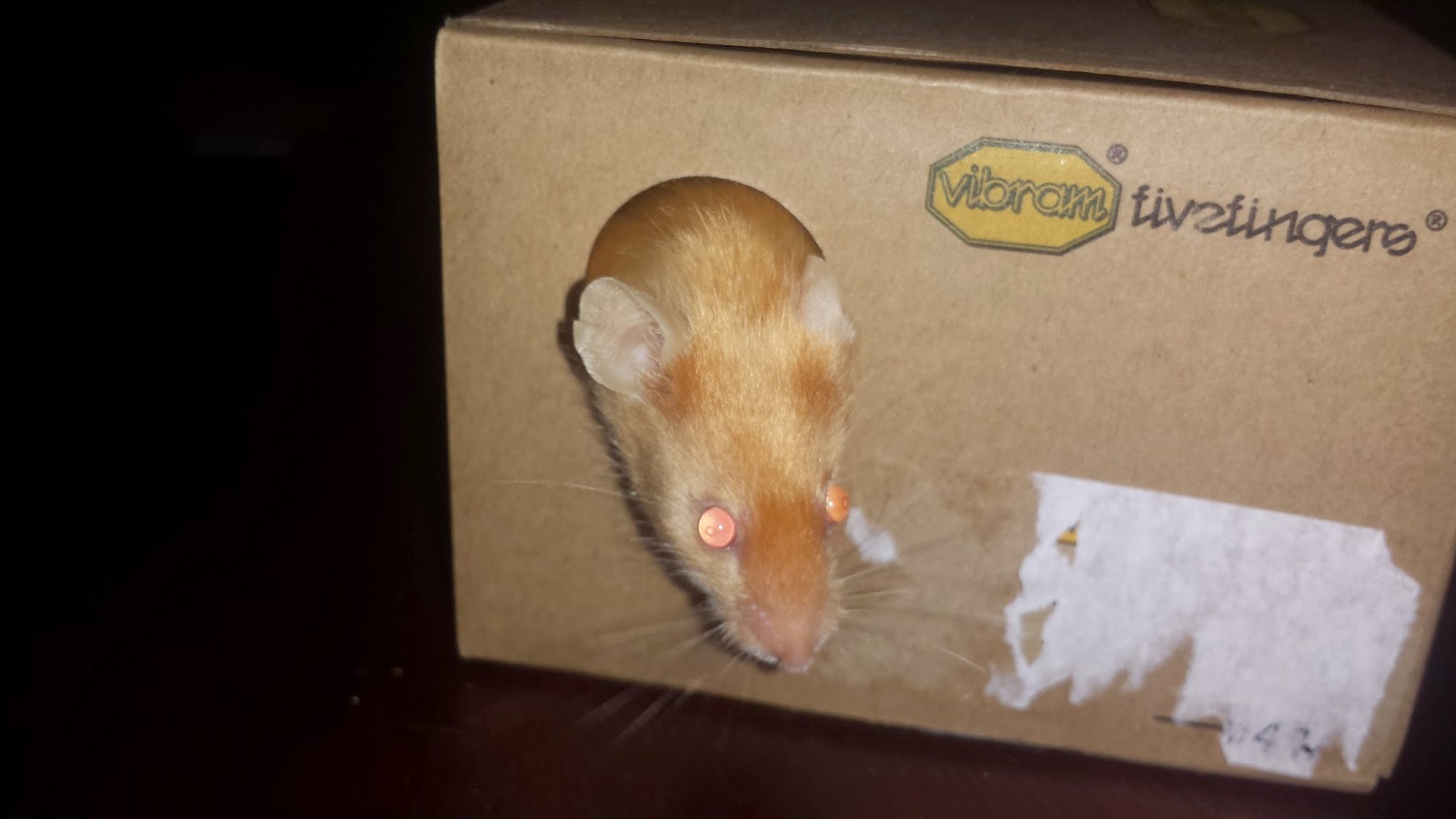
Ginger-root, fawn/dominant yellow/lethal yellow fancy mouse, satin coat, pink eye dilute.

Because of some confusion, I'm not going to make these completely wordless. 

Friday, August 22, 2014

Ebon's First BarkBox!


My mother was kind enough to gift Ebon with a six month subscription to BarkBox and the first one arrived today! I quite like the idea, but haven't been able to subscribe. The greyhounds are also getting a box. So, what came this month?


This is how my silly boy plays

Loopies Floppy Fishbone

Company link: here Note: this toy is not currently on their website
The toy is made of polyester and has a single squeaker at one end. The stitching looks durable and it's low on easily chewable bits, which should help it hold up to rougher pups. Though Ebon stopped destroying his toys some time ago, I wonder how it will hold up to Willow, who is not so restrained as of yet. As Ebon is quite fond of squeaky toys, it was an immediate hit. He did his "happy dance" where he rolls around on his back while squeaking the toy like mad. 

Bixbi Daily Essentials Chicken Breast Jerky Treats

Company link: here
Ingredients: Chicken breast, blueberries, cranberries, organic reishi mushrooms, vegetable glycerin
Guaranteed Analysis: 
Crude Protein: 71.89% minimum
Crude Fat: 3% minimum
Crude Fiber: 5% maximum
Moisture: 9.22% maximum

This is the first dog product I've ever found that includes muchrooms, which I find quite interesting. The jerky is slightly soft, breaking very easily into smaller pieces, a trait I generally like as I usually prefer to treat in smaller portions. They do not have a particularly strong smell, being faintly meaty with a hint of mushroom. Ebon was quite excited to try one as he never turns down chicken. 

Healthy Dogma Coconut Barkers

Company link: here
Ingredients: Peas, pea flour, potato, tapioca, coconut, canola oil (preserved with mixed tocopherols), pumpkin, cranberry powder, cinnamon
Guaranteed Analysis: 
Crude Protein: 12.0% minimum
Crude Fat: 5.0% minimum
Crude Fiber: 4.50% maximum
Moisture: 12.0% maximum

These treats are grain free and also meat and other animal product free, which can be a bit unusual for a dog treat. They smell pleasantly of coconut. Like most crunchy treats, they snap easily into smaller pieces. Ebon was quite happy to gobble them up as he is quite fond of crunchy treats. 

Etta Says! Crunchy Duck Chew (12 Inch)

Company link: here
Ingredients: Rawhide, duck feet, natural caramel color, salt
Guaranteed Analysis: 
Crude Protein: 52% minimum
Crude Fat: 20% minimum
Crude Fiber: 4% maximum
Moisture: 10% maximum

I somehow managed to miss getting this in the photograph, but there was one twelve inch chew. The chew smells pretty standard for an animal product chew, a bit smokey and of collagen. It breaks easily into smaller pieces, so if the box is being shared between multiple pups it can be easily split. Ebon has had duck feet before, so I'm sure it will be a big hit. I'm saving it for later. 

Mr. Barksmith's Cool Treats Smoothies for Dogs

Company link: here 
Ingredients: Apple puree, banana puree, water, natural pina colada flavor
Guaranteed Analysis:
Crude Protein: 0.41% minimum
Crude Fat: 0.38% minimum, 0.45% maximum
Crude Fiber: 1.30% maximum
Moisture: 86.80% maximum

I've tried out a frozen treat before and even made some myself. Since Ebon likes to eat ice cubes when we throw some in his bowl in the heat, he definitely enjoys something cold with a little more interest! Ebon likes both banana and apple, and after the coconut treats that came in this box I'm sure he'll enjoy the coconut too. We've been having a heatwave for days now, with the heat index during the day well over 100°F and at night often barely dipping below 90°F. Ebon is going to really appreciate his cool treat as soon as it's finished freezing. 

One happy dog

Tuesday, August 19, 2014

Mismark Case Study: Great Dane Revisit and Expansion

The first mismark case study I ever did was of the great Dane. To a large extent that post was incomplete, so I started from scratch. This took me an embarrassingly long time to put together, but I was determined to finish it before doing anything else.
A group of great Danes, two in standard colors (fawn and mantle) and two in non-standard colors (merle mantle and "true" blue merle aka dilute merle). Image is from Flickr.com under a Creative Commons License
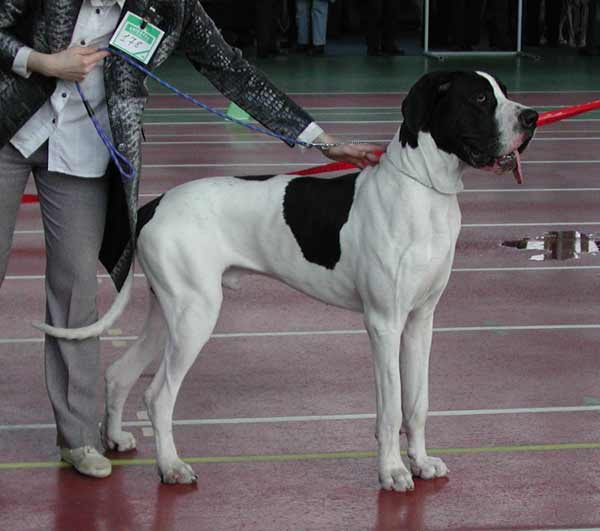
Of all breeds that I have looked at, the great Dane breed color standard makes the least amount of sense. While most will restrict a few colors, often recessives or minor aesthetic differences such as eye color, the Dane standard is much more restrictive. Using only the genes that go into making the six "acceptable" colors (fawn, brindle, black, blue, mantle, and Harlequin), there is a significant list of non-standard colors that could occur simple by breeding between those six standard colors. This has lead to color class breeding. For people who breed show Danes, those color classes are a way of life. What are the color classes? According to the Great Dane Club of America, there are four of them. Breeding between these classes is severely frowned upon and there is potential that it could lead to expulsion from the breed club.

Fawn and Brindle
Breeding of fawns and brindles to other fawns and brindles whose pedigrees are free of black, blue, or Harlequin
Blue
Breeding of blues to other blues or to "blue-bred blacks" whose pedigrees are free of fawn, brindle, or Harlequin. A blue or blue-bred black can also be bred to a black-bred black
Harlequin
Breeding between mantles, Harlequins, and "Harlequin-bred blacks." It is also acceptable to breed a dog from this class to a black-bred black. Any combination is acceptable so long as the pedigrees are free of fawn, brindle, or blue. This includes the pairing of two Harlequins.
Black
"Black-bred blacks" come from generations of exclusively black to black breeding, resulting in pedigrees free of blue, fawn, mantle, brindle, or Harlequin.

Even breeding within these classes does not eliminate mismarks, with more than a few breeders being surprised when, for example, they pair a mantle with a five-generation pedigree fitting the Harlequin class to another mantle of the same designation and produce a blue mantle or fawn mantle. This is not even getting into the flaws with Harlequin in and of itself.

The Mismarks:

This great Dane is a merle mismark, one of the most common seen in the breed.
Bolded are standard colors and green are non-standard colors produced ONLY from genes that go into the standard colors. I've omitted Harlequin + mantle and similar as they can be visually indistinguishable from dogs without.

BlackFawnBrindle
add Irish white MantleFawn mantleBrindle mantle
add dilute BlueBlue fawnBlue brindle
add Irish + dilute Blue mantleBlue fawn mantleBlue brindle mantle
add merle MerleFawn merleBrindle merle
add merle + dilute Blue merleBlue fawn merleBlue brindle merle
add merle + Irish MerlequinFawn merle mantleBrindle merle mantle
add merle + Irish + dilute Blue merlequinBlue fawn merle mantleBlue brindle merle mantle
add merle + Harlequin modifier HarlequinFawnequinBrindlequin
add merle + Harlequin + dilute Blue HarlequinBlue fawnequinBlue brindlequin
add merle + merleDouble merle replaces single merle. Causes an increase in white.
Has a high likelihood of deafness, blindness, and/or eye abnormalities.
add merle + merle + HarlWhite. Most whites have virtually no color.
Has the same health concerns as double merle. 
add liverChocolate acts like dilute, replacing black.
This includes masks on fawns and stripes on brindles
add liver + diluteBlue and chocolate combine to make Silver
Silver replaces chocolate, dilute, or black 
add piebaldPiebald would replace Irish in the above combinations.
Both piebald and extreme white piebald are possible

Tan on this Dane is consistent with a seal
This great Dane has no mask
All of these colors are recognized as existing by the American Kennel Club so, unlike with some breeds, the vast quantity of potential mismarks are well known to exist. Fitting (mostly) within the above chart are subsets that would severely penalize or disqualify an otherwise acceptable color from conformation: bad black (aka seal), improper pigmentation (usually a pink-nosed Harlequin) and white on a blue, black, fawn, or brindle (some is allowed, but not preferred). Although unusual, there have been instances of tan pointed and maskless great Danes as well. Ticking sometimes happens, but, for the AKC at least, there is no mention of whether it would be penalized or not.

So, what causes all of that, anyway? 

As can be seen in the chart above, a very large number of mismarks can occur when only looking at the genes that make the six standard colors.

This puppy is a Brindlequin mismark
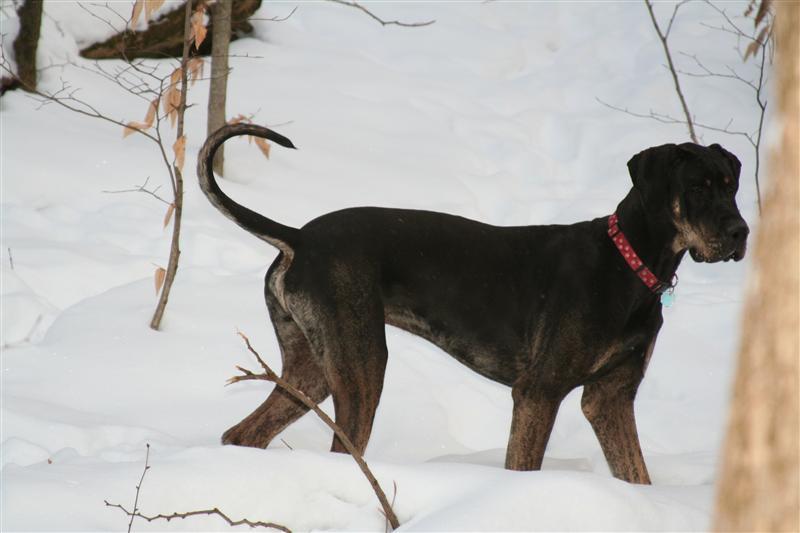
Perhaps the biggest indicator of color in great Danes is the K locus, which codes for black and brindle. Black (K) is most dominant, followed by brindle (kbr), and then non-black/non-brindle (k). Since a black dog only needs one copy of the dominant K gene to be black, it can easily carry either brindle or fawn as Kkbr or Kk, respectively. When the right two dogs come together, a litter that was expected to be all standard black mantles could throw something unexpected. When homozygous for the non-black/brindle allele (kk), the agouti locus will show through unobstructed. For most Danes, this will make them fawn, but this would also be why the tan pointed or even brindle pointed Dane appears. In the case of brindle points, the agouti locus is still peaking through, but it is obscured by the brindle overlay.

Referring back to the chart, it's quite clear that most of the standard Dane colors are black-based. Black, mantle, and Harlequin all have obvious black on them, while blues are genetically dominant black with the extra quality of also being diluted. Due to the black base of all of these colors, if a dog inherits a gene combo that does NOT code for black (kbrkbr, kbrk, or kk) then it would have either brindle or fawn instead of black. This includes Harlequins (turned to brindlequin or fawnequin) and mantles (turned to brindle mantle/brantle or fawn mantle/fawntle).
This dog is a heavily marked blue Harlequin

Blue/dilute is a simple recessive gene inherited on the D locus, with the dog having to receive two copies (dd) for it to show. Dilute affects all black in a dog's coat, turning it to some shade of gray. This includes masks and stripes in brindles. Even if trying to only breed the dominant variant of a gene, there is no guarantee that the recessive form will disappear. This is why diluted variants such as blue Harlequin (aka porcelain) continue to pop up from parents whose pedigrees may have not seen a blue for decades.
This Dane is a fawn mantle mismark

The A (agouti) locus is probably the most varied locus in the dog world, but in great Danes there appears to be only two variations, with the breed being nearly fixed for one of them. Being fixed for a gene means that no other genetic variants are seen at that locus. Sable (Ay), which causes Fawn, is the most dominant of the agouti variants and tan point (at) one of the recessive variants. Considering the low incidence of tan point, great Danes can, for the most part, be treated as if they were fixed for sable due to there not being many tan point carriers.

Fawn and brindle great Danes are also known for having black masks. This is inherited independently on the E locus, aka the extension locus. The most dominant of the extension genes is, indeed, the mask gene (Em). Considering that maskless Danes do exist, some other variation has to exist, but it can be difficult to tell whether that would be recessive red (e, which strips away all black in a coat, leaving it entirely red) or the "null" allele of non-masked, non-everything-else (E). There is some evidence for both but, like with the agouti locus, the breed appears to be near fixed for one allele. In this case, that's the mask gene.

This dog is a dark blue mantle mismark
Mantle comes from recessives on the S (spotting) locus. White spotting varies significantly from virtually no white to virtually all white. Blue, black, fawn, and brindle Danes must have at least one copy of the solid (S) allele. If carrying Irish white (si), piebald (sp), or extreme white piebald (sw) a dog will likely have at least a small amount of white due to the semi-dominant nature of the spotting genes. This is usually on the chest and/or toes, but may also lead to a white tail tip or some facial white. A dog with white, however, does not necessarily carry any of the recessive variants. Residual white is quite common in genetically solid (SS) dogs due to how color migrates during very early development. It essentially spreads from the spine to the extremities in the womb, so if the color doesn't spread all the way, a dog will be born with some amount of white. As with many breeds some white is allowed on otherwise solid Danes, but too much is penalized.

This great Dane is a piebald merle
To be mantle, a dog's phenotype must have more white than what is possible from a homozygous solid dog. The white required by the breed standard is essentially Irish white, a pattern most people associate with breeds such as the border collie. This appearance can come from several variations of the spotting locus. As expected, a dog can be homozygous for the Irish white variant (sisi), but a dog carrying piebald (sisp) will look similar, though possibly with a little more white. Since the standard allows white to break the main body of the dog, some Danes who fit the standard appear to be minimal piebalds (spsp).  In addition, pseudo Irish white, caused by either a solid carrying extreme white (Ssw) or what would have been a low-white Irish carrying extreme white (sisw), will look like a homozygous Irish dog.

I've met a dog much like this extreme white Dane
Due to the vast amount of variation in the potential genotypes that would lead to the acceptable mantle phenotype, it isn't surprising that piebalds and extreme white piebalds are known to pop up in the breed. As extreme white is more common, it's likely there are a lot of pseudo Irish dogs out there.

In addition to the vast quantity of potential for mismarks seen above, there is the illogicality of the nature of breeding for Harlequins. Harlequin can, by its nature, NEVER breed true. It is a color caused by a very specific combination of two problematic genes. One of them is merle (M), which is well known to cause serious issues when a dog inherits a double dose of the gene. Harlequin (H) is, in some ways, worse than merle. While double merles are generally viable despite the high incidence of deafness and/or blindness, double Harlequins are lethal in utero. Since no living dog can be homozygous for Harlequin, this explains why merle dogs are to be expected in every litter with at least one Harlequin parent. The worst part of Harlequins, however, is that breeding a Harlequin to another Harlequin is perfectly acceptable under color class breeding. This is a serious problem.

Here is a Punnet square for a Harlequin/Harlequin cross:
HMHmhMhm
HM
HHMM
double double
lethal!

HHMm
double Harlequin merle
lethal!

HhMM
double merle Harlequin
possibly deaf/blind

HhMm
Harlequin
Hm
HHMm
double Harlequin merle
lethal!

HHmm
double Harlequin
lethal!

HhMm
Harlequin

Hhmm
black or mantle
carrying Harlequin
hM
HhMM
double merle Harlequin
possibly deaf/blind

HhMm
Harlequin

hhMM
double merle
possibly deaf/blind

hhMm
merle or merle mantle
hm
HhMm
Harlequin

Hhmm
black or mantle
carrying Harlequin

hhMm
merle or merle mantle

hhmm
black or mantle

This white Dane is deaf.
When crossing two Harlequins together, the assumption is that the breeder wishes to produce more Harlequins. Considering this, a 25% chance of a Harlequin is pretty bad when the price to pay is the likelihood one-in-four of the puppies will never even have a chance to live and another 18.75% of embryos have a very high chance of being blind and/or deaf. That's almost half the litter! Some breeders cull double merles, but this is a shameful practice, sweeping poor decisions under the rug in the form of dead puppies. The alternative, however, isn't exactly wonderful. Due to their sheer size, only so many people are willing to adopt a great Dane. When that size comes with impaired senses, the number of available homes plummets. A dog that is deaf and/or blind is significantly more difficult to train than a dog with full use of its senses, and a huge, poorly trained dog can be very difficult to deal with. I once met a deaf great Dane at my local dog park who would not stop humping my Labrador. My poor dog barked at him in frustration, but, being deaf, the dog had no awareness of such social cues. If my dog wasn't so even-tempered the Dane could have easily been injured due to his poor social skills. Since the Dane's owner wasn't leaving, I understandably removed my dog from the situation.

Many assume that white great Danes are albinos, but their lack of pigment is caused by a very different set of circumstances. As breeding from a merle is not acceptable in color class breeding, whites come from Harl/Harl crosses like the one above and, as they are double merles, they have a high risk of sensory issues. Some may be very lightly marked Harlequins, but this is unlikely. I have also seen at least one dog that appears to be an extreme white piebald Harlequin, but this is also not the most likely phenotype. What patches you do see on white great Danes will usually be solid black, but just as fawn mantle and blue Harlequin can occur, you can also get double merle Harlequins of a different color as well.

In contrast to the Harl/Harl cross, here's a Punnet for a Harlequin/black cross where the black does not carry the Harlequin modifier:

HMHmhMhm
hmHhMm
Harlequin

Hhmm
black or mantle
carrying Harlequin

hhMm
merle or merle mantle

hhmm
black or mantle

This cross has the same 25% chance of producing a harlequin, but there is a 0% chance of color-related non-viable embryos and a 0% chance of double merles, so the breeder will not have to find homes for deaf and/or blind dogs. There will still be merles, but since the Harlequin modifier is lethal in a double dose, this is an inevitable consequence of Harlequins.

This great Dane is a merle mantle mismark
Since merle is never going away, the absurdity of making it a disqualification is rather remarkable. In most breeds, colors that pop up with the high frequency of merles in great Danes are generally accepted by the standard. In addition, why does the Great Dane Club of America allow Harlequin/Harlequin cross when crossing a merle with a black that's been tested positive as a carrier for the Harlequin modifier is frowned upon? Both have the potential to produce Harlequins, but the merle cross, like breeding a Harlequin to a non-carrier black, doesn't have the issues that a Harlequin/Harlequin cross does. Mantle became an accepted breed color because of Harlequin breeding. I don't see why merle shouldn't be treated the same way.

This puppy is a chocolate fawn
This portrait is believed to include a Dane
The last color determinant I have not discussed is the B locus. Brown/liver acts much like the blue dilution. It's a simple recessive (so all dogs expressing it are bb) that turns any black in the dog's coat from black to some shade of brown. Like dilute, any dog with black can have liver coloration instead. In great Danes, liver is known as chocolate. It can also act in combination with blue, diluting down to Isabella (also known by names such as silver, gray, ash, pearl, lilac, and fawn). Weimeraners are well known for their Isabella color. In great Danes, it appears that Isabella is known as either silver, lilac, or dilute chocolate. There is some evidence that chocolate was once an acceptable color in the breed that since fell out of favor, and the seventeenth century portrait at right is interesting in relation to this possibility. If the dog is in fact a very early great Dane or Dane relative, it isn't any color that would be found in a modern show ring. It appears to be an Isabella mantle.

Conclussions

Of all the breeds I have looked at, the great Dane is most problematic in terms of its color standard. It's one thing for a breed to have a number of recessive colors that show up on occasion, but on top of that Danes have mismarks that are guaranteed to occur when breeding one of its six acceptable colors. Also problematic are the color classes, which essentially create breeds within breeds. All purebreds have limited gene pools due to closed registries. Color classes take that genetic variation and limit it again. Since closed registries prevent any new genetic variation from being added, what there is cannot be replaced once it's gone. Genetc variation is essential to a healthy animal, allowing their immune system to function effectively. The less variation, the less functional the immune system.

With the limited variation that comes with closed registries, selective breeding is like taking a weed-wacker to a spindly bush. It can only take so much before there isn't enough of it left to survive. That is essentially what is occurring in modern dog breeds, where effective populations sizes are worse than what is considered at risk of immediate extinction in endangered species. Since the great Dane has such major restrictions in color acceptance, there is a massive amount of potential for loss in genetic variation that could have otherwise been saved.

Images in this post are from Flickr.com or Wikimedia Commons with the exception of the heads used in the Punnett squares, which were created by me. Everything is under a Creative Commons license and source links can be found beneath each image.