|
| Ebon, showing some of the brown that can be seen on his legs |
For the longest time I thought nobody else noticed the fact that Ebon has distinct rusty markings on his legs. Then, this past November I came home from the vet and found this on Ebon's shot records:
Color: Black
and Brown. The vet did once list him as Black, but some time during the many years they've been caring for him it was changed. I apparently wasn't the only one to notice.
 |
| Ebon at 21 months, Hellon at 8 years. Click to view larger |
Recently I also found out that Ebon's mother, Hellon, apparently had red markings on her legs as well. I honestly never looked close enough to tell. I hunted through the pictures that I can find of her and yes, in the pictures to the right you can see what appears to be some hints of lighter color on her front legs. Considering that none of the pictures I can find are of her in bright sunlight, and many are from more recent years when her legs had heavy greying, this is probably the best I'm going to be able to find.
So, this is my conundrum. What exactly
is Ebon? In my Guess the Genotype posts I try to take a stab at determining the likely genotypes of dogs who sometimes have some very unusual markings. I would place Ebon into the somewhat unusual category. Mismark Labrador retrievers happen. Some of them are
quite striking. Dogs with tan points, with or without brindle, have been popping up in purebred litters for many, many years. It does seem that, to some extent, this mismark is more common in working lines since there is generally little to no real concern over what the dog looks like, as long as it can retrieve. However, usually the mismarks that are seen are far more obvious than what is seen on Ebon or his mother. Why in the world are their markings so subtle?
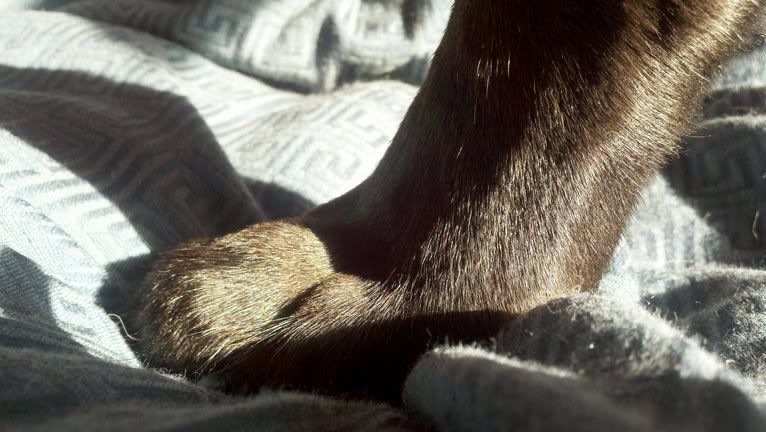 |
| Ebon's left forepaw in bright sunlight, the most red it ever appears |
I
have broken down Ebon's markings before, and theorized that he might be a "bad black" over black and tan. Bad black, aka seal, has been shown to be genetically dominant black when tested, seen in a
study on Italian greyhounds. However, unlike normal dominant black, some of the underlying Agouti locus is able to show through. In most breeds where seal is a known color, tan point and other recessive alleles on the Agouti locus are either rare or completely absent. The Italian greyhound is one such breed, with tan point being nearly absent from the population. This could explain why seals usually have red that is
patterned much like a
shaded sable. Ebon, on the other hand, has red in an almost identical pattern to dogs who are tan point, such as Rottweilers and Doberman pinschers. Labrador retrievers are quite possibly fixed or near fixed for the tan point gene. The mismarks that are seen are never sable or the like, but tan point pops up on a fairly regular bases. If Ebon were bad black, he would have to be bad black covering tan point, otherwise the "bad black theory" would not work.
However, this is not the only possible explanation for Ebon's rusty legs. There are, in fact, two more.
The first is that he's a very minimal black and tan. Though highly unusual, there are dogs that occasionally pop up in breeds that are normally tan pointed that appear to have little to no red on them. This seems to be somewhat prominent in Rottweilers, as some people seem to prefer the low amount of tan. If you do a little hunting around the Internet, it isn't that difficult to come across
dogs with almost no tan at all. The same is true for Dobermans, though the dogs with less tan usually have more than the near-black Rotties. However, this is
not always the case. There are some dogs that seem to have absolutely no tan at all, but those dogs usually appear to not be purebreds. The "all black Rotties" usually look like Labrador or molosser mixes and the "all black Dobes" usually look like they have some great Dane or greyhound in them. The fact of the matter is, dogs who are simply black and tan never have as little red as Ebon does. There has to be something else at work.
 |
| You can draw a line between the solid black and the red-laced |
The final theory is that he's a black and tan with heavy brindle. When I first discovered his red markings, this was my thought. However, I was hesitant to say this was the case because I couldn't see any distinctive stripes on his legs. Despite this initial thought, the more I stare at his legs the more I start to think that he does indeed have stripes. For one thing, brindle is a highly variable pattern, with the stripes so randomly placed that a dog can have lots of stripes on one side of their body and virtually none on the other. Ebon's legs don't match, and the color is not consistent. His right foreleg has more red than his left, including a quarter-sized patch near his wrist that has more red than the surrounding area. Black and brindle is a
known mismark in Labradors, with nearly as many black and brindle dogs popping up as black and tan dogs. This, combined with the mask gene to explain why he has virtually no red on his face, could very well be the truth behind Ebon's rusty legs.
So, all in all, I find the black and brindle theory to be the most plausible. Black and tan doesn't fit very well at all and the bad black theory is based on a variant that may not even be present in the Labrador breed. Much of the reason why I went with the bad black theory is his Guess the Genotype post was purely for the sake of argument. It is still possible that Ebon's coloring could be explained this way, but black and brindle is more likely. I only wish I could afford to test him to abate my curiosity.