Showing posts with label crazy plants. Show all posts

Saturday, September 8, 2012

Crazy Plants: Bracatinga

The bright yellow flowers of a bracatinga (Mimosa scabrella)
This fairly sizable plant is a relative of the far smaller sensitive plant, which responds to touch, making it an interesting plant for kids. The two species are in the same genus, though they look quite different. The bracatinga also appears to lack the characteristic movement of its cousin. Like just about every species in the genus Mimosa, the complex flowers look rather like puffballs. While many in the genus have pink or purplish flowers, the bracatinga has whitish to yellow flowers. The tree can grow to fifteen meters tall, sometimes more, and up fifty centimeters in diameter. A height of five meters can be reached in a little over a year. The plant can handle fairly acidic soil, but doesn't like too much water. Its leaves are nitrogen rich, and their decomposition after falling can be very good for the soil.

The bracatinga was a very important source of wood for the Brazilian railroads. Due to this use, and its rapid growth, the species is often planted as a source of fuel. It is also used as a shade tree and for ornamentation. It has also be used for making paper, fence posts, and, interestingly enough, as a food source for goats. The flowers can also be used for honey production.

Sources are Purdue University, Winrock International, World Agroforestry Centre, Encyclo, and Erika Styger, PhD. Image is from Wikimedia Commons under a Creative Commons license.

Sunday, July 8, 2012

Crazy Plants: White Baneberry

The white baneberry (Actaea pachypoda) is also known as the doll's eye
Ripening berries
The white baneberry is a plant found throughout the Eastern United States and Canada, extending out to Nebraska and Oklahoma at its most western range. In addition, its range extends from Florida all the way north to Quebec. They are also found in parts of Europe. The most unusual feature of this plant is perhaps the appearance of its fruit. When ripe, they resemble eyes, which is why one of the other common names of the white baneberry is the doll's eye. The berries are red when not fully ripe and sometimes will remain red even after ripening. To make things more confusing, the species is quite similar in appearance to the red baneberry, which, despite its name, can have white berries. The most effective way of telling them apart is based on stalk diameter. Red baneberry plants will have thinner stalks than the white baneberry.

As I was taught as a child: never ever eat white berries as they are almost invariably toxic. This rule holds true for the white baneberry, where eating as few as five of the fruits will make you very ill and eating more than that can potentially kill you. Though tea was once made from the plant's roots as a folk remedy, every part of this plant is toxic and thus should be avoided. Symptoms following ingestion include a burning sensation in the throat and mouth, headache, dizziness, salivation, hallucinations, stomach cramps, and diarrhea.

Flowers
As the plants grow in average soil and low light, they are adapted to best make use of what they have, and thus have abnormally large roots to absorb as many nutrients as possible. The flowers of the baneberry plant are rather pretty white clusters and are seen in May and June. Fruit production follows, beginning in July. Though toxic to humans, the berries are dispersed by animals that can tolerate the fruits: mainly rodents and birds.

This plant is currently listed as Threatened in New York and Endangered in Florida. It is common in many other areas of its native range.

Sources are the United States Department of Agriculture, University of Texas at Austin Ladybird Johnson Wildflower Center, Ontario Wildflowers, and Skidmore College North Woods Wiki. Images are from Wikimedia Commons under Creative Commons licenses: one, two, three.

Monday, June 25, 2012

Crazy Plants: Blue Agave

A blue agave plant (Agave tequilana) in Mexico
L. nivalis
Blue agave is a succulent plant native to Mexico whose common name comes from the blueish tint that can been seen in the leaves. The plant's reproduction is the same as other members of the Agave genus, after maturing at five to eight years. the plant sends up a long stalk that sprouts flowers at the top. These flowers are pollinated by the native Mexican long-nosed bat (Leptonycteris nivalis). A single plant is capable to producing thousands of seeds.

Despite some other interesting aspects to the plant, what is perhaps its best-known characteristics is the aguamiel (aka "honey water") found in the plant's core. This liquid substance is very sweet and has been used for years in the plant's native range for folk remedies. When processed, the aguamiel is turned into agave nectar, which has lately been touted for its supposed health benefits. Despite claims that the syrupy sweetener is healthier than other forms of sugar and friendlier to diabetics, there isn't much evidence that agave nectar has any health advantages. Though blue agave appears to be one of the main sources of agave nectar, other agave species are also used.

A core harvested for tequila making
Though agave nectar has received much press lately, it is far better known in its fermented form: tequila. That's right: blue agave is also known as the tequila agave or tequila plant as its aguamiel is used to produce the distilled beverage. Though other agave species can be used for production of agave nectar, only blue agave can legally be used for tequila making. Production is very labor intensive, requiring many steps to get from the plant to a bottle of alcohol. Those who choose to imbibe in tequila either in straight or mixed form shouldn't be left unaware of how much effort goes into that drink.

It's also true that without pollination by the long-nosed bat, there would be no new generations of blue agave to make into tequila. So, thank bats and thank the workers the next time you drink a little tequila. I, personally, cannot stand the stuff.

Sources are the University of Connecticut, Dave's Garden, Botanical Journeys Plant Guides, WebMD, USDA, and ITIS. Images are from Wikimedia Commons and are under Creative Commons licenses or copyright free: one, two, three.

Tuesday, June 5, 2012

Crazy Plants: Coulter pine

The Coulter pine (Pinus coulteri) is also known as the bigcone pine and pitch pine
A "widow maker"
The Coulter pine is infamous for having the heaviest pine cones in the world. They're so heavy, up to ten pounds, that it's extremely dangerous to be hit in the head by one. Because of this, the cones have been appropriately nicknamed "widow makers." Apparently, loggers were the source of the name as several have died after being hit in the head by these massive pine cones. The needles on this pine are actually frequently shorter than its cones, with the needles being about nine inches and the cones up to about fourteen inches in length. The tree itself is large, with the tallest ever recorded coming in at one hundred sixteen feet.

The distribution of these trees is restricted to California and parts of the Baja Peninsula. It favors drier areas such as the chaparral. The tree is not a favorite for use as wood, as it's weak and brittle.


Sources are Stanford University, United States Department of Agriculture, US Forest Service, The Gymnosperm Database, the Pine Cone Festival. Images are from Wikimedia Commons under Creative Commons licenses: one, two.

Tuesday, May 29, 2012

Crazy Plants: Eelgrass

Eelgrass (Zostera marina) at low tide
Submerged eelgrass
If you saw this plant, you might assume that it's a seaweed or other algae. However, that's far from the case. It's actually a flowering plant! Eelgrass is one of a number of marine flowering plant species that thrive while fully submerged under water. Its distribution includes just about every shallow water marine area in the Norther Hemisphere. They reproduce by having male flowers release pollen into the surrounding water, which will then float on the current to nearby female flowers. After seeds develop, the pods break off of the plant and float to the surface so that the seeds can be distributed far away from the parent plants.

Closeup of eelgrass blades
Eelgrass and other marine plants are amazingly ecologically significant, providing habitats and food sources for all sorts of living things. If you look closely at a single blade of the grass, it will frequently have a frosted look that's caused by the sheer amount of life that is living on the plant. The tiny organisms can include bacteria, algae, and invertebrates. It can get to the point where this coating of stuff can actually cause the blade to die off due to a lack of sunlight. Countless species on animal feed on the grass, and beds also act as hiding places for these and other species. Eelgrass beds also act as nurseries, with species such as herring laying their eggs in the beds.

Unfortunately, eelgrass and other seagrass beds are at risk due to a number of factors. Boat propellers and dredging operations will destroy beds directly. In contrast, runoff from land can lead to increased turbidity that can shade out beds. Also, this runoff can bring excess nutrients and lead to heavy algae growth, which will also shade out beds. The damaging and loss of beds had led to decreases in fish populations, though the exact amount of loss can't really be determined. Though these concerns do exist and eelgrass populations are decreasing, they are still considered to be of Least Concern by the IUCN.

Sources are the Maryland Department of Natural Resources, University of Delaware, Washington State Department of Ecology, and IUCN Red List. Images are from Wikimedia Commons and are under Creative Commons licenses or are copyright free: one, two, three.

Saturday, May 19, 2012

Crazy Plants: Rafflesia

The flower of Rafflesia arnoldii
The genus Rafflesia contains some quite unusual species found in Asian forests. They are parasites, and are missing many of the parts that are so recognizable as making a plant a plant. They can't photosynthesize, and lack roots, leaves, and stems! In fact, their filamentous body tissue more closely resembles a fungus. Despite these traits, one prominent structure makes it very obvious that they are plants: the flowers. These flowers are quite remarkable in that they are the largest single flowers in the world. There are even larger structures that are made up of a group of flowers, but Rafflesia arnoldii, also known as the corpse flower, holds the record for largest single flower, up to three feet in diameter and weighing up to a whopping fifteen pounds. The flower is pollinated by carrion flies (which eat rotten meat) and to attract them the flower is the color of meat and smells of rotting flesh. Since the plants are only intermittently distributed throughout the forest, there is concern over whether the flower will be pollinated. The flower is only around for five to seven days and the size and stench helps make it more likely that pollination will occur.

Here's a video of this amazing flower narrated by David Attenborough (begins at 0:30):


Sources are the Library of Congress, Southern Illinois University, Western Michigan University, and Yale Peabody Museum of Natural History. Image is from Wikimedia Commons under a Creative Commons license.

Thursday, May 10, 2012

Crazy Plants: Wild Cabbage

Wild cabbage (Brassica oleracea, also Brassica oleracea var. oleracea) in bloom
Wild cabbage is a rather unassuming plant, but you probably are quite familiar with a number of its cultivars. Cultivars are domesticated plants that have been selected for specific characteristics. Most often, the differences between the cultivars of a certain species are fairly minor. This can be seen in the apple, which has quite a list of cultivars that vary in taste, color, size and texture but still remain very obviously an apple. This is not true of the wild cabbage. The species has been selected for emphasis on a wide variety of different traits. This is why the cultivars have ended up looking so different from each other.

Selection for large leaves
 B. oleracea var. acephala
Kale. This cultivar varies in color and also includes spring and collard greens, such as the plant shown. Leaf growth spreads outward rather than balling up as in cabbage. There are even decorative forms.
B. oleracea var. capitata
Cabbage. This cultivar varies in color and leaf texture, but always has this tight central ball

Selection for many flowers
B. oleracea var. italica
Broccoli. Though it may not look like it, those tiny green specks that make up a head of broccoli are flowers
 B. oleracea var. botrytis

Cauliflower, also made of many tiny flowers. Color of these flowers varies


Selection for emphasized lateral stem buds
 B. oleracea var. gemmifera
Brussels sprouts. The plant stalk holds many tiny cabbages that form perpendicular to the stem

Selection for a swollen stem
B. oleracea var. gongylodes
Kohlrabi, also called German turnip is not as commonly known. It also varies in color
Other cultivars: B. oleracea var. alboglabra (Chinese broccoli), costata (tronchuda cabbage), medullosa (marrow-stem kale), palmifolia (palm cabbage), sabauda (Savoy cabbage), sabellica (curly kale), others.

Sources are The Nerdy Gardener, Plants for a Future, Carleton College, Carleton College again, GeoChemBio, University of Florida, and Evolutionary Analysis. Images are from Wikimedia Commons under Creative Commons licenses: one, two, three, four, five, six, seven.

Tuesday, April 24, 2012

Crazy Plants: Pineapple

A pineapple (Ananas comosus) that isn't fully ripe.
A flowering pineapple
The pineapple is a commonly eaten fruit, but few people have actually seen the plant from which that edible fruit comes. This is likely in part due to the fact that most pineapple eaten in developed countries is eaten in the canned form. For example, did you know that before becoming that fruit, a pineapple is a series of red flowers in need of pollination? This is thanks to the fact that pineapple the fruit is actual not a sinlge fruit, but a compound fruit made of a number of smaller fruits. Each flower on the inflorescence will become only a small section of the fully ripened pineapple of which we are so familiar. You can see where each flower was when looking at the compound fruit, as each of the honey comb-like sections on the exterior of the fruit represents what was once a flower. When cutting up a whole pineapple, you can also see the flower remnants in the form of withered stamens near the rind.

The pineapple is also worth note thanks to how it photosynthesizes. It uses a fairly unusual method known as Crassulacean Acid Metabolism or CAM. Plants that use this form of metabolism are best adapted for areas that can be rather dry. Instead of opening their stomate during the day to gather carbon dioxide, CAM plants open them during the night when less water vapor will evaporate. Carbon dioxide is then stored as an acid and used for photosynthesis during the day when stomata are closed. This form of photosynthesis is nor particularly efficient under moist, cool conditions, but when it's arid, nothing can beat a CAM plant. CAM plants don't include a great number of species compared to C3 plants (i.e. most plant species), but groups that photosynthesize this way include some of the bromeliads and orchids, as well as many succulents. CAM plants are not very well studied, and there's even the International Society of Crassulacean Acid Metabolism that is working on bettering our understanding the process.

A field of pineapple plants
In addition to its use as a food, pineapple has also been used as a folk remedy for a wide variety of illnesses. These include such varied problems as corns and warts to soars, scarlet fever, scurvy, sprains, bladder problems, and even venereal diseases. By the way, unripened pineapple is actually toxic. Those harvesting pineapple can become injured thanks to the methods of harvesting and a chemical known as bromelain. A secondary infection following injury has been termed pineapple estate pyosis. This toxicity is also part of why the fruit was so heavily used as a folk remedy, since the toxins act as a violent purgative. So, be sure to eat your pineapple when it's fully ripe.

If you have not yet had fresh pineapple, it's a real treat that's much better than canned. Just beware to eat it ripe and don't eat the core or rind.

Sources are Purdue University, Pima Community College, Purdue University again, International Society of Crassulacean Acid Metabolism, Newcastle University, and University of Nebraska-Lincoln. Images are from Wikimedia Commons under Creative Commons licenses: one, two, three.

Thursday, April 5, 2012

Crazy Plants: Baobab

One of several species of baobab, Adansonia grandidieri. 
The Australian A. gibbosa
The genus Adansonia is a fascinating group that is commonly known by the common name name baobab. These trees have a very unique appearance. There are eight species total, with the majority being found exclusively on Madagascar. One of the species is found on the African continent and parts of the Arabian Peninsula and the last is found in parts of Australia. Of the six species currently listed on the IUCN Red List of Endangered Species, three are endangered (including A. grandidieri) and the other three are near threatened. The two species of baobab that are missing from the Red List happen to be the ones that are found away from Madagascar.

The fruit of the African A. digitata
A. grandidieri is the largest of the species, and, thanks in part to its great height of up to twenty-five meters, possibly the oddest in appearance. The trunk itself can be three meters in diameter. The species prefers dry area, and a major risk is encroaching farmland. In fact, now one of the most common places to find the tree is on land that is used for agriculture. Its flowers supposedly smell rather like watermelon that is sour. A major pollinator of the plant is one of the many species of lemur that are found on Madagascar. It's believed that the species of animal that acted as a disperser of this plant's seeds has gone extinct as no disperser has been witnessed beyond possible water dispersal. This is possibly another risk to the species' survival. What's most likely not much of a threat is the fact that these trees are used as a source of food and materials. Pulp and seeds are eaten and used for oil, with collectors hammering pegs into the trees to make them easier to climb. Scars at the base of the trunk is evidence of bark being collected to make rope. The wood of the tree is used for thatch. All of the collection methods used do not severely damage or kill the trees, and thus probably do not have much affect on survival.

The flower of another Madagascar species: A. rubrostipa
Sources are the IUCN Red List, ARKive, and University of Queensland. Images are from Wikimedia Commons under Creative Commons licenses: one, two, three, four.

Saturday, March 31, 2012

Crazy Plants: Gnetum

One species that is to be found in the genus Gnetum.
Gnetum is the genus with the most species in the Phylum Genotophyta. The phylum also includes such strange plants as Ephedra and Welwitschia. All are strange species that don't really fit into any other grouping. Though this plant is fairly obscure, where it does occur (parts of South America and Asia) it's sometimes cultivated for food. The seeds and young leaves are eaten. Fiber will also be made from the bark. The gum that comes form a species in Brazil is used to treat injuries such as muscle or tendon tears and supposedly reduces swelling. It is also used to treat headaches and those who are thin, weak, and not eating.

Gnetum seeds
They prefer soils that are neutral or slightly acidic. Thought the ground needs to be well-drained, a lot of nutrients are not necessary. The majority of the species are woody vines. The seeds the plants produced are usually rather bright shades of red, yellow, or orange and also usually fleshy. They resemble drupes such as cherries. It appears these species are not very well studied. What species exist today are remnants of a time when the Gentums were more common. amazingly, these plants are known to exchange genetic information with flowering plants such as petunias. How this is done isn't know, but there is likely some sort of vector involved.

Sources are University of Connecticut, Discover Life, and the Gymnosperm Database.  Images are from Wikimedia Commons under Creative Commons licenses: one, two.

Wednesday, March 14, 2012

Crazy Plant: Ephedra

This plant is rather small, but Epherdra species can be quite sizable. These plants are also sometimes called mormon tea
Species in the Ephedra genus are some of the strange plants that have been placed into the Phylum Gentophyta. The Gnetophytes are vascular plants that appear to represent a stepping stone between the gymnosperms and angiosperms, with many characteristics supporting this conclusion. For example, double fertilization occurs but instead of the second egg developing into the endosperm that will provide food to the seedling, it simply dies off. I have mentioned another of the Gentophytes before: Welwitschia.

Unlike most plants, photosynthesis in Ephedra species happens almost exclusively in the stems. This is because the plant is basically all stem, with only tiny leaves between branch segments. This body structure is very reminiscent of certain horsetails, thought there are also quite a number of differences between them. That's why horsetails are in the completely separate Phylum Sphenophyta.

Fleshy female Ephedra cones
The fact that these plants produce something that looks rather a lot like a fruit would make an outside observer more than a bit skeptical about their placement in the plant world. However, thought the structures look like fruits, they are not. They are actually fleshy female cones. Though the general concept of "cone" is often restricted to things resembling pine cones, cones can come in a variety of types. Fleshy cones are far from unknown in the plant world and occur in such species as the junipers, yews, and the ginkgo.

In the United States, Ephedra species are found in dry the southwest, including such states as New Mexico and California. Two chemicals can be isolated from these plants: ephedrine and pseudoephedrine. Once a common component of weight loss supplements, ephedrine has been banned from supplements in the United States since 2004. This is due to side effects that were seen in people taking these products, including psychiatric issues, heart palpitations, nausea and vomiting. It's also believed that the chemical can be linked with far more serious issues, Pseudoephedrine is used as a decongestant and isn't as dangerous.


Sources are McDaniel College, United States Department of Agriculture, and National Institutes of Health. Images are from Wikimedia Commons under Creative Commons licenses: one, two.

Tuesday, February 28, 2012

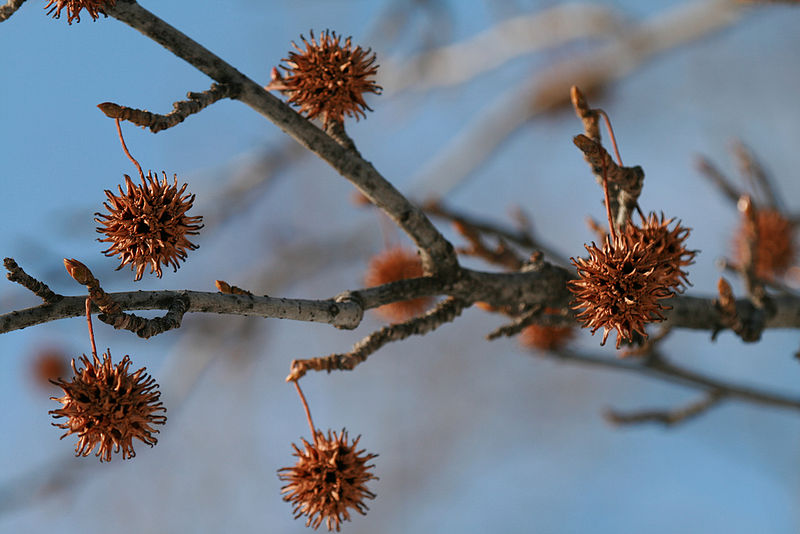
Crazy Plants: Sweetgum

A sweetgum (Liquidambar styraciflua), also known as sapgum, bilsted, redgum, and starleaf-gum.
Sweetgum fruits
This plant can make life a bit difficult thanks to its large, bur-like fruits. The leaves are sizable and star-shaped, being deep green that turns to red, purple, or even yellow in autumn. The tree is a commonly seen pioneer plant, being one of the first to begin growing after an area has been cleared of trees. The up to fifty-six seeds that are contained within the strange fruits are eaten by a variety of animals, including birds and squirrels. It is commonly found in combination with such other trees as pines and oaks, often competing for space. The roots are rather shallow, which can be a problem in certain situations.

The sweetgum's range
The native range of this species is rather far-reaching, covering the majority of the southern United States and north into Connecticut and Illinois. There are also pockets found is such places as Mexico and Guatamala. It is a commonly used hardwood in the South, partly because it grows so well in the acidic soils found there. The wood is attractive, and as such it is a commonly-used veneer. The "gum" part of the tree's common name comes from one of its former uses. The rather solid resin that can be found within the tree would be cut out and made into chewing gum. Today, the main use of the tree is as an ornamental since the leaves are rather attractive, and also sometimes as a shade tree. They are rather easy to grow, which is an advantage for landscaping. Unfortunately, those spiky fruits tend to fall in mass, making a mess than needs to be raked. I know from experience that they are quite painful to step on.


Sources are University of Florida, Perdue University, University of Connecticut, and the USDA Forest Service. Images are from Wikimedia Commons under Creative Commons licenses: one, two, three.

Wednesday, February 8, 2012

Crazy Plants: Spanish Moss

Spanish moss is a plant found everywhere where I live. It's appearance, draped from the limbs of trees, is iconic to the south and it's something you can't miss.

A tree covered in Spanish moss (Tillandsia usneoides), also known as long moss, Florida moss, and graybeard. 
A Spanish moss flower
Despite what the common name implies, Spanish moss is not a moss at all. In fact, it's a flowering plant. Though it lives on other plants, it isn't a parasite, and instead is perfectly capable of making its own food. These types of plants are called epiphytes rather than parasites. Unlike other "air plants," as epiphytes are sometimes called, Spanish moss does not have aerial roots.  Instead, the leaves of this plant are specially adapted with tiny cup-like structures to capture available moisture. When moisture is lacking, the plant is able to become dormant until moisture is available again. The seeds that are produced by this plant are quite small and are dispersed through birds and wind.

Spanish moss has been used for various purposes both past and present. In the early days of automobiles, these plants would sometimes be used to stuff seats, and stuffing of furniture and mattresses was once incredibly common. In fact, many claimed that Spanish moss mattresses were preferable since they were cooler to sleep on than other types. Of course, keeping cool was very important in the days before air conditioning. Today, the plant is used for mulch and is a popular addition to arrangements of flowers, partly because it helps keep the flowers moist. Animals often use the plant for hiding and birds like to use it to build their nests. In addition, chiggers, which I have mentioned before, love to live in Spanish moss once it hits the ground. So, if you ever intend to stuff your mattress with graybeard, don't collect it from the ground or you will soon regret it!

Though Spanish moss is not parasitic, it can still be damaging to whatever tree it calls home since it can shade out the leaves.

Source is the University of Florida School of Forest Resources & Conservation. Images are from Wikimedia Commons under Creative Commons licenses: one, two.

Thursday, January 26, 2012

Crazy Plants: Resurrection Plant

 This post would have been up on time if my computer hadn't decided to freeze on me.

A resurrection plant (Selaginella lepidophylla). There are many other resurrection plants in the same genus.
A time-lapse of the rehydration process
This plant is a rather remarkable species that can look completely dead, but when water is added can spring back to life as if by magic. The plant is approximately one foot high and is a primitive species that shares characteristics of both ferns and mosses. It is a seedless plant, with its closest relatives being the lycopods such as club mosses and group pines. Though it does appear to have leaves, they are not leaves at all and are instead mere segments of the stem of the plant. It is a desert plant, which is why the ability to dry itself out is so helpful. This is despite the fact that most of the other simple plants in the lycopod grouping require a great deal of moisture to survive. Though the lycopods that exist today are all quite small, the group once included some incredibly tall trees and are what much of the coal seen today came from.

When dry, the plant isn't actually as dead as it appears, but in fact retains what moisture it can and shuts down all but the basic functions it needs to stay alive. This unique characteristic is such a novelty that it is commonly sold to tourists who marvel at its rehydration abilities. It is native to the Southern United States from Arizona to Texas to the area South all the way to El Salvador. However, there are many more resurrection plants than just this one species, with over seven hundred species being in the same genus.

Source is Union County College. Images are from Wikimedia Commons under Creative Commons licenses: one, two.

Friday, January 6, 2012

Crazy Plants: Strangler fig

A strangler fig (Ficus aurea) wrapping itself around a tree
The strangler fig is native to parts of Florida and into the West Indies. It has a common name that is a name that is incredibly appropriate. It starts out as a parasite after seeds, which are transported by birds and other animals, fall into crevices and cracks in a tree. The plant then sends air roots out, which are used to collect all of the nutrients and water needed for it to grow, both from the host plant and the surrounding air. Eventually, these air roost will grow into each other, covering the host tree. With time, it will strangle its host and, if the tree dies, the strangler fig can then support itself, leaving a hollow where the host once was. The fig can become incredibly complex thanks to the growth patterns of the plant, potentially covering a large area. They are really quite fascinating to look at, thanks to their web-like growth patterns. The parasitic life cycle allows the strangler fig to gain access to light, something that can be an issue for plants growing in a forest.

Strangler figs can be incredibly large in size, up to sixty feet tall and four feet in diameter. Leaves are fairly large and yellowy green, up to three inches wide and five inches long. The half-inch fruit is fig-like, and varies from deep purple to yellow. It grows best in the sandy soils that are so common in its native range. The plant has been used as an ornamental in some Florida cities for several reasons. It grows quickly, provides a great amount of shade, it is large in size. However, it isn't very good for small areas as it can take over and drop a great amount of fruit. 

A strangler fig being used as an ornamental
Sources are the School of Forest Resources and Conservation from the University of Florida and the California Institute of Technology. Images are from Wikimedia Commons and are copyright free or under a Creative Commons license: one, two.

Saturday, December 17, 2011

Crazy Plants: Duckweed

Duckweed in Spain
Duckweed is a quite unassuming-looking plant that is commonly seen floating on the surface of ponds and lakes. Believe it or not, one species is actually the smallest flowering plant known and is thus worthy of note. There are numerous species which can vary quite a bit in size The structure is simple, with one to three small leaves, each with a small root hair. It can reproduce both sexually and asexually,

The plant is generally considered a pest species. If not kept in check it can actually become a serious issue. If the pond is completely covered, photosynthesis cannot occur and this oxygen levels will drop in the water, leading the death of any fish or other aquatic creatures present. To help prevent this from occurring, there are a wide variety of products and methods used to control the plant. One of the basic methods is simply removing the plant by hand, but this will not eliminate it. Ducks and carp (including koi) are effective biological controls, as both will eat duckweed. Chemical methods can also be used, with some being more effective than others. Preventive measures can also be taken to prevent duckweed from becoming a problem in the first place.

Despite this, duckweed has the potential for doing a lot of good. It is being promoted by the UN for use as a food for poultry and other animals, particularly ducks. It is cheap to produce, and thus can be a quite quite useful component of animal feed.

Sources are Ohio State University, Texas A&M University, and the Food and Agricultural Organization of the United Nations. Image is from Wikimedia Commons and is copyright free.

Saturday, November 26, 2011

Crazy Plants: Venus Flytrap

A trap of the Venus flytrap (Dionaea muscipula)

Native distribution of this species
Of course, carnivorous plants have to be some of the most fascinating ones out there due to the fact that they don't strictly photosynthesize all of their food. Instead, they use specialized structures to capture insects to aide in their own nutrition. Most of them can grow without this extra food source, but are much healthier when insects are readily available. Generally, carnivorous plants are only found in areas with poor soil, which is true of the Venus flytrap. In fact, it is native to my area, where the soil is sandy, often saturated with water, and acidic in pH. This harsh environment can make it very difficult for plants to grow, so several different carnivorous plants are found locally.

Multiple views, including the flowers
The Venus flytrap is famous for the action of its traps. Some carnivorous plants use pitchers or other devices to capture insects, but the flytrap uses traps made from modified leaves. The red coloration on the inside is meant to mimic rotting meat to attract insects, and a sweet nectar is also meant to attract. Tiny hairs on the inside of the trap are triggers that cause the trap to close, and the more of the hairs that are triggered, the faster and tighter will it close. A minimum of two hairs have to be triggered before the trap will close at all. The projections on the outer edge of the trap are used to keep struggling insects inside. For digestion of prey to occur, the trap has to close completely. The flowers are rather pretty as well.

The Venus fly trap is a prized plant for cultivation due to its interesting shape, color, and behavior. Unfortunately, it has proven to be such a popular plant and so many have been collected that they actually became endangered. Currently, according to the IUCN Red List, the plant is Vulnerable.The major threat continues to be the illegal collection of these plants.

Here's a video of this unusual plant (and other carnivorous plants), narrated by the ever-great David Attenborough:


Source is the Botanical Society of America and the ARKive. Images are from Wikimedia Commons and are either under Creative Commons licenses or are copyright free: one, two, three.

Tuesday, November 15, 2011

Crazy Plants: Jumping Cholla

The cholla (pronounced CHOY-uh) is also known as the teddy bear cactus due to its soft appearance at a distance.
There are several species of cholla, but one of the most memorable is the jumping cholla (Cylindropuntia fulgida). The common name comes from the fact that the spine-covered segments of the plant seems to jump at you. Apparently, not only can they bounce, but if only a single spine gets you, it can easily cause an entire section to spring off of the tree and embed itself in your skin. They then prove to be painful and difficult to remove.

Believe it or not, the jumping cholla is commonly used in cultivation, especially in the areas where it is native. It may help that the flowers are a bright shade of pink. Chollas can be quite useful, such as habitat for several native species, including as a nesting place for a species of thrasher.The can also be planted to create a natural fence since the well-armed nature of the plant would discourage all but the craziest intruder.

A close up of a cholla spine
The plant's appearance is rather like a tree, especially when it becomes older. The stems are jointed, which is part of the reason section break off so easily. It's an adaptive feature, as it is the major means by which the plant reproduces and spreads. Though fruit is produced, it is most often sterile. The fruits often stay on the tree for years, collecting in chains that led to another common name: the chain-fruit cholla.

One of my very early memories involves this plant. My grandparents used to live in Arizona, and my grandfather made me afraid of the jumping cholla. He told me to steer clear, or it would jump out and bite me. The warning was necessary, as my father ended up getting stuck soon thereafter. Needless to say, my six-year-old self gave them a wide berth!

Source is Desert Connections. Images are from Wikimedia Commons and are under a crative commons license or are copyright free: one, two.

Tuesday, November 8, 2011

Crazy Plants: Monkey Puzzle Tree

Today's crazy plant is the monkey puzzle tree, which I have mentioned before.

A full sized monkey puzzle tree (Araucaria araucana).
A close up of the sharp leaves.

This tree. a native of Chile and other areas of South America, is a rather unusual one. The appearance of the tree is best described as "prehistoric." This is apt, as fossils of the species have been found that date back 60 million years. Its common name comes from a man from England who, upon seeing the tree, proclaimed that a monkey would be quite puzzled as to how to climb such a well-armored tree. Despite what the name may imply, there are no monkeys to be found in the tree's native range.

From a distance, it looks like an unassuming evergreen, but is a more unusual conifer. The leaves are sharp, almost arrow-shaped, and often are not shed individually. Like how pines will shed their needles in bunches, the monkey puzzle tree often sheds its leaves branches at a time. In fact, many places that choose to plant one of these trees lament the cleanup of the very sharp sections that drop rather frequently. The species has separate male and female trees.

The seeds are apparently highly edible, raw or cooked, and taste not unlike pine nuts. In fact, it is a staple food for the native peoples Chile and the rest of the tree's native range. The tree's resin was used to treat ulcers. The wood has been prized for use in boats, construction, furniture, and as pulp for paper making.  In its native range, it's endangered, but is commonly cultivated as an ornamental all over the world. Over-harvesting is probably one of the most devastating events it the plant's history. It is now considered a national monument in Chile.

Sources are Union County College and Plants For A Future. Images are from Wikimedia Commons under creative commons licenses: one, two.

Wednesday, October 26, 2011

Crazy Plants: Ginkgo

Today's crazy plant is a living fossil.

A close up of the leaves of Ginkgo biloba.
Fossil Ginkgo leaf from the Eocene
I'm not kidding when I say that the gingko tree is a living fossil. 50 million years ago, the trees in this genus were really quite common in the temperate areas of the world. Now, G. biloba is the only species in the genus Gingko that is still living, and this is only due to the fact that a few individual trees survived in remote gardens in Asia. The fact still remains that this tree can only be found in cultivation, and if it weren't for us, it would have died out quite some time ago. Due to the unique shape of the leaves of the "maidenhair tree," it is a commonly used tree in landscaping. If you want one of these trees for your home, however, you better hope it isn't a female tree because the seeds of the ginkgo smell rather like vomit (or, as my source describes it, "rancid butter and gym socks"). By the way: yes, I have experience this smell first hand.

A ginkgo in autumn
The leaves of the ginkgo are fan-shaped and are often split into two lobes (thus the specific epithet biloba). The leaves grow in clusters on short branches. They are green in summer and become a beautiful shade of gold in the autumn. The leaf venation is unique for the overall shape of the leaf, what is termed dichotomous venation. Generally, fan-shaped leaves will be veined in one of three ways: palmate, parallel, or pinnate.

The closest living relatives of the ginkgo are the conifers and as such the ginkgo is classified as a gymnosperm (or non-flowering plant). This species is unusual among the gymnosperms due to the fact that it is dioecious (i.e. have separate sexes), with the male and female cones on separate plants. Seeds resemble cherries when fully mature. Though some would say the ginkgo has fruit, the fleshy outer coating that is seen is actually the seed coat.

Ginkgo seeds are actually eaten in parts of Asia, being sold with the odoriferous outer flesh removed.


Source is Bellevue College. Images are from Wikimedia Commons under creative commons licenses: one, two, three.