Saturday, March 3, 2012

Invasive Species: Cotton Whitefly

The cotton whitefly (Bemisia tabaci) is also known as the sweet potato whitefly
These little insects are rather cute, but that doesn't change the fact that they are invasive. Found on every continent besides Antarctica, the native range of this species can't actually be confirmed, but is believed to be in India.  Global transport of goods has been the main cause of the now wide-spread distribution. The source of original importation to the United Kingdom is believed to be the ornamental poinsettia, which is known to be a host of these animals. However, the insects have also been found on numerous other plants. It's likely that many different goods were involved in causing the current distribution.Adults are also able to fly from crop to crop in local areas.

These creatures are parasites that feed on the fluids found inside of plants. They will feed from a wide variety of plants, of which at least six hundred are known. Though the act of the insects feeding on the plant is damaging, it is not the only point of concern. This species is known to carry over one hundred different plant viruses. Thanks to this fact, an infestation of these small insects can lead to the loss of an entire crop! In addition, the watery droppings of the larval whiteflies, known as honeydew, causes the growth of mold, further damaging the plant.

These small flies disperse and reproduce quickly, making an infestation difficult to control. Of major concern is the potential danger to staple crops of poor farming communities, such as cassava in Africa and elsewhere. If cassava crops become infected with viruses that the whiteflies carry, it will be devastating to a poor area. Management is possible, but success requires many steps. This includes removing infected plants, spraying pesticides, use of nets and traps, and biological controls.

This species is currently listed as one of the 100 World's Worst Invasives at #14.

Image is from Wikimedia Commons and is copyright free.

Friday, March 2, 2012

Mismark Case Study: Shiba Inu

I got a suggestion recently from MC over at The House of Two Bows to discuss the Shiba Inu mismarks, especially the cream coloration. So, here we go.

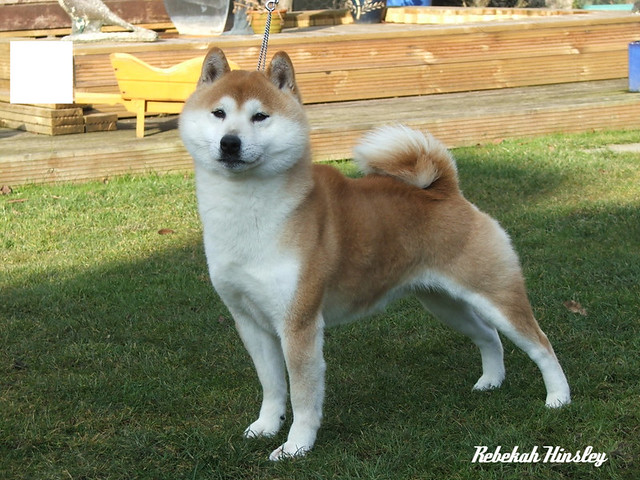
Two Shiba Inus is the breed's most commonly seen color: red. Image is from Wikimedia Commons under a Creative Commons license.

Red sesame
Black and tan
 The Shiba Inu is a breed originating in Japan and is a popular pet. Though the breed is most commonly seen in red, allowable colors also include black and tan and red sesame.

As with so many Asian breeds, Shibas have what is known as urajiro: pale points in a similar orientation to those seen in tan pointed dogs. Urajiro is not controlled by the same gene, though (which is why the breed can be black and tan with urajiro), and is either a simple recessive or a polygenic recessive. There is quite a bit of support for the polygenic theory because the intensity of the urajiro can vary so much. As with so many purebreds, Shibas have some mismarks:

  • Cream/white
    • Very pale recessive red
  • Pinto
    • Piebald white

This Shiba is a cream mismark
Cream is by far the most commonly seen mismark in the breed. It's caused by the same genes that cause white German shepherds. This color is a form of red that has just been very diluted. Characteristically, this means that the dog will usually not be white, but instead a shaded cream, often with red-tipped ears. Since it is a sort of recessive red, there will be no black hairs to be found on the dog. These genes also don't have any potential negative affects on the dog's health, unlike other forms of "white," such as albino, double merle, harlequin, and extreme white piebald. The only potential for health issues in dogs of this color would come from inbreeding which, since the color is recessive, is a common technique used by breeders who purposefully breed creams for profit. However, if a cream randomly pops up in a litter it will be no more likely to develop some sort of health issue than its siblings.

Pinto markings are also found in the breed, but seem to be far less common. It is far from unusual to see a Shiba Inu with a white paw or two and/or white chest, so there are several white spotting genes seen. Dogs with a bit of white, or even those that have basically none, can quite possibly carry the piebald gene that causes pinto. So, if you breed the right two dogs together, a pinto or two will pop up.

Another cream Shiba Inu
Though the Shiba Inu was once a dog used for hunting, now it is almost exclusively a companion animal. I have not found a single good argument as to why the colors continue to be excluded from the standard. Unlike some standards that exclude a color because of known common health issues that are linked to the genetics of the color itself, this is one of those cases where there doesn't seem to be any good reason to disallow the mismarks. Also, any attempts to breed them out really won't work because, if you remove all creams and pintos from the breeding population, you will still have dogs (including 2/3 of the siblings of the mismarks) who still carry the recessives. Any inbreeding that occurs will only make it more likely for the mismarks to show up. Even without close inbreeding, the occasional mismark will still pop up. In addition, by removing dogs from a closed population simply because they are the "wrong" color, precious genetic diversity is being removed for no good reason. In a closed population, genetic diversity is of serious concern because there is only so much to go around. Since the pedigree dog world is so against adding new genetic diversity by out-crossing to other breeds, what diversity there is needs to be maintained as much as possible or things do not bode well for a closed registry system.

Dog Treat Review: Happy Howie's (plus previews)

I took another trip to one of the local pet boutiques today and picked up a few things I was curious about. I'm really starting to love this particular store, and it may end up being my go-to place for certain things, even though it's a bit farther than any other place to buy dog things locally. The owner is a very nice British woman who has an adorable dark buff American cocker spaniel.

The purchases

As soon as I got home, I took the above picture, then gave Ebon the thing in front. It's a Happy Howie's All Natural Doggie Burger. The company also offers sausages, woof stix and woof bites, doggie jerky, and meat rolls. The burger treats come in two sizes: two inches and four inches diameters. According to the website, they also come in packages of twelve two inch burgers, two four inch burgers, and bulk boxes. Of course, I bought the four inch one. As you can see, these aren't sold in packages at the store I went to, but instead there's a bulk box that you pick them out of. This is part of the reason I gave it to him so quickly because, since there isn't an expiration date I can reference, I didn't want to put it somewhere and forget about it. They can be frozen, though. Anyway, here's the stats:

Ingredients: Beef, Rice Flour, Garlic, Salt, Sodium Lactate, Sorbic Acid, Citric Acid, Natural Mixed Tocopherols (a natural preservative), Vegetable Oil, and Rosemary Extract.

Nutrition Facts:
Crude Protein: minimum of 30.0%
Crude Fat: minimum of 11.0%
Crude Fiber: maximum of 1.0%
Moisture: maximum of 14.0%

The treat smells very meaty, and Ebon took note of it as soon as I walked in with the bag. It's also pretty easy to tear if you wish to break it into smaller pieces for a smaller dog, for training nibbles, or whatever. I like to known if a treat can be easily portioned out, and this one didn't take any wrestling, cutting, or anything of the sort. It was easy for Ebon to chew, even though he is still favoring his tooth extraction site a bit.

I find the slogan used on their website of "Soft enough for poodles, tough enough for labs" rather amusing because of how long it took Ebon to eat his burger: about three minutes. Of course, he is a big boy and has big teeth but I still wouldn't exactly call that tough. Overall, the treats seem to be good. I payed $1.59 for a four inch burger, which isn't too bad, especially if you tear it into smaller pieces. I would buy the burgers again, especially if I can buy a bulk box and freeze them for later. I might also go back and grab some of the other treats from this brand.

As for the others items in the picture, I'll be talking about them sometime soon. Of course, the chew won't be given to him for a little while yet.