Showing posts with label labrador retriever. Show all posts

Sunday, May 18, 2014

Dwarfism in Labradors: A Look at Genetic Disease and Inbreeding

Labradors used in a study published last year. Upper left is a dwarf female. Upper right is a dwarf mother and her unaffected daughter. Bottom left are three litter-mates, two unaffected and one dwarf.
One heritable condition many people are not aware of in the ever-popular Labrador retriever breed is dwarfism. As can be seen above, some of the dwarfs have only slightly shortened legs, which can explain why the trait can be easily glossed over. Interestingly enough, there are at least two different forms of dwarfism in the breed: one (osteochondrodysplasia) with a more obvious bent-legged phenotype and the other (skeletal dysplasia 2 aka SD2) with more normal appearing, only subtly shortened legs. I will be concentrating on the latter.

So, why should we even be concerned about dwarfism? Whereas some forms of dwarfism can lead to severe limb malformations and subsequent joint issues, as well as eye problems, SD2 does not. Instead, the gene may be linked to deafness. There hasn't been an examination of SD2 dogs to see if they do in fact have any hearing impairments, but similar genes in other animals lead to at least some deafness. In truth, any sort of abnormality should be concerning, at least to some degree. In the case of these dwarf Labradors, all from working- or field-type stock in a recent study, the decrease in leg length would lessen effectiveness as a working dog, as would any impairment to hearing.

Variation in the Labrador retriever. There is some more extreme type on both ends of the spectrum.
This form of dwarfism also brings up some interesting questions about breed type. Labrador retrievers vary significantly in size and shape, most notably between the comparatively lanky, lightly built working lines and the far more stocky, low-slung show lines. Some less-than scrupulous breeders could use SD2 to their advantage, taking a dog like the third one in the above image and getting it to resemble something more like the first two dogs. I honestly wouldn't be overtly surprised if someone used such a tactic as there are people that are that desperate to win a ribbon. Low-slung and stocky is what's winning right now, after all.

The average height difference between affected and unaffected dogs is only about 6 cm (2.4 in). Scientists were able to identify the likely source of SD2: a single allele change in a gene that is involved in collagen development. The trait is a recessive, which explains the generation jumping seen in the following pedigree.

Pedigree of the dogs in the study. Squares are male, circles are female. The dark individuals are all affected with dwarfism, with the red showing a form not caused by the same gene as the others. The arrow indicates the likely source of the gene, a popular sire who is the common ancestor of every dwarf in the study.
What else is remarkable about this pedigree? Do you see it? There is quite a bit of inbreeding going on. Though it's very difficult to trace all of the relationships (this chart has serious organizational issues), this pedigree is rife with shared ancestors, though most of the duplicates are a few generations back. For example, LA101, who is the black square closest to the top of the pedigree, has a grandfather and a great-great-grandmother who are full siblings. In fact, every affected individual can indeed be traced back to a common ancestor on both their sire's side and their dam's side.

And that's the problem.

This is a classic example of inbreeding leading to genetic disease. Inbreeding is risky business as it leads to an increase in homozygosity. Related individuals are more likely to have identical versions of a certain gene, and if you breed them together, it's quite likely that you will end up with offspring getting two copies of this gene, one from each parent. A lot of dog breeders think this is advantageous, allowing them to more easily select for a desirably trait. However, in all likelihood there will be bad that comes with this perceived good. There are numerous genetic diseases found in purebred dogs, and almost all of them appeared through inbreeding. This is why so many conditions can be traced to a single, common ancestor.

Often, the founding populations of a given dog breed are disturbingly low when viewed from with an eye toward population genetics. When you have breeds numbering in the thousands that are descended from maybe seven individuals, it's no wonder there is so much disease. If there are any detrimental recessive alleles in that small of a population, homozygous individuals affected by that detrimental gene are bound to occur. Labradors, to some extent, are lucky. Their popularity has persisted long enough that there have been fewer genetic bottlenecks, at least not to the extent of, say, the long list of breeds whose populations plummeted around WWII. The fact that retrievers were once interbred is also an advantage, giving a fairly large gene pool for all of the retriever breeds before they were separated. While some breeds are severely lacking in genetic diversity, such as the collie's paltry effective population size of 33, Labradors in Great Britain have an effective population size of 114.

This, however, is still far from spectacular.

For those not in the know, conservation biologists use something called the 50/500 Rule when assessing endangered species for extinction risk. At an effective population size of 500, there is concern that the species will not be able to maintain genetic diversity over a long period of time. At an effective population size of 50, the species is at immediate risk for extinction. They're circling the drain. Domestic animals have the advantage of veterinary care, but no owner in their right mind would prefer to have a sick pet. While the 50/500 Rule definitely doesn't bode well for the health of the aforementioned collie, the Labrador isn't in much better shape. When nearly one hundred thousand dogs have genetic variation equal to little more than one hundred individuals, there is a serious problem. For one thing, it makes it that much harder to avoid mating a certain dog to another that doesn't share a significant percentage of its genotype.

Since purebred dogs are closed populations, lack of genetic diversity is a serious problem. Comparing these populations to endangered species is very appropriate given the tiny effective populations sizes. Inbreeding serves to eliminate heterozygosity, and the more it is done, the more diversity is lost forever. If registries continue to insist on keeping studbooks closed, inbreeding has to stop or the only savior is going to be systematic outcrossing.

Sources are images from Wikimedia Commons for the type comparison (1, 2, 3, 4: all being copyright free or under Creative Commons licenses), Princeton University PressPopulation Structure and Inbreeding From Pedigree Analysis of Purebred Dogs, and most importantly, A COL11A2 Mutation in Labrador Retrievers with Mild Disproportionate Dwarfism published in PLOS One, a peer-reviewed, free to access, Creative Commons licensed publication. Authors are Mirjam Frischknecht, Helena Niehof-Oellers, Vidhya Jagannathan, Marta Owczarek-Lipska, Cord Drögemüller, Elisabeth Dietschi, Gaudenz Dolf, Bernd Tellhelm, Johann Lang, Katriina Tiira, Hannes Lohi, and Tosso Leeb. 

Thursday, June 13, 2013

Mystery Leg Markings: Some Theories

Ebon, showing some of the brown that can be seen on his legs
For the longest time I thought nobody else noticed the fact that Ebon has distinct rusty markings on his legs. Then, this past November I came home from the vet and found this on Ebon's shot records:


Color: Black and Brown. The vet did once list him as Black, but some time during the many years they've been caring for him it was changed. I apparently wasn't the only one to notice.

Ebon at 21 months, Hellon at 8 years. Click to view larger
Recently I also found out that Ebon's mother, Hellon, apparently had red markings on her legs as well. I honestly never looked close enough to tell. I hunted through the pictures that I can find of her and yes, in the pictures to the right you can see what appears to be some hints of lighter color on her front legs. Considering that none of the pictures I can find are of her in bright sunlight, and many are from more recent years when her legs had heavy greying, this is probably the best I'm going to be able to find.

So, this is my conundrum. What exactly is Ebon? In my Guess the Genotype posts I try to take a stab at determining the likely genotypes of dogs who sometimes have some very unusual markings. I would place Ebon into the somewhat unusual category. Mismark Labrador retrievers happen. Some of them are quite striking. Dogs with tan points, with or without brindle, have been popping up in purebred litters for many, many years. It does seem that, to some extent, this mismark is more common in working lines since there is generally little to no real concern over what the dog looks like, as long as it can retrieve. However, usually the mismarks that are seen are far more obvious than what is seen on Ebon or his mother. Why in the world are their markings so subtle?

Ebon's left forepaw in bright sunlight, the most red it ever appears
I have broken down Ebon's markings before, and theorized that he might be a "bad black" over black and tan. Bad black, aka seal, has been shown to be genetically dominant black when tested, seen in a study on Italian greyhounds. However, unlike normal dominant black, some of the underlying Agouti locus is able to show through. In most breeds where seal is a known color, tan point and other recessive alleles on the Agouti locus are either rare or completely absent. The Italian greyhound is one such breed, with tan point being nearly absent from the population. This could explain why seals usually have red that is patterned much like a shaded sable. Ebon, on the other hand, has red in an almost identical pattern to dogs who are tan point, such as Rottweilers and Doberman pinschers. Labrador retrievers are quite possibly fixed or near fixed for the tan point gene. The mismarks that are seen are never sable or the like, but tan point pops up on a fairly regular bases. If Ebon were bad black, he would have to be bad black covering tan point, otherwise the "bad black theory" would not work.

However, this is not the only possible explanation for Ebon's rusty legs. There are, in fact, two more.

The first is that he's a very minimal black and tan. Though highly unusual, there are dogs that occasionally pop up in breeds that are normally tan pointed that appear to have little to no red on them. This seems to be somewhat prominent in Rottweilers, as some people seem to prefer the low amount of tan. If you do a little hunting around the Internet, it isn't that difficult to come across dogs with almost no tan at all. The same is true for Dobermans, though the dogs with less tan usually have more than the near-black Rotties. However, this is not always the case. There are some dogs that seem to have absolutely no tan at all, but those dogs usually appear to not be purebreds. The "all black Rotties" usually look like Labrador or molosser mixes and the "all black Dobes" usually look like they have some great Dane or greyhound in them. The fact of the matter is, dogs who are simply black and tan never have as little red as Ebon does. There has to be something else at work.

You can draw a line between the solid black and the red-laced
The final theory is that he's a black and tan with heavy brindle. When I first discovered his red markings, this was my thought. However, I was hesitant to say this was the case because I couldn't see any distinctive stripes on his legs. Despite this initial thought, the more I stare at his legs the more I start to think that he does indeed have stripes. For one thing, brindle is a highly variable pattern, with the stripes so randomly placed that a dog can have lots of stripes on one side of their body and virtually none on the other. Ebon's legs don't match, and the color is not consistent. His right foreleg has more red than his left, including a quarter-sized patch near his wrist that has more red than the surrounding area. Black and brindle is a known mismark in Labradors, with nearly as many black and brindle dogs popping up as black and tan dogs. This, combined with the mask gene to explain why he has virtually no red on his face, could very well be the truth behind Ebon's rusty legs.

So, all in all, I find the black and brindle theory to be the most plausible. Black and tan doesn't fit very well at all and the bad black theory is based on a variant that may not even be present in the Labrador breed. Much of the reason why I went with the bad black theory is his Guess the Genotype post was purely for the sake of argument. It is still possible that Ebon's coloring could be explained this way, but black and brindle is more likely. I only wish I could afford to test him to abate my curiosity.

Friday, December 30, 2011

Mismark Case Study: Labrador Retriever

A gaggle of Labradors showing all three acceptable colors: black, chocolate, and yellow. Yellow can be in any shade of the red spectrum, from near-white to deep red. Chocolate can also vary. Image is from Flickr.com under a Creative Commons license.
Ebon is black with hints of red
Labradors, year after year recently, have been the AKC's most-registered breed. They are incredibly popular pet, and are also used for numerous working purposes, including hunting, tracking, and as service dogs. As those who read my blog regularly know, I myself have a Labrador, and he's a mismark to boot, though it's more subtle than most. The breed actually has a great number of mismarks that are seen:

  • Too much white
    • Anything more than a small amount on the chest isn't allowed
  • Tan points
    • In either black or chocolate dogs
  • Brindle points
    • In either black or chocolate dogs
  • Improper pigmentation
    • Where a yellow has a liver nose
  • Silver (controversial)
    • The blue dilution. Variations include "silver" (dilute chocolate, aka fawn/Isabella), "charcoal" (dilute black, aka blue), and "champagne" (yellow with a blue or fawn nose)

This yellow Labrador has a brown nose
Thanks to the restrictions provided by the standard,  Labs will usually be bred using color classes. Blacks are bred to chocolates and yellows are bred to blacks, but chocolates will rarely be bred to yellows. This is thanks to the fact that a brown nose on a yellow is not just frowned upon, but will actually disqualify a dog from showing. Usually, breeding chocolate to yellow is only done by those who breed their dogs for working ability rather than conformation. As such, brown-nosed yellows are most commonly seen in the more lightly built field-type Labradors and are rarely seen in the more heavily build show-type Labradors. As is so often the case, breeders of working lines could generally care less what the breed standard has to say as long as the dog can perform the required job.

This Labrador has too much white
One unacceptable appearance that constantly pops up in litters is too much white. Residual white happens all of the time in dogs that are genetically solid in color, which is why the mismark is present in every single breed out there that isn't supposed to have any white whatsoever. In Labradors, this is most often only a chest patch, but more extensive white can occur, spreading up the neck or appearing on the toes. The St. Johns water dog, a major ancestor of the Lab, had this amount of white as a standard occurrence. It seems odd to me that it is now considered unacceptable in the descendents. Interestingly enough, Bolo spots (white patches on the underside of the paws that are generally not visible when the dog is standing) are allowed.

This Labrador has tan points
Two mismarks that have been around for basically as long as the Labrador has been a breed are black and tan and black and brindle. Most Labs are dominant black (even chocolates and yellows) and dominant black can easily hide the recessives brindle and non-black/brindle that both allow the Agouti locus to show through. As such, two dogs carrying these recessives can easily produce black and tan or black and brindle puppies. Also, since the genes are recessive, carries aren't obvious until they throw a mismark. Even with selection, the colors simply aren't going to go away. In addition, there are other dogs like my Ebon with just a hint of red that may be very minimal black and tan and may go completely unnoticed, all depending on the amount of red that is distinguishable.

This Labrador is silver
Silver is a highly controversial color in the breed, thanks in part to the suspicion that the color was introduced through crossing with a Weimeraner. Whether it was that or a mutation: the color exists. Unlike a very large amount of people familiar with the breed, I don't really have much of an issue with silver existing in Labradors. However, I do disapprove of the breeding practices going into producing silver dogs, as well as the "charcoals" and "champagnes." It's inbreeding, pure and simple. It's a classic story: one or two dogs show up that are a desired color. Breeder wants to make more of that color and inbreeds like mad to produce a bunch of dogs that are the desired color. The blue dilution is recessive, and as such inbreeding is the only way to ensure the production of the color. This would be done through either only mating dogs that express the desired color or only matings dogs who are known to carry the color (and are thus related to that original population). Also, most silver breeders brag about their ability to produce litters that are guaranteed to have silvers and will charge heavy prices for the puppies of the desired silver color. There is usually no mention of the heavy inbreeding required to make the color possible. This is ridiculous, and does not bode well for dogs as all these people likely care about is profit.

Another practice I do not approve of when it comes to "silver" in Labradors is the mislabeling of colors. The AKC has advised breeders to register silver dogs as chocolate, when it fact the two colors are quite different. Silver, unlike chocolate, requires an additional gene for the color to be expressed. They also look quite different, with chocolate looking like, well, chocolate and silver looking like ash. The parent club doesn't support the practice of mislabeling, and neither do I. The two are different colors and should be identified as such. I hold the same position about all other breeds.

The Labrador retriever was originally meant to be a working dog: able to run and swim easily to go retrieve birds without breaking a feather. As such, color should not be a factor deciding what the breed should be. A dog with tan points is just as capable of retrieving a bird as a solid black one. If modern show breeds want to maintain that their dogs are still just as capable, why care about color? Why not stay true to what the breed once was? As I keep emphasizing, genetic diversity is of serious concern in purebred dogs. By disallowing certain colors, standards are only eliminating more and more diversity from the breed. Breeding for two separate types (show or "English" and field or "American") doesn't help either.

Monday, November 14, 2011

Recent Happenings

Things have been pretty busy as of late. As always, the later part of the semester is always the busiest, which is why I missed several post days recently. Luckily, most of my major assignments have been completed and turned in and I can turn to less exhausting ways of keeping myself busy.

Anyway, on to some pictures of the fuzzy creatures in my life.

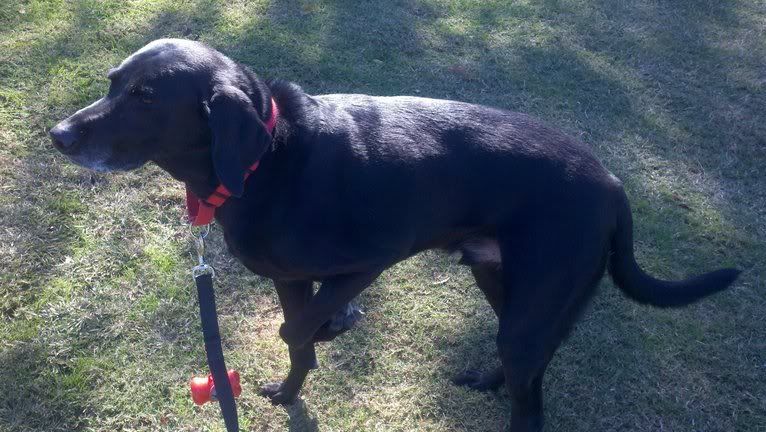
Ebon at the vet before getting his yearly vaccinations early this month. He knows the place well, and really doesn't like being there. He gets extremely anxious and basically forgets all of his training. He jumps and whines and trots in circles and pulls at the leash. I've been trying to work with him on that. At least he's not fear-aggressive at all!
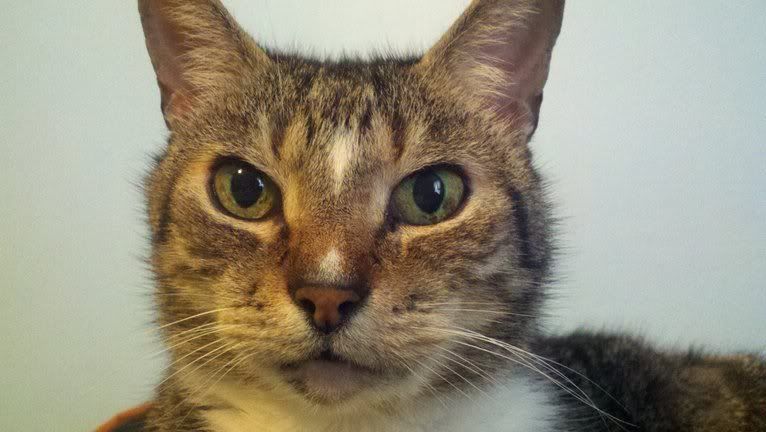
This is Jen, one of my brother's cats, who has been introduced previously. Jen is the perpetually-happy, bigger, older brother. I believe he is fifteen years old. When I say perpetually happy, I mean perpetually happy. He is nearly constantly purring and trying to rub his face all over you. He loves belly rubs and if you touch him he'll attack you with love. His meow is a bit odd, since he really more screams than anything else. His purr is also quite loud. He usually has this odd wide-eyed look on his face, which I call "The Jen Face." He's a very unusual cat, and honestly one of the best words to describe him is "simple."
For contrast, here is Ash, who has also been mentioned before. Ash is the more mellow, smaller, younger brother. I believe he is fourteen years old. He's a petite, quiet little fireball who chirps like a bird when he meows. His favorite place is in your lap (which is where he is in this picture). He's very kitten-like in appearance but not in temperament, and probably has some sort of condition that made him so small and finely boned. He's the problem-child when it comes to relations with Ebon. Usually, they're fine with each other now, but when we first introduced them he was the one to swat at the dog.
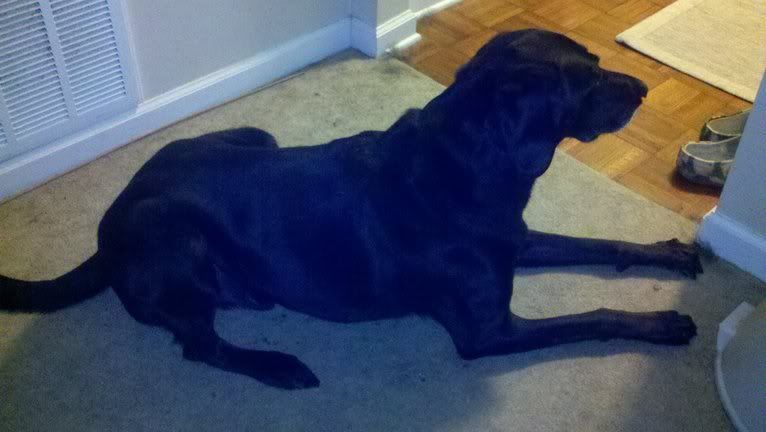
Ebon being good and waiting for his dinner today. I make him do a little "work" for every meal. Usually it's tricks, sometimes it's waiting for thirty seconds or more, other times I give him a food puzzle.
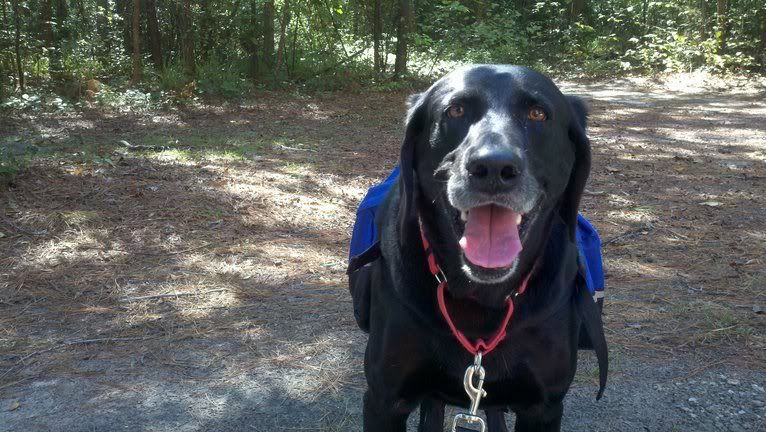
And, of course, I did change my banner image. It's from a nice walk Ebon and I took a while ago now.
Ebon loves his backpack! Here's it's only weighted with two liters of water (about four and a half pounds of weight). I would like it to be a bit heavier, probably eight to ten pounds. This is actually part of the same trail I mentioned before.

Tuesday, July 12, 2011

Saturday, July 2, 2011

Bath Day

I meant to post this earlier, but I've honestly been too lazy to upload the images until now.

Clean puppy, still damp
The bathtub drain
On Wednesday, I gave Ebon a bath. Nothing special about that. It does amuse me, however, the sheer amount of fur that I get off of that dog every time I bathe him. It tends to look like I murdered a small animal. When balled up, I got a full handful out of the drain (so that's not counting the other handful or so that came out later when he dried out). I realize that Labradors often have more coat than you would expect, but Ebon's coat is very sleek for a Lab.

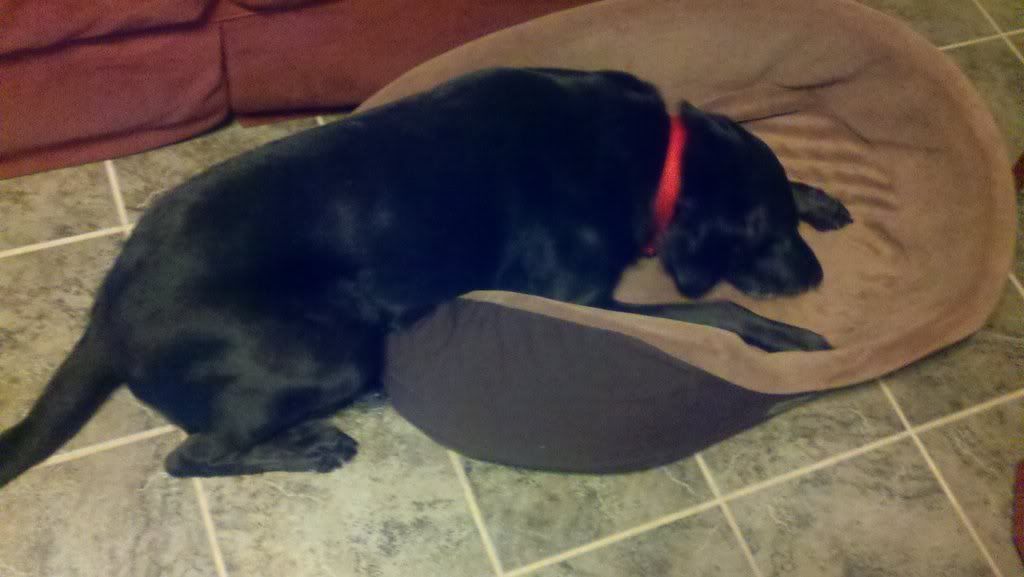
After the dog gets a bath I always try to go and wash all of the beds and blankets. We actually have quite a lot. There are four dog beds: a lot for one dog, but we had two not so long ago. There's also the blankets that always reside in Ebon's kennel. So, it's a lot to wash. I gathered everything up, piling the uncovered beds on top of the dog kennel to keep them from getting dirty. The covers went in the washing machine and when I turned around I saw something rather predictable in my house:

Albus had hopped onto the pile. That cat gets into everything. As with him drowning his toy mouse, it's more of Albus being Albus. He's very predictable, honestly. He has to hop onto everything, and especially into any box or bag that happens to be on the floor. In doing so, he once managed to get himself caught in a television box. He hopped into it from the back of a chair not realizing the sides were taller than his "jump maximum." He has a very distinctive desperate meow in situations like that.

By the way, that's his "you caught me" face.

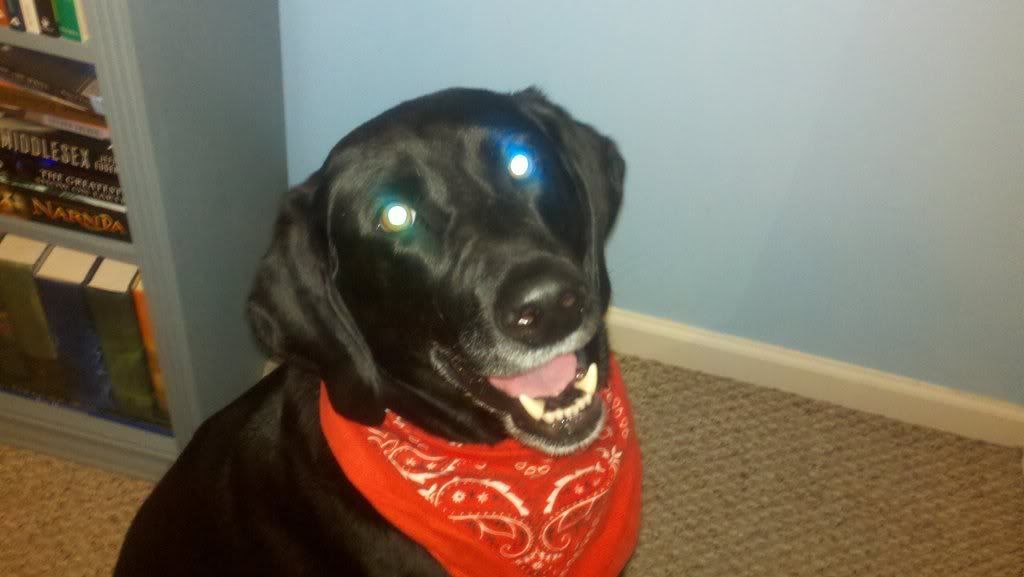
I do occasionally subject Ebon to wearing things, though it's usually just a bandana. He looks good in red, so he has his very own red bandana.

Monday, June 27, 2011

All of This for Cheese Crackers

Three attentive little creatures: Ebon, Albus, and Ginny
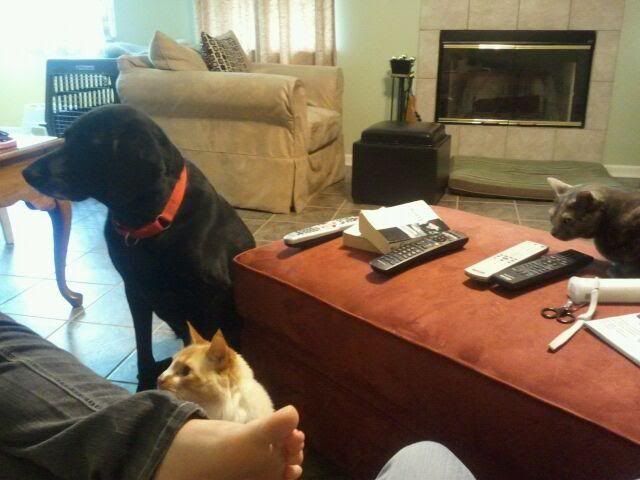
I mentioned a little bit ago about Albus' love of cheese crackers. Well, he's not alone. At one time or another, all of the pets (the mammals at least) have managed to get their paws on one and they've gone crazy for them. I decided to have a little snack of Goldfish crackers today, and within a minute this happened. That's my foot, and they are all in fact staring directly at me. Well, Ginny was, but she glanced down right before the flash went off. Isn't that always how it happens?

Albus is the worst offender. He knows what the packages sound like when you open them and he will come running, meowing and purring and pawing at the counter in the hope that he will get one. He's always done this, but he's been spoiled a bit lately because he lost weight during his hospital stay and he's become especially bratty. It's funny because Albus goes gaga over cheese crackers, but he won't touch real meat. They get some occasionally as a treat, and though the others chow down he'll just sniff it and walk away. He's a very odd cat.

Ebon, being a dog, is nearly always at hand in case someone drops something. He especially likes crunchy things because they have nearly the same texture as the treats I use when training him, and he always gets excited about the prospect of training. I suspect he associates anything crunchy with this, and thus crackers = crunchy = treats = fun times. With a simple word he'll stop begging, but this was just too funny.

Ginny was a bit of a surprise. She's not very fond of Ebon because he's so much larger than her and his playfulness doesn't mesh well with her skittish nature (due to the fact that she's rather feral). However, they're on fairly good terms and she does love cheese crackers nearly as much as the other two. I think she's also learning what the package sounds like.

And yes, I gave in and they each got one. Except Ginny. She managed to put on weight while Albus lost it, so I'm being hard-hearted and abstaining from giving her any treats.

Thursday, June 23, 2011

Fun in the Sun

Who's a happy dog?
I took Ebon out to play this morning and I though I would do a sort of diary entry about it.

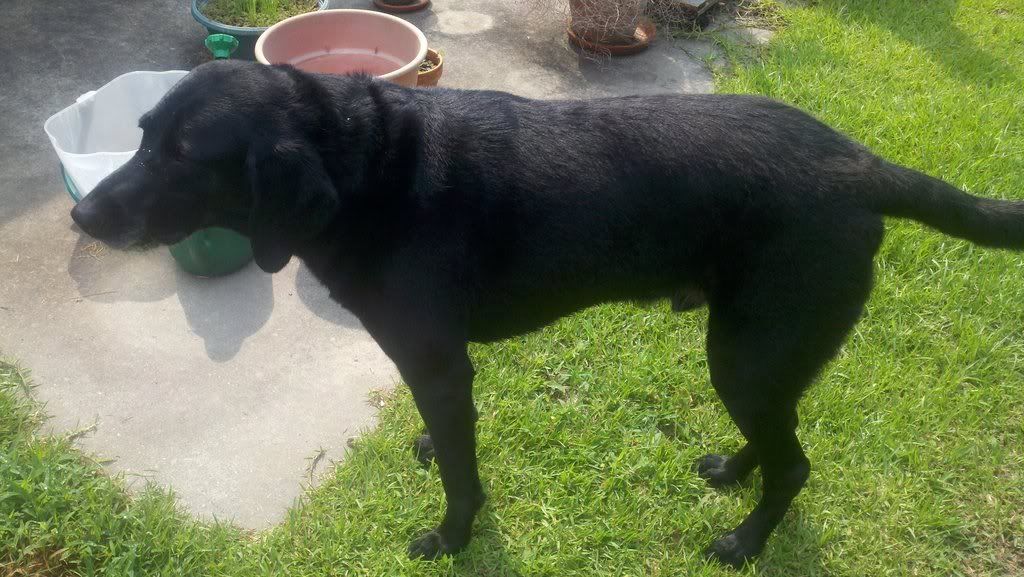
For those who haven't read the first post on this blog,  Ebon is a Labrador Retriever from field stock, also sometimes called an "American" lab (I don't like that terminology because dogs from America come in both the "English" show type and the "American" field type). He is nearly 27 inches at the withers and weighs about 85 pounds.

Ebon will do anything for a tennis ball. It's absolutely his favorite toy by far, and we have a ball chucker to help fling them further. He loves it, and if you have a dog that is a lover of tennis balls like Ebon, I highly recommend it. The special balls you can get for them are pretty nifty. Ebon seems to really like The Whistler, but a regular tennis ball does just fine.

We have a long expanse of yard next to the house, and that is the perfect place to play fetch with him. It's just long enough for me to miss the treeline with the chucker, and there's a handy shade tree that he can rest under. We used to have a kiddy pool for him, but it cracked over the winter and we haven't had a chance to replace it yet.

Throw it, throw it!
And he's off!
We don't have a fence, but Ebon's recall is great. The only times that he won't come when called are when he has to potty, to say hello if a person actually enters our yard, or he runs off to chase a small mammal (usually rabbits). He's never caught one, but it seems that he just can't stop himself. If someone walks or drives by, he doesn't really seem to care, especially if I have a ball in my hand!

Glug, glug, slurp, splash...
Unfortunately, it was exceptionally hot today, so we only played for about five or ten minutes before he was panting awfully hard and I took him inside to cool of. He went through his usual cooling down sequence: drink water, dribble it onto the floor, lay in own drool on cool tile floor, pant for a minute. Repeat until cool. I'll be taking him out again later when it's not so hot.

By the way, if you're curious, Ebon's collar is a nylon no-slip collar modeled after the martingale collars used on sighthounds.  It's, frankly, the best collar I've ever used on a dog and is necessary because he has a small head for a Labrador, a common sight in field lines. It is not a choker collar and in fact when fully closed has the recommended two-finger gap, but when loose it fits him more comfortably than any other collar I have tried on him (which were either too snug or would basically fall off him).

Wednesday, June 15, 2011

About a Dog

Ebon specifically. Ebon is a black Labrador Retriever from field stock who had his sixth birthday earlier this year. I knew him nearly from birth, and I am glad I was able to go through such an experience. His breeder was the mother of a good friend of mine. Ebon's mother, Hellon, was a sixty pound chocolate working duck retriever and was getting older. She was good at what she did, and the breeder hoped they could get a puppy just as good. I never met the father, but Rebel was also a duck dog, yellow this time and nearly one hundred pounds. Unfortunately, when Hellon was pregnant their home was robbed and the dogs were drugged and thrown into the bathroom. They were concerned about the puppies, and had reason to be. 

The litter was born in mid January 2005: five boys, all black. It came as quite a surprise to the breeder. With a chocolate mother and yellow father, they were expecting a colorful litter. I met the pups for the first time when they were two weeks old. They were five perfect little creatures, active and vocal as can be. Their puppy names came quickly: partly from their behavior and partly from the ribbons placed around their necks. Red was Reddy, yellow Sunshine, dark blue Grunt, light blue Little Boy Blue, and green was Crapper. They grew so quickly into active little things, and their mother would hop the baby gate to be away from them when they got especially rowdy.

Before long, they were two months old and it was time for them to go to their new homes. One by one, they left, and eventually little Grunt, then called Calvin was the only one left. The person who was supposed to take him had changed their mind. The breeder didn't want to keep him, as she had wanted to keep a female, so she went on the hunt to find him a new home. Time passed, and he got older, and now few people wanted to adopt a puppy that old. After he turned five months old, the breeder approached me. If I fixed him he would be mine free of charge. I was a junior in high school, and after some coaxing my parents let it happen.

Ebon became my dog, joining a household that already included a ten-year-old Lab mutt (Charlie) and two cats (four-year-old Albus and three-year-old Ginny). He has been my pride and joy ever since. He matured to be a handsome, eighty-five pounds of lean muscle. He's no duck dog, but he probably could have been if that was the path I had wanted to go down. Instead, he's a much-loved pet and will be mine until the day he dies. He's been quite a lesson to me, and we grew up together in a lot of ways. I teach him tricks for fun, and hope to one day certify him as a therapy dog. I might also get him into dock jumping, flyball, or agility. Right now we do aspects of each in play. I plan to post the list of commands he knows. It's fairly extensive.

Last year we discovered Ebon has epilepsy. It's mild, and he only has a seizure every four to six months or so. Each episode had been brief and minor, though it clearly frightens him. He does not require medication. I wonder if the incident while his mother was pregnant could have caused it, because there isn't a family history and all the puppies in the litter have it. No matter what, I still love him to bits and I always will.