Spanish moss is a plant found everywhere where I live. It's appearance, draped from the limbs of trees, is iconic to the south and it's something you can't miss.
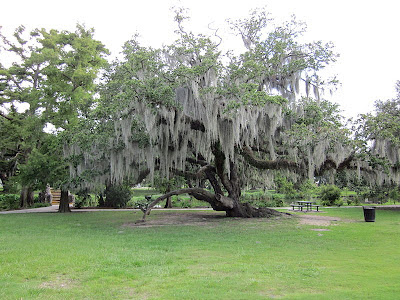 |
| A tree covered in Spanish moss (Tillandsia usneoides), also known as long moss, Florida moss, and graybeard. |
 |
| A Spanish moss flower |
Despite what the common name implies, Spanish moss is not a moss at all. In fact, it's a flowering plant. Though it lives on other plants, it isn't a parasite, and instead is perfectly capable of making its own food. These types of plants are called epiphytes rather than parasites. Unlike other "air plants," as epiphytes are sometimes called, Spanish moss does not have aerial roots. Instead, the leaves of this plant are specially adapted with tiny cup-like structures to capture available moisture. When moisture is lacking, the plant is able to become dormant until moisture is available again. The seeds that are produced by this plant are quite small and are dispersed through birds and wind.
Spanish moss has been used for various purposes both past and present. In the early days of automobiles, these plants would sometimes be used to stuff seats, and stuffing of furniture and mattresses was once incredibly common. In fact, many claimed that Spanish moss mattresses were preferable since they were cooler to sleep on than other types. Of course, keeping cool was very important in the days before air conditioning. Today, the plant is used for mulch and is a popular addition to arrangements of flowers, partly because it helps keep the flowers moist. Animals often use the plant for hiding and birds like to use it to build their nests. In addition, chiggers, which I have
mentioned before, love to live in Spanish moss once it hits the ground. So, if you ever intend to stuff your mattress with graybeard, don't collect it from the ground or you will soon regret it!
Though Spanish moss is not parasitic, it can still be damaging to whatever tree it calls home since it can shade out the leaves.
Source is the University of Florida School of Forest Resources & Conservation. Images are from Wikimedia Commons under Creative Commons licenses: one, two.


