Thursday, April 5, 2012

Crazy Plants: Baobab

One of several species of baobab, Adansonia grandidieri. 
The Australian A. gibbosa
The genus Adansonia is a fascinating group that is commonly known by the common name name baobab. These trees have a very unique appearance. There are eight species total, with the majority being found exclusively on Madagascar. One of the species is found on the African continent and parts of the Arabian Peninsula and the last is found in parts of Australia. Of the six species currently listed on the IUCN Red List of Endangered Species, three are endangered (including A. grandidieri) and the other three are near threatened. The two species of baobab that are missing from the Red List happen to be the ones that are found away from Madagascar.

The fruit of the African A. digitata
A. grandidieri is the largest of the species, and, thanks in part to its great height of up to twenty-five meters, possibly the oddest in appearance. The trunk itself can be three meters in diameter. The species prefers dry area, and a major risk is encroaching farmland. In fact, now one of the most common places to find the tree is on land that is used for agriculture. Its flowers supposedly smell rather like watermelon that is sour. A major pollinator of the plant is one of the many species of lemur that are found on Madagascar. It's believed that the species of animal that acted as a disperser of this plant's seeds has gone extinct as no disperser has been witnessed beyond possible water dispersal. This is possibly another risk to the species' survival. What's most likely not much of a threat is the fact that these trees are used as a source of food and materials. Pulp and seeds are eaten and used for oil, with collectors hammering pegs into the trees to make them easier to climb. Scars at the base of the trunk is evidence of bark being collected to make rope. The wood of the tree is used for thatch. All of the collection methods used do not severely damage or kill the trees, and thus probably do not have much affect on survival.

The flower of another Madagascar species: A. rubrostipa
Sources are the IUCN Red List, ARKive, and University of Queensland. Images are from Wikimedia Commons under Creative Commons licenses: one, two, three, four.

Wednesday, April 4, 2012

Trail at Dusk

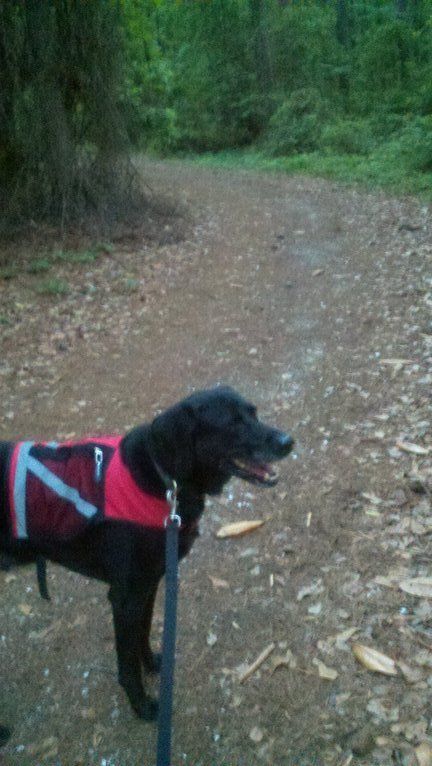
Happy dog where the trails start. This is one of the most-traveled areas.
So many leaves
Is that a squirrel?
I took Ebon back to campus today and went to another section that he hadn't yet seen. He's been to certain sections many times now, namely the paved trail, the drainage ditch and retention pond, and the campus itself. However, there are also a series of unpaved trails that crisscross a section of forest which is mostly ringed by the paved trail. This is the same network of trails that I took to as an Undergrad student to observe and collect samples of local wildlife. We covered most of these forest trails, then when a section met up with the paved path I diverted onto it so that we could do a little jogging. I wouldn't trust jogging on the unpaved areas. Since most of the trails were covered with heavy leaf-litter, it's very possible that hidden holes or sticks could lead to a twisted ankle.

There were a few downsides to our trip. I didn't make it to campus until late, so we were racing the sun. It rained yesterday, so the mosquitoes were especially bad. I came home with several bites (note to self: buy bug spray). Also irritating was the sheer number of squirrels that were along the trails. Ebon tends to go crazy for squirrels, but luckily today he was very good. He didn't go after any, and when he did get excited I was able to easily redirect him.

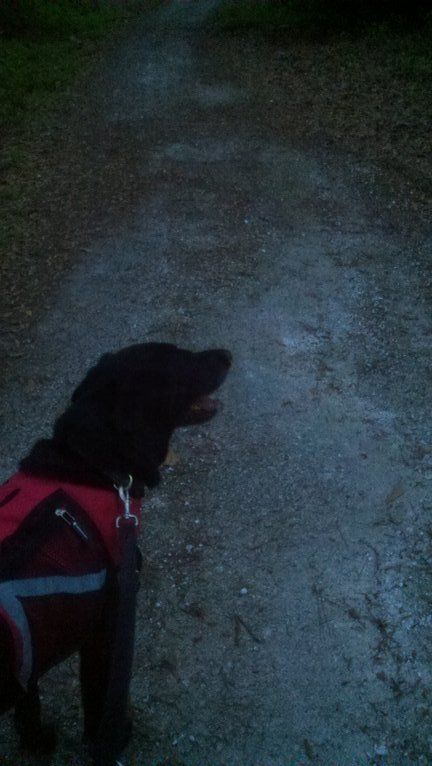
In the fading light. This section is clearly traveled far more frequently. I suspect the campus caretakers drive their golf carts along it. It looks like it's frequented by wheeled vehicles, but is too narrow for it to be cars.

Tuesday, April 3, 2012

Unusual Breed: Kromfohrländer

A Kromfohrländer in one of the two acceptable coat types: rough.
This breed originated in Germany through crossing of the wire fox terrier and grand griffon vendeen, with perhaps a bit more thrown in the mix. It's a fairly modern breed, with its status as a unique breed only being recognized in 1955. The breed comes in two acceptable coat types: rough and smooth. The differences are purely texture-based, with rough being wiry and smooth being soft, as the length of the coat can vary. Coat color does not have a lot of variety with the only acceptable pattern being white with red patches. In appearance, this breed is often compared to a wire haired Parson Russell or Jack Russell terrier. It is medium sized, ranging in height from fifteen to eighteen inches and weighing between twenty and thirty-five pounds.

A smooth Kromfohrländer
Since the breed is fairly obscure, it's obvious why it could be confused with a mixed breed or maybe even a "designer breed" by those who are not familiar with it. The breed is rarely seen outside of its native Germany, and it's even more uncommon to find it outside of Europe. The registries that do accept this breed disagree as to where it should be placed. While the UKC places the breed in with the terriers, the FCI has placed it in with the toy and companion breeds. It's even been given its own section in the group (Group 9 Section 10), which is fairly unusual for the registry. Both placements do seem to be fitting. Though there has clearly been terrier influence on the breed, it was originally bred for companionship. As such, it's known for having a good temperament. Adaptability and high spirited-ness are also traits that are considered key traits of the breed.

The major health concern in the Kromfohrländer is stifle-joint disease, which is inherited. Other conditions are also sometimes seen, namely epilepsy and cataracts.

Sources are the United Kennel Club, Fédération Cynologique Internationale, Finnish Breed Association for Kromfohrländer, and Complete Dogs Guide. Images are from Wikimedia Commons under Creative Commons licenses: one, two.