When I still had my hissers, I heard them hissing all of the time. The sound is pretty unusual and, when you aren't used to it, can be quite startling.
Hissers are very unique in the insect world for how they make their hissing sounds. The vast majority of insects manipulate their bodies in some way to make noise. A mosquito's buzz comes from the beating of its wings. Crickets chirp by rubbing parts of their wings together. Cicadas have a special concave membrane that they "pop" to make their characteristic noise. Other species rub against surroundings to produce a sound. Roaches are far more like us as they force air out of their spiracles (breathing holes), creating the hiss.You can often see this when they hiss, as the sound is so often accompanied by sudden contraction of the abdomen.
Source is Cornell University. Videos are from YouTube: one, two.

Showing posts with label madagascar hissing cockroaches. Show all posts
Showing posts with label madagascar hissing cockroaches. Show all posts
Tuesday, March 6, 2012

Saturday, December 31, 2011
The Saga of the Cockroaches
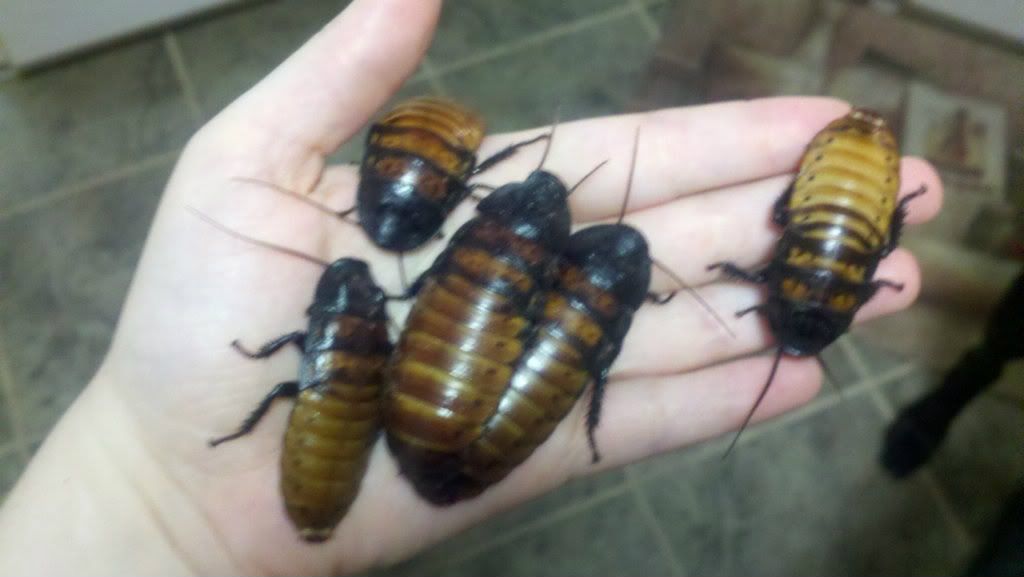 |
| This photo was taken this past June. |
My journey with the hissers started during my Junior year in college. I was taking Ecology and had to do some sort of experiment for my final in lab. After much thought, I decided to do an experiment to test for phenotypic plasticity. My test subjects were a group of fifty one-week-old baby Madagascar hissing cockroaches I obtained via my professor from her colony. When the month long experiment was over, I decided to keep one of the babies. That was who would eventually be known as Frankie. I wanted to have a group of all females, and we thought Frankie was a girl. I then picked up two adult females who I named Thelma and Louise. The other females (Lola and Brigite) I also obtained as adults, and Walter came later when I found out Frankie was a boy. I got them a nice terrarium, a sponge for water, and stuff to hide under. I was living with my parents at the time, and it took a lot of convincing to let me have them. I still couldn't get agreement to get some rats, but that's another story.
The first babies were born less than a month after I initially obtained the adult females. I hadn't thought about them being housed with males and coming to me gravid. I took them back to my professor, who was kind enough to take them. At that point, I thought I just had a few females and I might get a male some time in the future. Then, Frankie grew horns. Male hissers have prominent horns that are completely lacking in the females. I separated them for about six months, not wanting to end up with two hundred roaches. Then, I thought, why not? I got Walter and put them all in the same terrarium. That's not long before my first post about them began.
I don't know if I'll be getting more hissers. If I do, it's going to be a little while. I still have the terrarium and there's a store less than a mile away that sells them. They also have discoid roaches and some other very interesting critters. We shall see.
Thursday, October 6, 2011
More Cockroaches (Plus a Cycad)
I'm sure you're tired of them by now, but I promised a picture of the babies, so here we go. There are currently a total of fourteen. There were more than a few skin sheds in the terrarium (they shed in mass recently and I forgot about it) which threw off my estimate.
I also got a shot of one of the cardboard palms on campus today. Enjoy!
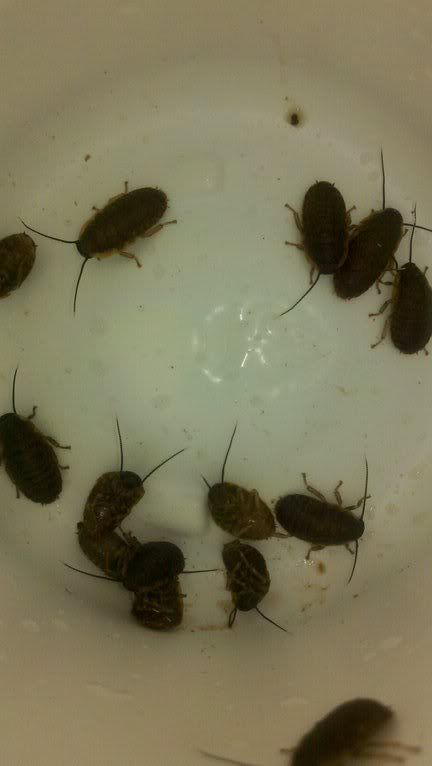 |
| I washed out an empty vitamin bottle for this picture, and apparently there was still some water in it. The ones on their backs are stuck in the droplets! |
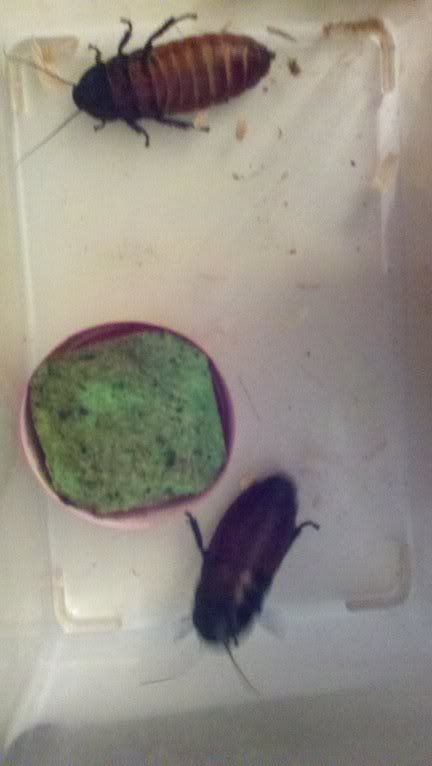 |
| Lola and Brigite in the smaller terrarium during the cleaning. I'm sure they were glad to not have the babies crawling on their backs for a change, |
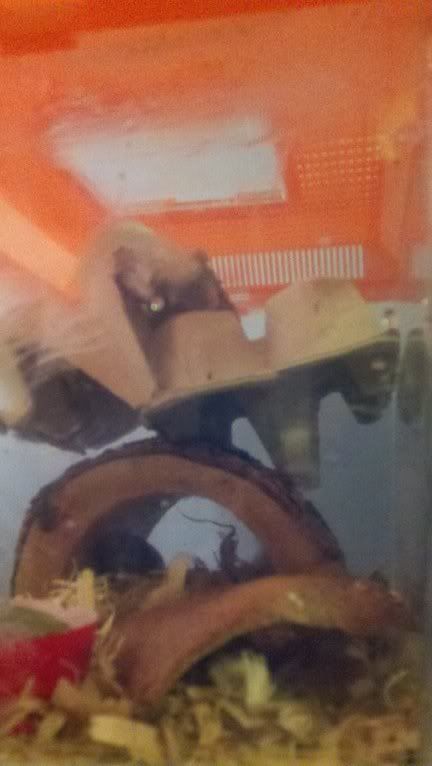 |
| A bad picture of the newly cleaned terrarium. Can you spot an adult and a baby? By the way, a trick of the trade: that fuzzy smear at the top is actually Petroleum Jelly, which keeps the babies from climbing out. I've learned from experience that they can fit through the slits in the lid. It's generally a good idea to use it for adults too if your lid doesn't clip on like mine does. They are quite strong and can push open a non-latchable lid, even if it seems secure. |
I also got a shot of one of the cardboard palms on campus today. Enjoy!
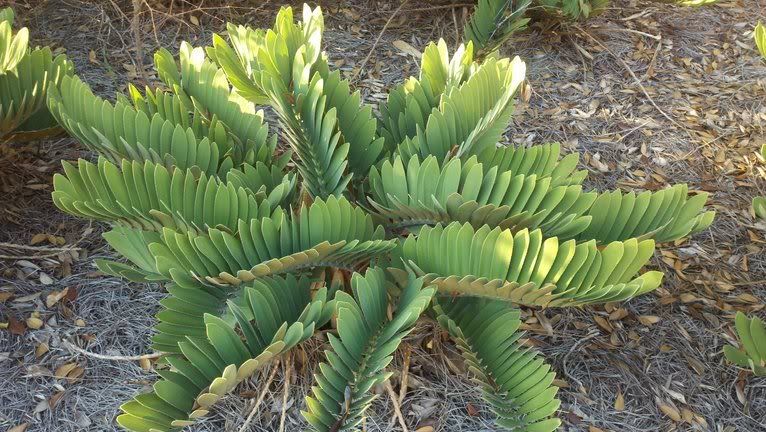 |
| It hasn't gotten below about sixty degrees so far. Depending on this winter's severity, this plant may end up dead. |
Wednesday, October 5, 2011
An Update on the Cockroaches
I've mentioned my pet Madagascar hissing cockroaches before (on three different occasions ), and here they are again. Unfortunately, two of my adults, Louise and Frankie, have now both died. I blame age, since I have had them for so long. So, I'm down to only two adult hissers. Another of the females gave birth, but, miraculously, the last adult female is still pregnant! I'm expecting yet more babies any day now. I still can't get past how amazingly fat they look when they're expecting.
The first set of babies has more than doubled in size, and the second set is not far behind. The next time I clean their terrarium I'll be gathering together all of the babies, and I'll give you guys one crazy picture of them gathered together. My best guess is that there are about twenty-five, not counting the five that died, probably as a result of the move. The terrarium fell over, even though I tried my best to pack it so that it wouldn't shift. I honestly haven't had a chance to count them yet. They're also horribly difficult to photograph because they're tiny speed demons. I dropped one of them during my attempts and Ebon tried to eat it! Luckily, I was able to catch it and it's back safe and sound with the others. .
Ironically, the condo has a bit of a cockroach problem, but the pests look nothing at all like my hissers. For one thing, they fly.
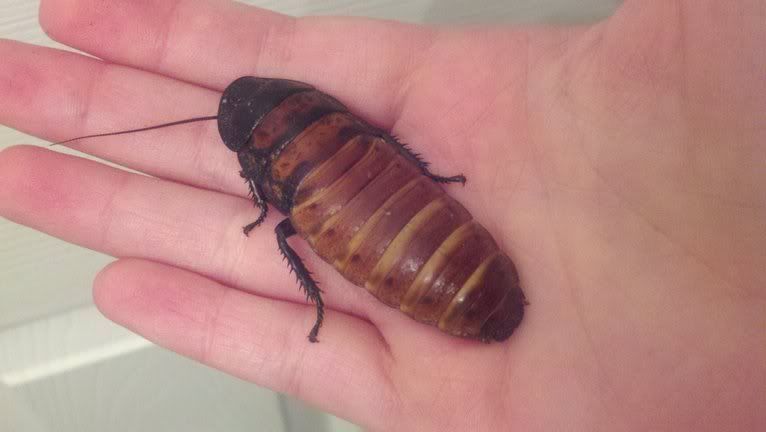 |
| A very fat Lola, full of babies. She was not at all happy to be handled. |
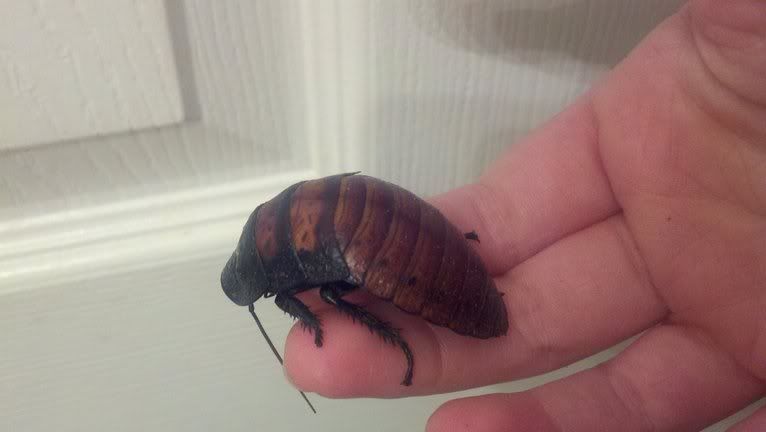 |
| In contrast: Brigite, who gave birth a couple of weeks ago |
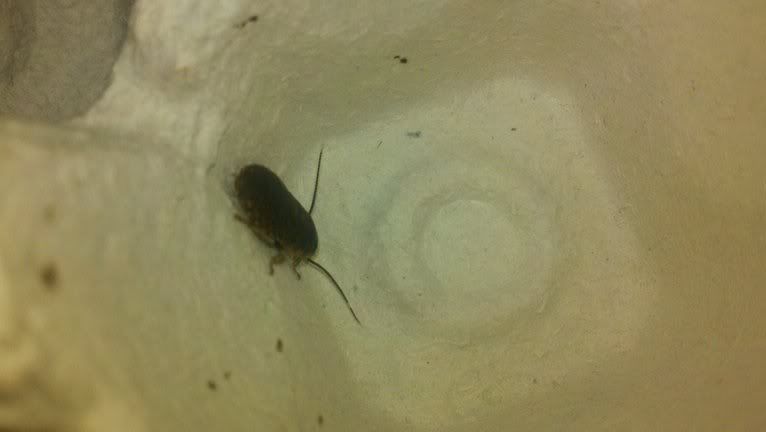 |
| One of the younger little ones in the egg crate |
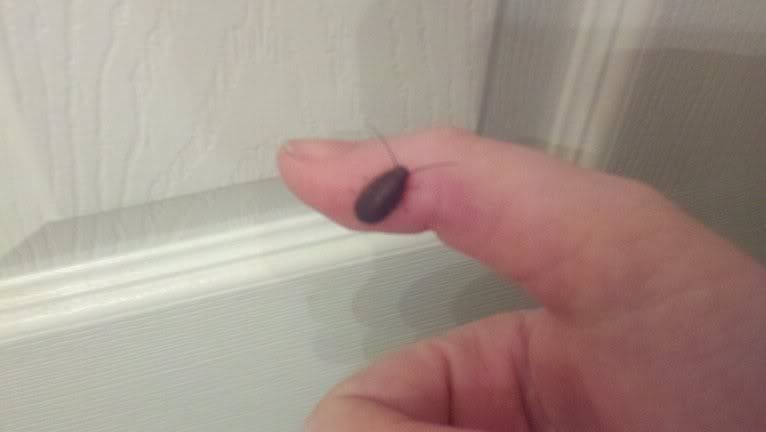 |
| An older baby, about one half inch long |
Ironically, the condo has a bit of a cockroach problem, but the pests look nothing at all like my hissers. For one thing, they fly.
Wednesday, August 31, 2011
Babies! Of the cockroach kind, that is
I mentioned back in June that I though one of my females was pregnant. Well, guess what...
I was re-wetting my cockcroaches' watering sponge this morning and found little baby roaches! I don't know how many there are yet, but my other two females are also clearly preggers so there are going to be a lot. I'm expecting that all-told there will end up being around sixty. It amazes me how fat they get when they're gravid. Their exoskeleton expands and pale bands start to appear along the abdomen.
Yes, unlike most insects Madagascar hissing cockroaches give live birth so I'm not kidding when I'm calling them "pregnant." Interestingly enough, if there is no male around they will create an entire set of eggs and then expel them if they are not fertilized. The first time I saw it I thought there was something wrong, but it's completely normal.
Unfortunately, I think momma Louise is going to die soon. She's been lethargic for about three days, which in the past has been the first sign that they were going to die. I'm really not surprised as the females were at least a year or two old when I got them and I have had them for some time. Louise was also one of the first two adults I obtained. She's still responsive, though, so I'm hoping she will recover. Her original partner in crime Thelma died some time ago. I also lost my younger male, Walter, recently after he had been getting progressively thinner for several weeks. I think Frankie, who I believe to be the father of the babies, had been keeping him away from the food.
I was going to clean the terrarium today, but instead I'll clean it tomorrow. I'm a bit concerned about the nymphs being delicate right now because their bodies may still be soft. They are born white and will darken to a dark brown color over time. This happens again each time they shed, and when they are still pale they are vulnerable and shouldn't be handled. When I do clean their terrarium I'll replace the bedding and separate out the babies and count them.
I also found a millipede outside. It's a North American millipede (Narceus americanus), which is incredibly common around here. I used to keep these guys as pets but the three I had died earlier this year. They are mostly black or nearly so and have bands of yellow, orange, red, or even purple. This one is obviously red. I find them quite cute, and they're completely harmless. The do excrete a chemical irritant (though it's only irritating to some people) when startled that will stain your skin. I know this from experience, having caught many of these creatures in the wild and coming away with purple fingers.
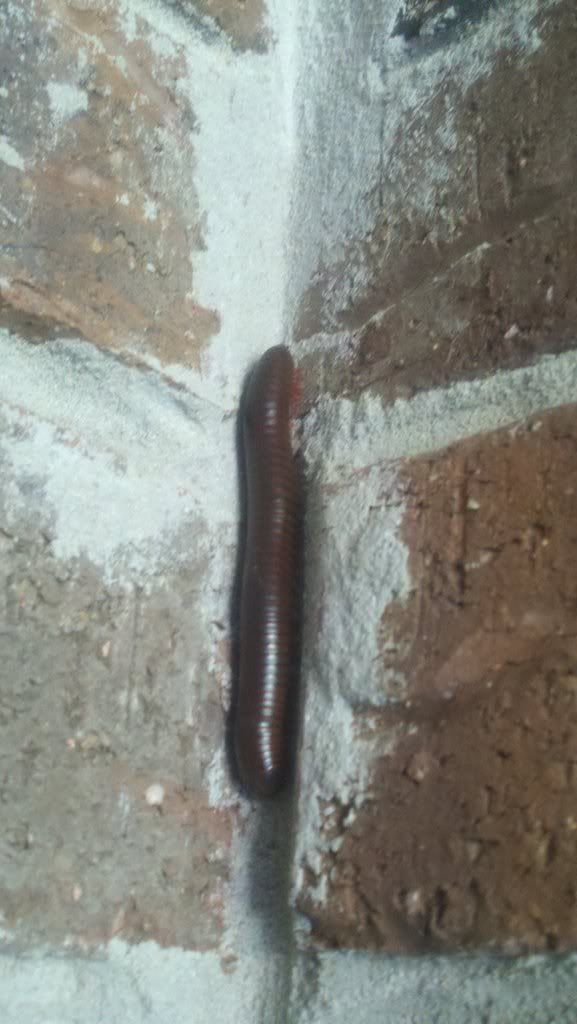
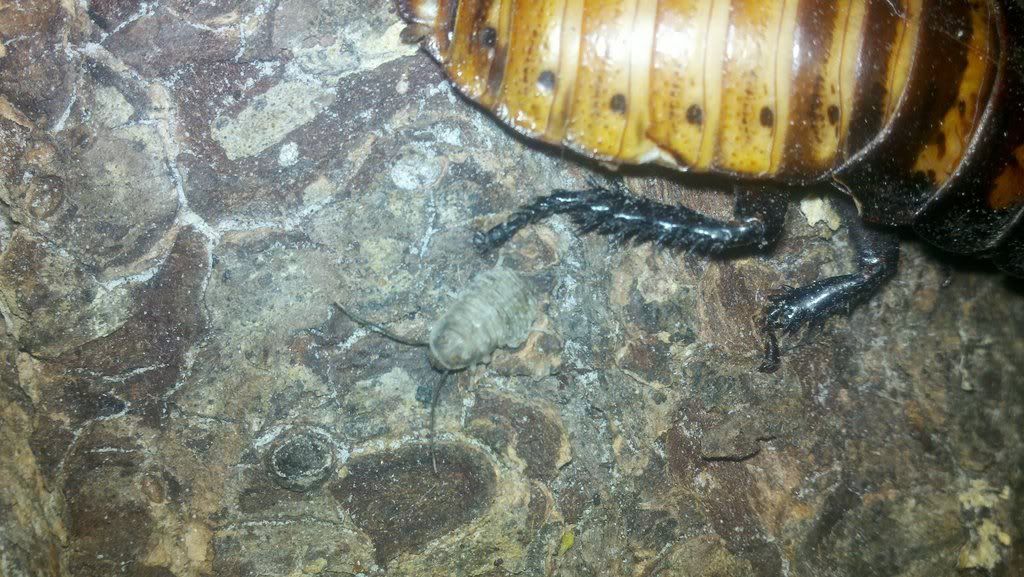 |
| Baby hisser #1 next to daddy Frankie |
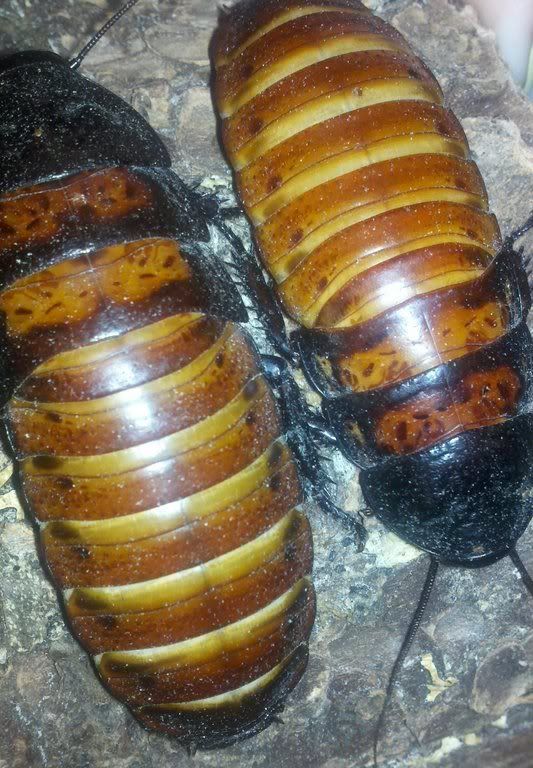 |
| The two still-pregnant females: Lola and Brigite |
Yes, unlike most insects Madagascar hissing cockroaches give live birth so I'm not kidding when I'm calling them "pregnant." Interestingly enough, if there is no male around they will create an entire set of eggs and then expel them if they are not fertilized. The first time I saw it I thought there was something wrong, but it's completely normal.
Unfortunately, I think momma Louise is going to die soon. She's been lethargic for about three days, which in the past has been the first sign that they were going to die. I'm really not surprised as the females were at least a year or two old when I got them and I have had them for some time. Louise was also one of the first two adults I obtained. She's still responsive, though, so I'm hoping she will recover. Her original partner in crime Thelma died some time ago. I also lost my younger male, Walter, recently after he had been getting progressively thinner for several weeks. I think Frankie, who I believe to be the father of the babies, had been keeping him away from the food.
I was going to clean the terrarium today, but instead I'll clean it tomorrow. I'm a bit concerned about the nymphs being delicate right now because their bodies may still be soft. They are born white and will darken to a dark brown color over time. This happens again each time they shed, and when they are still pale they are vulnerable and shouldn't be handled. When I do clean their terrarium I'll replace the bedding and separate out the babies and count them.
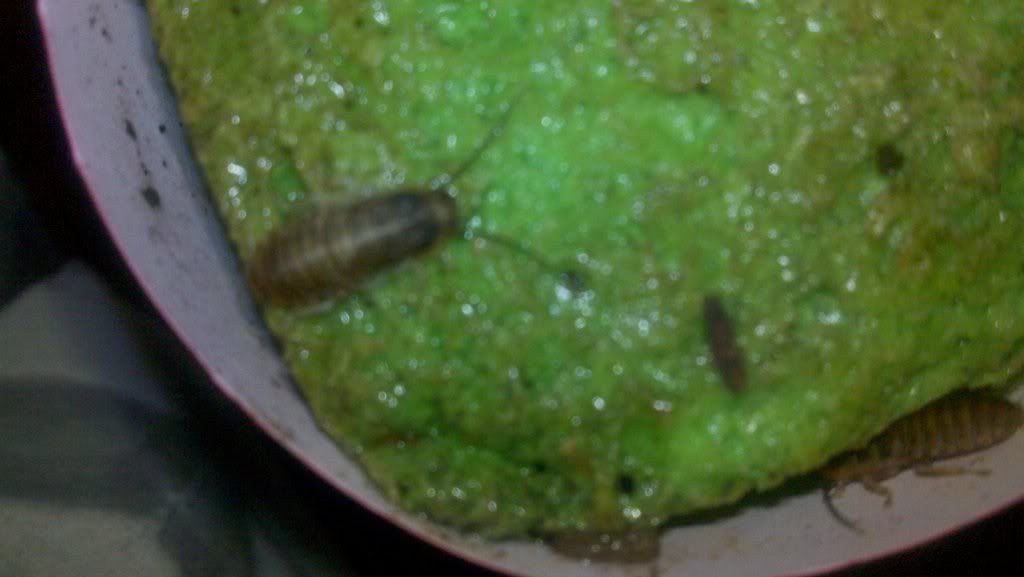 |
| Baby roaches #2 and 3 on the water sponge |
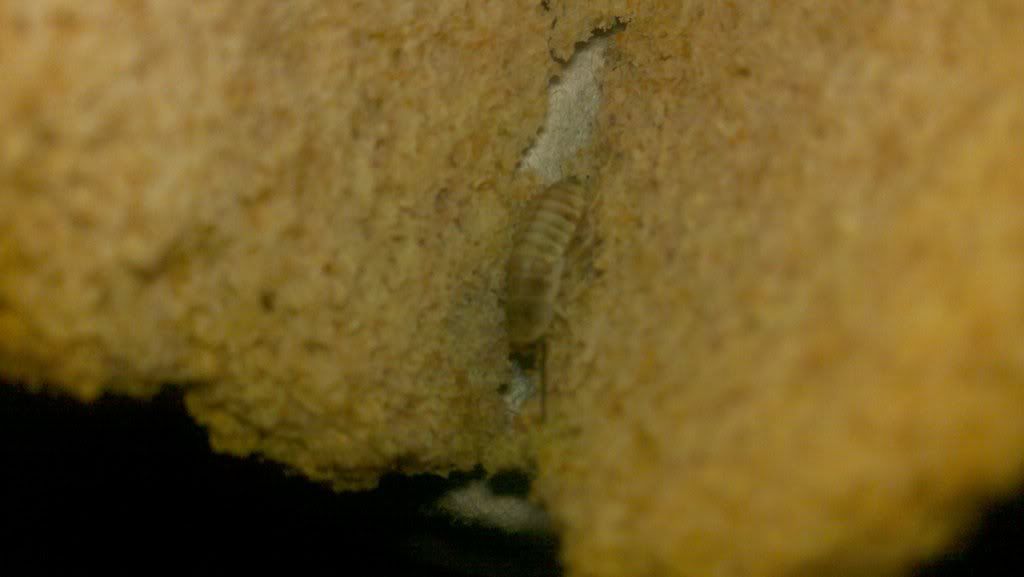 |
| Baby roach #4 on the wheat bread that the roaches love so much |
Saturday, July 9, 2011
How to De-mite Cockroaches
As I mentioned in my introductory post about my pet Madagascar hissing cockroaches, I was going to do an information post on how to reduce mite loads. My roaches have mites, most of which will tuck themselves under the legs. The mites are at least somewhat beneficial, reducing the amount of bacteria on the carapace. If you see more than one or two on the cockroaches' head or back there are too many. In a case like that, if you check their undersides there will be an astonishing amount to be found there.
I was made aware of this technique from the professor who gave the cockroaches to me after I discovered the mite load on my hissers had skyrocketed. So, here we go.
What you will need:
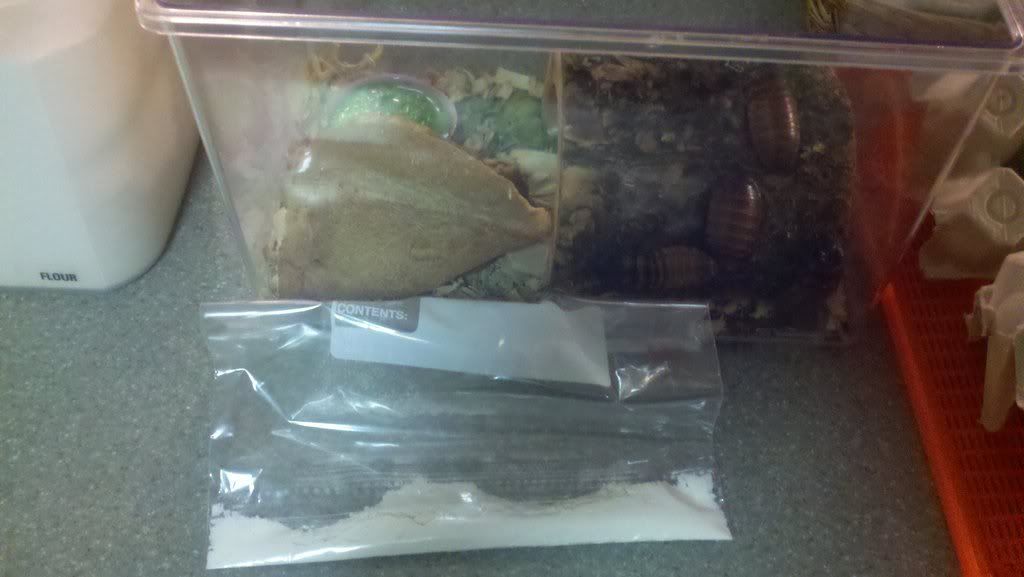 Step 1: Remove lid from terrarium and place flour in bag.
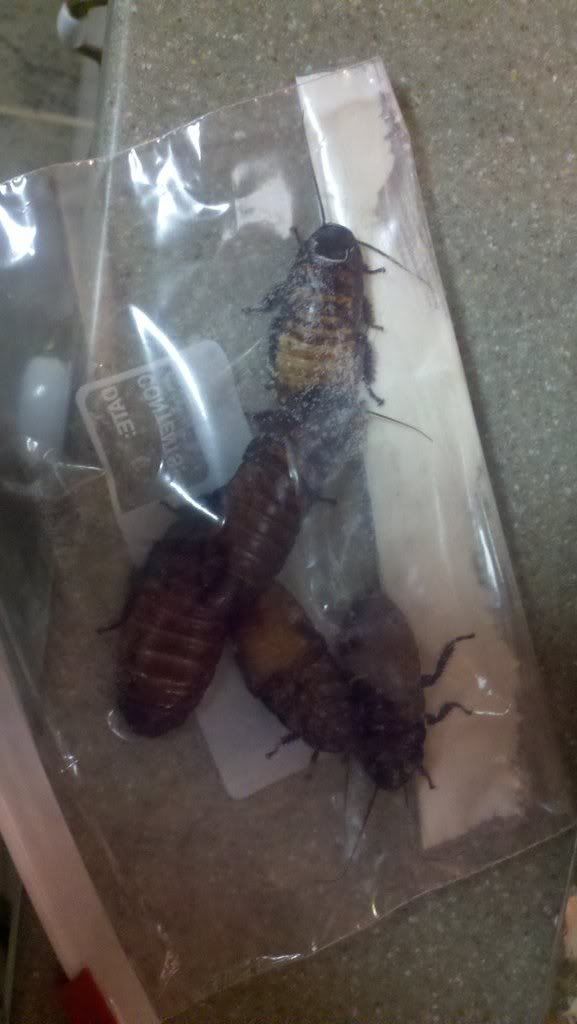 Step 2: Add cockroaches to bag, seal and shake. Remember to shake gently! Also, seal the bag for as short of a time as possible. You are dealing with live critters!
Step 3: Remove cockroaches immediately, brushing off as much excess flour as possible.
 Step 4: Check out how many mites you've removed! It's unlikely you've gotten rid of them all, but numbers should have decreased by about 60-70%. Dispose of the bag.
And that, boys and girls, is how to help your pet cockroaches with their mite problem without compromising their health. I do this as needed. Remember that keeping the terrarium clean and refreshing bedding more often will also help with mites.
I was made aware of this technique from the professor who gave the cockroaches to me after I discovered the mite load on my hissers had skyrocketed. So, here we go.
What you will need:
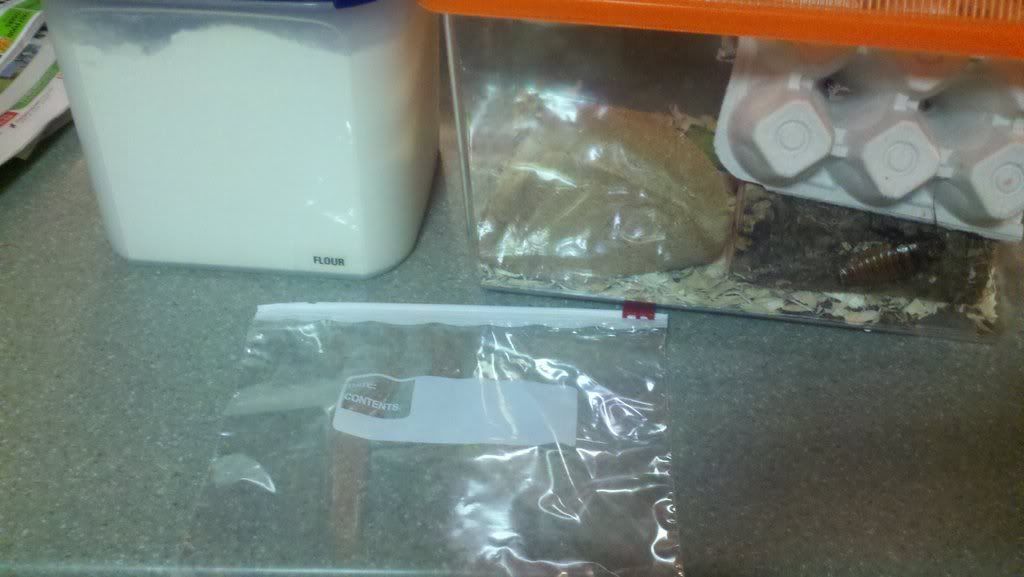 |
| Flour, Plastic bag, Cockroaches |
Step 2: Add cockroaches to bag, seal and shake. Remember to shake gently! Also, seal the bag for as short of a time as possible. You are dealing with live critters!  |
| My hissers, just after their flour-ing |
Step 4: Check out how many mites you've removed! It's unlikely you've gotten rid of them all, but numbers should have decreased by about 60-70%. Dispose of the bag. And that, boys and girls, is how to help your pet cockroaches with their mite problem without compromising their health. I do this as needed. Remember that keeping the terrarium clean and refreshing bedding more often will also help with mites.
Wednesday, June 22, 2011
For the Love of Odd Pets
|
| The hissers. Males are to the far left and right |
They are the easiest pets. They really are. They need water every few days (in the form of a damp sponge), and food just as often. They don't need any special food, and get whatever scraps we have (fruit, vegetables, bread, and dog food). They especially love apple and stale bread. Their terrarium needs cleaning only every week or two. They don't need a heat lamp or anything like that (you can provide one for them, but it will shorten their lives considerably).
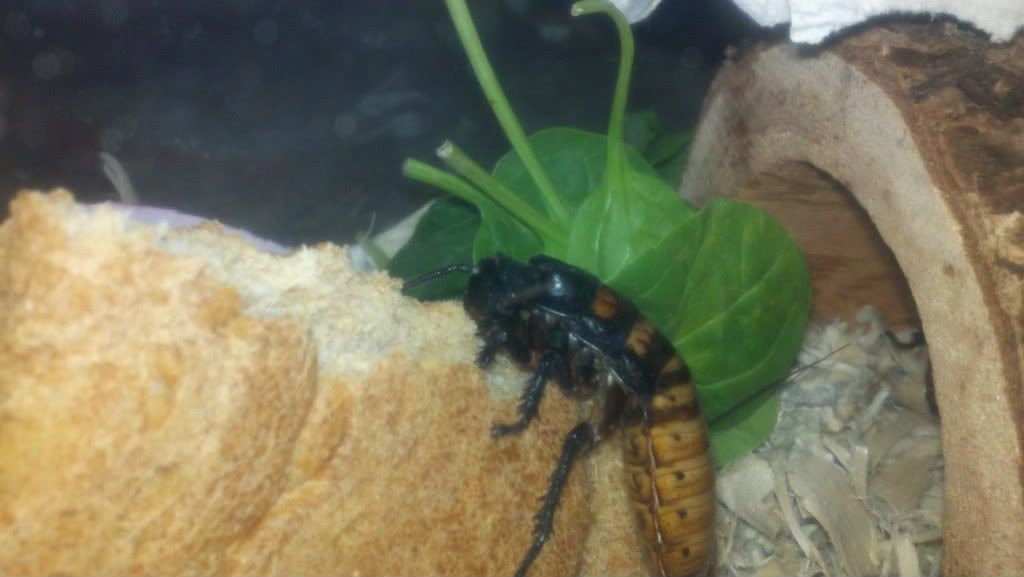 |
| Frankie eating bread. Today they got stale bread and spinach |
I've had them for some time now, and I suspect most of them are heading toward the ends of their lives. I got the girls as adults, and Frankie is not much younger. Walter is the youngest and I expect him to molt once more, if that. They don't molt again after they reach maturity. I had the males and females separated at one point, but I decided to house them together because I doubt the oldest will live more that six more months or so. At least two of them are around two to three years old already, and that's fairly old for them (they can live to five, but that's not super common). At least one of the females is pregnant, so I'm expecting little baby roaches any time now.
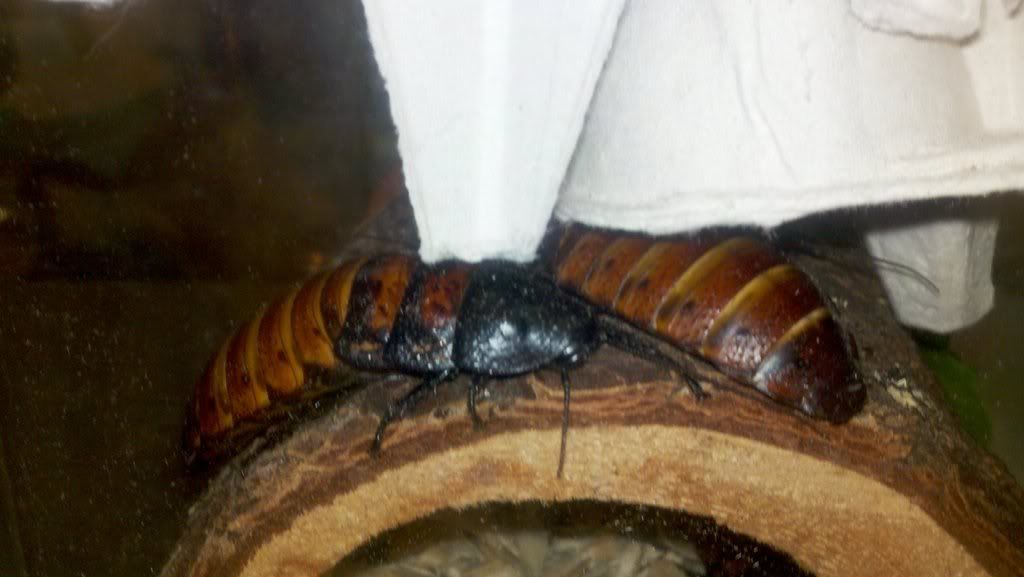 |
| Two of the girls in their "house" hiding under the egg crate. The one on the right is the one I believe to be pregnant. |
Today was terrarium cleaning day, and I took the pictures while I was doing that.
Subscribe to:
Posts (Atom)